


Brand:
JCID
JCID V1SE / V1S Pro Convert 14 to 15 Series Photosensitive Adaptor
JCID V1SE / V1S Pro Convert 14 to 15 Series Photosensitive Adaptor
Regular price
Rs.1,200.00 PKR
Regular price
Sale price
Rs.1,200.00 PKR
Shipping calculated at checkout.
Quantity
Couldn't load pickup availability
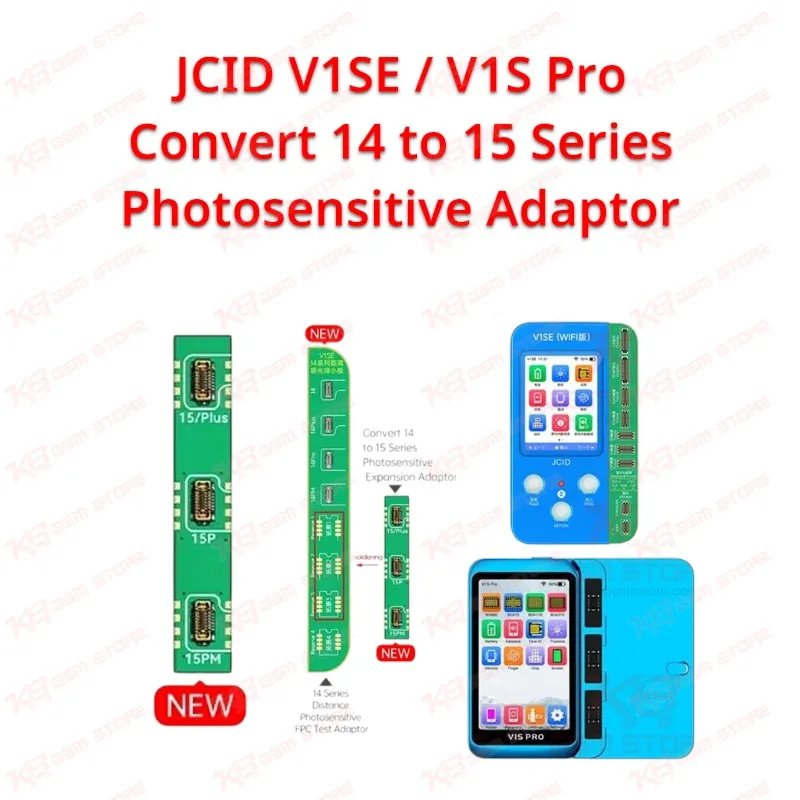
The JCID Convert 14 to 15 Series Photosensitive FPC Expansion Adaptor lets you solder onto the iPhone 14 series photosensitive pad and enable reading/writing of iPhone 15 series photosensitive FPC data. Use it when a true tone or auto brightness issue shows up after fitting a non-original photosensitive sensor on a converted display. It works only with the V1SE and V1S Pro programmer — V1S is not supported. A compact, single-board solution for technicians who convert 14 series panels for use on 15 series units, or vice versa, without losing ambient light and true tone function.
SKU:MST-SOLDERING-ACCESSORIES-360
⚖️ Weight: 0.01 kg
- Safe & Secure Payment
- Fast Delivery
- WhatsApp Support


Description
FAQ
What is the product name?
The product name is JCID V1SE / V1S Pro Convert 14 to 15 Series Photosensitive FPC Expansion Adaptor.
What is the brand of this product?
The brand of this product is JCID.
What is this product used for?
This product is used for enabling read/write access to iPhone 15 series photosensitive FPC after mounting it on an iPhone 14 series photosensitive adaptor, fixing true tone and auto brightness issues after display conversion.
Which devices are compatible with this product?
This adaptor is compatible with iPhone 14 series to iPhone 15 series photosensitive FPC conversions, but works only with the V1SE and V1S Pro programmer.
Who should use this product?
This product is suitable for mobile repair technicians, repair shops, service centers, and professional users doing display and true tone repair work.
Does this adaptor work with the standard V1S programmer?
No, this adaptor supports only the V1SE and V1S Pro programmers — it does not support the base V1S model.
Can this adaptor fix a true tone problem after converting a 14 series screen to a 15 series unit?
Yes, once soldered onto the 14 series photosensitive pad, it lets your V1SE or V1S Pro read and write the 15 series photosensitive FPC, restoring true tone and auto brightness function.