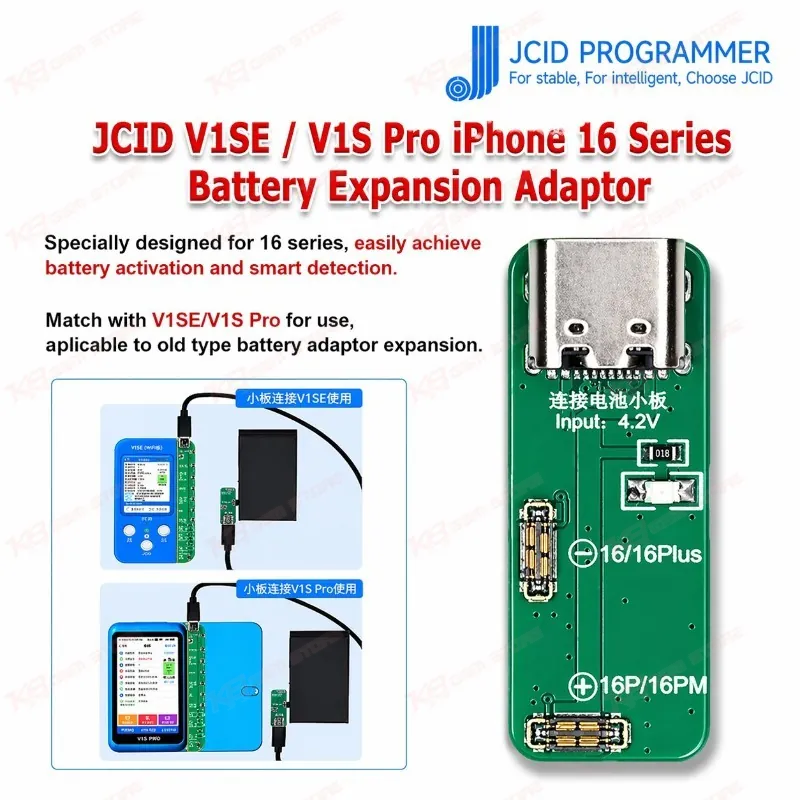
When Apple locked iPhone 16 series battery data behind tighter pairing checks, most V1SE and V1S Pro users found their existing battery board could still read the module but couldn't fully activate a replacement cell on the new series, and that's the gap this expansion adaptor closes. You solder the small plate directly onto your current 8-15 series battery board instead of replacing the whole board, so your existing drawing investment stays useful and you only add the piece that's actually missing. Once it's on, your V1SE or V1S Pro host reads the battery's stored data, writes fresh activation data after a swap, and runs the same authenticity check you already rely on to flag counterfeit or refurbished cells before a customer walks out with a phone that throws a battery health warning two weeks later. This matters on the Pakistan repair bench because battery swaps on 16 series units are now routine work, and a "Service" message on a freshly replaced battery kills customer trust fast. Technicians dealing with a battery issue on a 16 series unit that shows wrong battery percentage, unexpected shutdowns after a swap, or the non-genuine battery pop-up now have a direct fix path: read the original data, write it to the replacement, activate, and confirm. The adaptor itself carries no firmware or software, so your JC drawing version on the host handles the actual read/write logic; the plate's job is purely to bridge the physical connection between your battery board and the 16 series battery FPC pinout, which is why installation is a one-time solder job rather than a plug-and-play swap. Because it works off your existing 8-16 battery board rather than a standalone board, you keep bench clutter down and avoid running two separate battery adaptors for old and new series devices. This fits directly into your battery repair workflow: diagnose the battery issue on the bench, connect the 16 series battery through the expansion plate, pull the original activation data, swap in the new or tested cell, write the data back, and run activation before reassembly. For a repair shop handling volume, that workflow difference between a full teardown-and-guess approach and a direct read-write-activate cycle is the difference between a five-minute fix and a comeback customer. The build itself uses a compact FPC-style plate designed to solder cleanly onto the existing board pad without extra wiring, keeping the modification low-risk if you're comfortable with fine-pitch soldering under a microscope. It ships light at roughly 110 grams including packaging, so it's an easy add to any parts order without pushing shipping costs. Repair shops running mixed inventory of older and newer iPhone models get the most value here, since one V1SE or V1S Pro host with this expansion plate covers both the legacy 8-15 series workflow and the 16 series battery activation workflow without a second programmer purchase. If your bench already runs JC drawing tools for screen, Face ID, or camera repairs, adding battery-side coverage for 16 series through this adaptor keeps your JCID ecosystem consistent instead of mixing in a competing battery tool that needs its own drawing software and licensing.