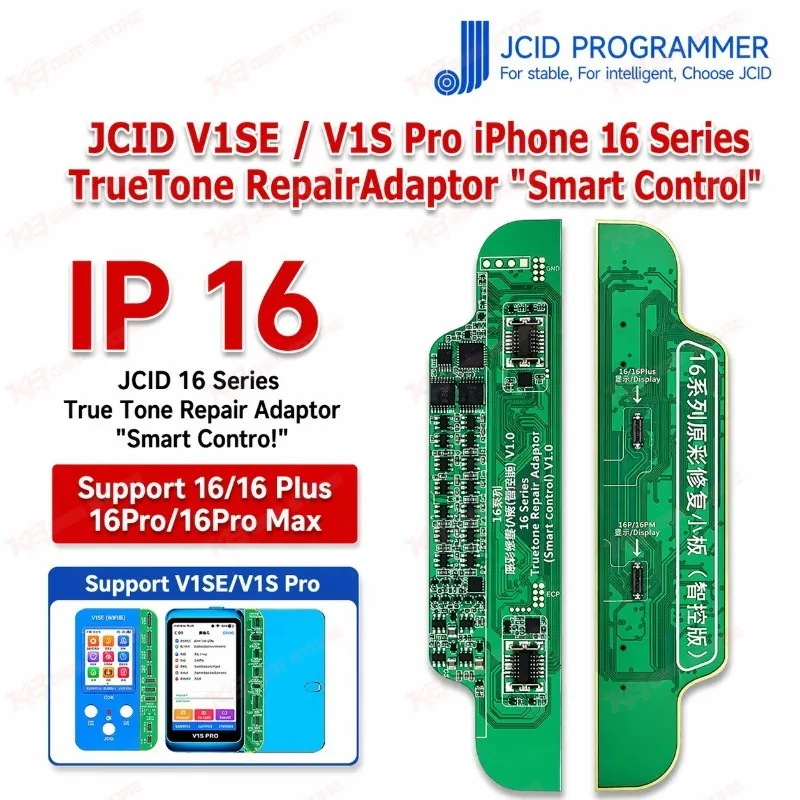
True Tone problems after a screen swap show up the same way on nearly every iPhone 16 bench job: the display works, touch responds fine, but the phone throws an auto-brightness pop-up and refuses to sensor-match ambient light the way an untouched original panel does. The JCID V1SE / V1S Pro Smart Control adaptor exists to close that gap. It reads the True Tone calibration data stored on the customer's original screen and writes it onto the replacement panel before you fit it, so the software side of the display problem gets solved at the data layer instead of through a workaround. You plug the board into a JCID V1SE or V1S Pro programmer, connect the screen through the adaptor, and run the read/write sequence from the JC software — no soldering, no manual chip transplant, no separate calibration tool required on the bench. What sets this particular board apart from earlier JCID True Tone adaptors is the single-board MIPI and EDP dual-fusion design. Previous solutions for the iPhone 16 lineup needed two separate boards to cover different panel interface types across the 16, 16 Plus, 16 Pro, and 16 Pro Max. This adaptor folds both interfaces into one board, so you stop swapping hardware mid-job when a customer walks in with a different model than the one you set up for. That matters on a busy repair counter where you might process a 16 and a 16 Pro Max back to back — you keep the same adaptor connected and move straight to the next unit. The board also carries an intelligent control chip that handles the True Tone read/write cycle with more precision than passive adaptor designs, which cuts down on failed writes and repeat attempts on panels where the data transfer is already tight on tolerance. Compatibility extends past original Apple panels. The adaptor works with aftermarket and OEM-pull screens from Samsung, Jingcheng (JCD), DD, and other domestic screen manufacturers commonly used in the Pakistani repair market, so shops running mixed original and compatible screen stock get consistent True Tone results regardless of panel source. It supports both LCD and OLED replacement screens, which covers the full range of aftermarket panels technicians actually install on iPhone 16 units today. On the workshop side, this solves a recurring complaint from customers: a screen replacement that looks perfect but keeps throwing brightness or True Tone warnings, which reads to a non-technical customer as a "faulty repair" even when the physical install is flawless. Fixing that at the data level protects your shop's reputation on jobs where the visible repair quality was never the issue. The adaptor is not a standalone unit — you need an existing JCID V1SE or V1S Pro programmer host for it to function, so confirm your bench already runs one of those before ordering. For shops already invested in the JCID ecosystem for battery, Face ID, or other iPhone data repairs, this board slots straight into your existing workflow as the iPhone 16-specific True Tone module. It plugs in the same way as JCID's earlier per-generation True Tone boards, so if your technicians have used the 12–15 series adaptors before, there's no new procedure to learn — just a new board on the shelf for the current-generation devices coming through the door.