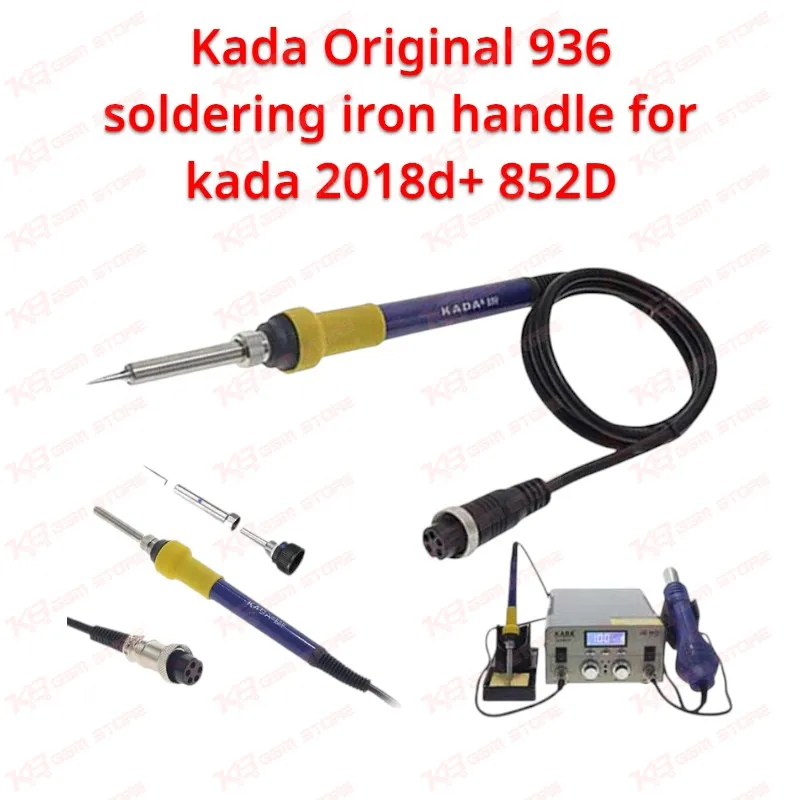
A repair bench runs on its soldering iron, and once the original handle on a KADA 2018D+ or 852D station starts losing heat consistency, cracking at the grip, or showing a loose 5-hole connector, the whole rework flow stalls until it gets replaced. This KADA 936 handle exists for exactly that moment: a direct, factory-matched swap that restores full heating performance without touching the station's control board or power supply. The tip core uses an iron-plated construction wrapped in a stainless steel shell, a combination that resists oxidation from daily flux exposure and holds its shape through repeated contact with PCB pads, IC legs, and connector pins. Technicians running back-to-back jobs on charging ports, camera modules, and small SMD components get a tip that keeps its plating instead of pitting after a few weeks of heavy use. The handle body itself uses a non-slip soft rubber coating, which matters more than it sounds on a long shift; a smooth or worn grip forces a technician to tighten their hold just to keep the iron steady, and that extra tension shows up as shaky tip placement on fine-pitch work. The rubber surface here stays grippy even with flux residue or light hand sweat on it, so control stays consistent whether the job is a quick jumper lagana fix or a slow reflow around a CPU. On the connection side, the handle uses the same 5-hole layout as the original KADA iron pen, so it seats into the 2018D+ and 852D stations without rewiring the pins or guessing at polarity. That plug-and-play fit matters for shops running multiple stations, since a technician can swap a failed handle mid-repair and get back to the board in minutes instead of sending the whole unit for service. Weight stays low across the pencil-style profile, which reduces wrist fatigue during extended sessions and keeps tip control tight when working close to sensitive components like PMICs or RF shields. That balance of light weight and steady heat delivery is what separates a workshop-grade handle from a generic replacement part, since heavier or unevenly weighted handles tend to drift off the target pad during precision work. In a typical mobile repair workflow, this handle sits at the soldering and rework stage: after diagnostics identify a hardware fault such as a dead phone with no charging response, a hang on logo condition tied to a loose IC, or a board showing physical damage under the microscope, the technician reaches for a reliable iron to desolder the faulty part, clean the pads, and reflow or replace the component. A handle that heats unevenly or loses temperature mid-joint turns a routine board cleaning or IC change karna task into a repeat visit, so consistent heat transfer through the tip directly affects first-time repair success. This handle also fits naturally into eMMC and connector-level rework, where clean, controlled heat prevents pad lifting on tightly packed boards. For repair shop owners managing several technicians on shared equipment, keeping a spare 936 handle on hand avoids downtime when one unit fails mid-job, and the direct compatibility with 2018D+ and 852D stations means no adapter or rewiring step slows the swap. Built as a genuine hardware replacement rather than a universal generic pen, this handle keeps the station's original heating characteristics intact, so technicians get back to soldering with the same feel and response they are already trained on.