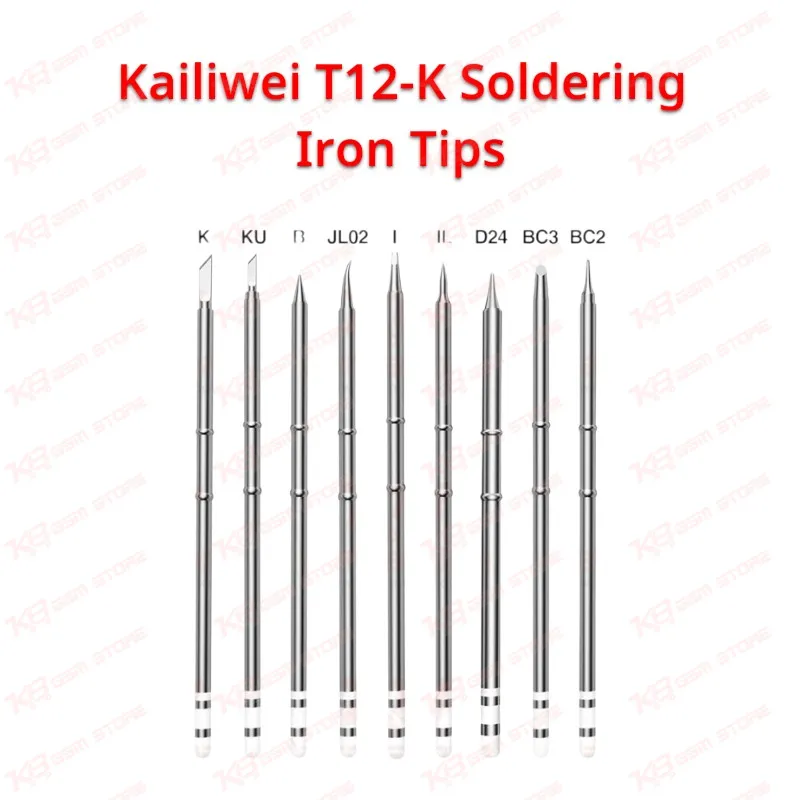
Every technician working on tight mobile phone boards knows a worn or wrong-shaped tip ruins a repair before you even start. The Kailiwei T12-K solves that problem with a knife-edge design made specifically for controlled, precise soldering on dense PCB layouts. Instead of a separate heater, sensor, and tip, the T12-K carries all three in a single composite unit, so heat reaches the working end almost instantly and temperature stays consistent while you work. You get less waiting time between joints and steadier results when reflowing components on a busy repair bench. The knife shape is what sets the T12-K apart from round or conical tips. You can apply it in three contact styles: line contact for dragging solder across multiple pins, face contact for flatter pads and shields, and point contact for isolated joints. This flexibility makes it a strong choice for narrow-pitch IC legs, correcting solder bridges after a reflow, and drag soldering rows of pins on connectors and small ICs. Technicians handling charging port repair, board cleaning after liquid damage, or reworking display flex connectors will find the K-tip shape suits the tight spacing found on modern phone boards. Material quality directly affects tip life, and this is where the T12-K holds up under daily use. The base uses refined copper for strong thermal conductivity, layered with an alloy plating that pushes back oxidation and slows down wear from lead-free solder, which oxidizes tips faster than leaded solder. A stainless steel outer sleeve reduces heat loss along the shaft and keeps the handle side cooler during extended sessions, and the heat-insulating silicone sleeve near the grip stops heat transfer to your hand during long repair jobs. The T12-K tip installs onto standard T12 handles, the same handle type used on Kailiwei T12 stations, Hakko-style FX-951 and FX-952 rework stations, and other T12-compatible soldering stations common in Pakistani repair shops. Before first use, make sure the retaining nut on the handle is tightened properly, since a loose nut can cause the tip to shift or fall during soldering. On first use, a temperature jump or a temporary error reading on the station display is normal behavior for a fresh tip and settles down after a few uses once the internal thermocouple stabilizes. For daily workshop soldering, keeping the working temperature between 300°C and 380°C gives the best balance between solder flow and tip life. Running the tip above 380°C speeds up oxidation and shortens the heating core's working life, so most board-level repair work, including IC change, jumper wire soldering, and pad rework, does not need temperatures beyond this range. Keeping the tip tinned and wiping it clean between joints is the simplest way to stop oxidation buildup and keep solder flow smooth job after job. For shops running multiple repair benches, having spare T12-K tips on hand reduces downtime, since tip wear is normal after months of daily reflow and rework work. Pairing this tip with other T12 series bits (KU, JL02, ILS, BL, BC2) covers most soldering tasks a mobile repair technician runs into, from fine SMD work to bulkier connector soldering, without needing to switch soldering stations. The T12-K works well alongside ISP pinout tools, eMMC programmers, hot air stations, and PCB holders already common on a technician's bench, fitting into diagnostic and rework workflows for dead phone, boot loop, and charging issue cases where board-level soldering is required.