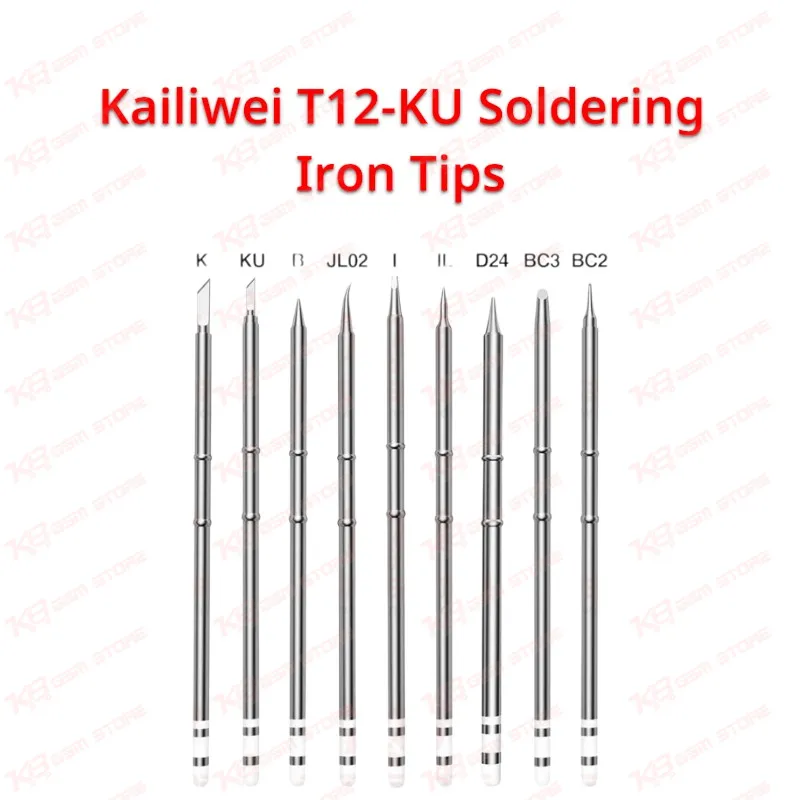
Every repair bench eventually needs a tip that handles tight spaces without smearing solder across neighboring pads. The Kailiwei T12-KU fills that role. Its knife-shaped head narrows to a beveled edge, so you can lay solder along a line, flatten it across a face, or land it on a single point depending on what the board demands. Technicians working on FRP lock boards, charging port pins, or dense connector rows reach for this shape because it keeps solder where it belongs instead of bridging across adjacent legs.The tip sits inside the T12 platform's composite heating design, where the heater and temperature sensor build directly into the tip body rather than the handle. You get faster response when you touch down on a joint and quicker recovery when you move to the next one — useful when you're running through a stack of boards during a busy shift. Oxygen-free copper forms the core of the tip, plated to resist oxidation, so the edge stays sharp and tin-friendly through repeated use instead of blackening after a few sessions.Drag soldering is where the knife shape earns its keep. Instead of touching each pin individually, you glide the beveled edge across a row of closely spaced legs — common on network ICs, power management chips, and connector footprints on modern phone boards. The T12-KU also handles bridging correction cleanly: when solder shorts two pads after reflow, the fine edge lifts the excess without disturbing the surrounding joints. That combination makes it a practical choice for jumper lagana work, dead-after-flash board diagnostics, and general hardware fault repair where precision at the tip decides whether the fix holds.Compatibility runs across the T12 ecosystem rather than one brand. The tip fits Hakko FX-951, FX-952, and FX-950 handles directly, and it drops into T12-based third-party stations from KSGER, QUICKO, QUECOO, and Kailiwei's own T12 soldering stations without modification. If your workshop already runs a T12 handle for other jobs, adding the T12-KU to your tip set costs little and expands what that same station can do — no need to buy a second iron for narrow-pitch work.Recommended working temperature sits in the 300–380°C range, which covers most lead and lead-free soldering on mobile boards without accelerating tip oxidation. Pushing past 380°C for extended periods shortens the tip's usable life, so technicians running constant-temperature stations should dial in the lower end of that range for routine board work and reserve higher settings only for stubborn joints. New tips sometimes show a temperature jump or an error reading on digital stations during the first few uses — this settles once the internal sensor stabilizes and isn't a sign of a defective tip.For a repair shop juggling software marna jobs alongside hardware fixes, having a dedicated knife tip means you're not fighting a rounded or chisel tip when a board calls for tight-space soldering. It's a low-cost addition that pays off on IC reballing prep, PCB holder-mounted board work, and any repair where the difference between a clean joint and a bridged one comes down to the shape of the tip touching the board.