Skip to product information
1 of 4
Brand: KAISI

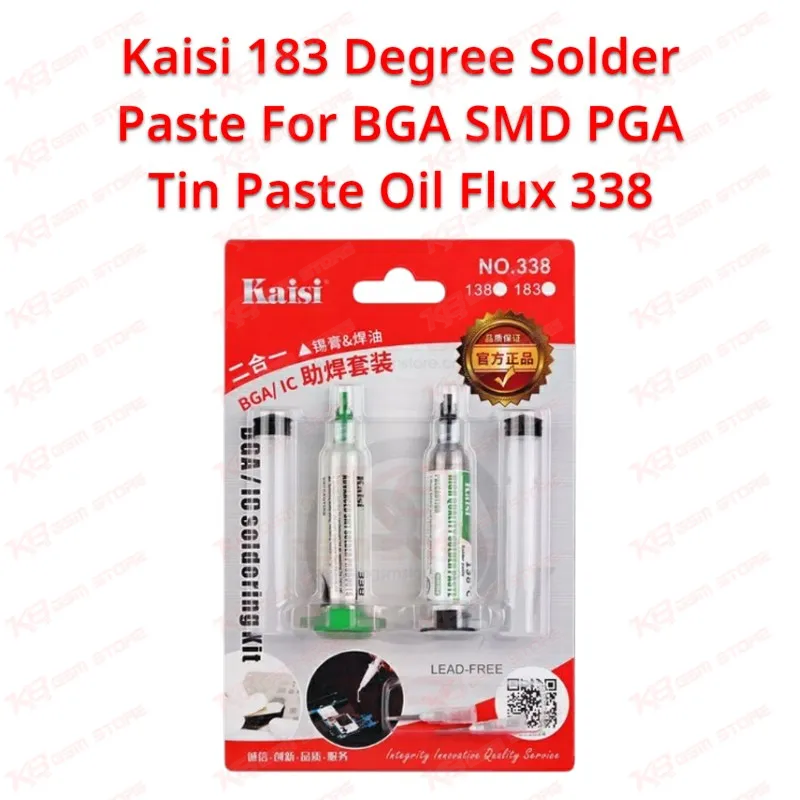
Kaisi 183 Degree Solder Paste For BGA SMD PGA Tin Paste Oil Flux 338

Kaisi 183 Degree Solder Paste For BGA SMD PGA Tin Paste Oil Flux 338

Regular price Rs.1.00 PKR
Regular price Sale price Rs.1.00 PKR
Sale Sold out
Shipping calculated at checkout.
Quantity

Kaisi 183°C solder paste is a lead-free tin paste built for BGA, SMD, and PGA rework on mobile phone motherboards. Paired with 338 flux oil, it gives technicians a reliable two-part solution for IC reballing, chip reattachment, and board-level soldering. The 183°C melting point matches standard eutectic reflow profiles, so it works smoothly with hot air rework stations and reflow ovens already common on a Pakistani repair bench. Its fine particle structure prints evenly through stencils and keeps its shape without spreading, which protects tight pad spacing on modern motherboards. Repair shops handling dead phone boards, charging IC swaps, or CPU reballing get a paste that holds strong joints and resists cold solder faults after reflow.

SKU:MST-SOLDERING-ACCESSORIES-185

⚖️ Weight: 0.15 kg

  • Safe & Secure Payment
  • Fast Delivery
  • WhatsApp Support
View full details

Description

Kaisi 183°C solder paste solves a problem every chip-level technician runs into sooner or later: getting a clean, uniform tin layer onto a BGA pad without bridging or voids. This lead-free paste carries a 183°C melting point, which lines up with the eutectic tin-lead reflow curve most hot air stations and reflow ovens use by default, so a technician does not need to reprogram a station's temperature profile before starting a job. The paste comes matched with 338 flux oil, and together they form a two-part system: the flux oil cleans and preps the pad surface while the paste supplies the actual solder material for reballing or direct chip soldering. On a busy repair bench, that pairing cuts prep time, because the flux removes oxidation and residue from a used pad in one pass rather than requiring a separate cleaning agent before tinning. The fine particle composition, sitting in the 20-38μm range typical of this paste type, prints through a stencil evenly and holds its printed shape on the board instead of slumping or bridging between neighboring pads, which matters most on today's motherboards where trace and pad spacing keeps shrinking. A technician working on a dead phone board, a charging IC swap, or a full CPU reballing job needs that kind of dimensional stability, because a paste that spreads even slightly can short adjacent pads and turn a straightforward repair into a rework loop. Kaisi built this paste for board-level work specifically: BGA chips, SMD components, and PGA packages all reflow cleanly with it, and the same tube handles PMIC reattachment, NAND repair, WiFi module reballing, and general motherboard rework without switching products. Storage matters with any tin-based paste, and this one keeps its working consistency best between 0-10°C; a technician who stores it properly avoids the dried-out, clumpy paste that ruins stencil prints and forces early replacement. Once reflowed at the correct profile, joints from this paste show the fine, uniform tin bead a technician wants to see under a microscope, without the graininess or dull surface that signals a bad melt or an old batch. That reliability shows up most clearly on repeat repairs: a board that comes back with a boot loop issue or a hardware fault after a first attempt costs a shop both time and reputation, and consistent joint quality from the paste itself removes one variable from that equation. Repair shops running high volumes of charging port repair, display problem diagnostics that lead into board work, or network issue troubleshooting that traces back to a baseband IC all rely on the same underlying skill: getting a clean reflow on the first attempt. This paste supports that goal by staying workable long enough during stencil printing, reflowing predictably at 183°C, and setting into a joint that holds up under thermal cycling from repeated phone use. For a workshop handling motherboard-level jobs daily, standardizing on one paste and flux combination for BGA, SMD, and PGA work simplifies inventory and training, since new technicians only need to learn one reflow profile rather than juggling different pastes for different chip packages. Kaisi's positioning in the Pakistani mobile repair supply chain reflects that demand: shops in Lahore, Karachi, and Islamabad that handle chip-level and motherboard repair regularly stock 183°C paste alongside their hot air stations, microscopes, and BGA stencils as a core consumable rather than an occasional purchase.

Key Features

  • 183°C melting point matches standard eutectic reflow profiles
  • Lead-free formulation for safer, cleaner rework
  • Paired 338 flux oil cleans pads before tinning
  • Fine 20-38μm particle size for even stencil printing
  • Resists spreading and bridging on tight pad spacing
  • Suitable for BGA, SMD, and PGA package types
  • Produces uniform, bright solder joints after reflow
  • Compatible with hot air rework stations and reflow ovens

Specifications

Brand Entity Kaisi
Product Entity 183°C BGA/SMD/PGA Solder Paste with 338 Flux Oil
Technology Entity Lead-free eutectic reflow solder paste
Compatible Device Entities Universal mobile phone motherboards and PCBs
Repair Process Entity BGA reballing, chip-level soldering, motherboard rework
Industry Entity Mobile phone repair, PCB repair, GSM hardware repair

Compatible Devices


Universal — compatible with mobile phone motherboards, PCBs, and IC packages across all major brands, since the paste works at the chip and board level rather than being device-specific.

Common Repair Uses


BGA IC reballing, CPU and PMIC reattachment, NAND and WiFi module rework, charging IC replacement, motherboard-level soldering, dead phone board repair, and general chip-level rework on repair benches.

FAQ

What is the product name?
The product name is Kaisi 183°C BGA SMD PGA Solder Paste with 338 Flux Oil.
What is the brand of this product?
The brand of this product is Kaisi.
What is the model of this product?
The model is 183 Degree solder paste, paired with 338 flux oil.
What is this product used for?
This product is used for BGA, SMD, and PGA reballing and chip-level soldering on mobile phone motherboards.
Which devices are compatible with this product?
This product works universally across mobile phone motherboards and PCBs, regardless of brand, since it functions at the chip and board level.
Who should use this product?
This product suits mobile repair technicians, repair shops, service centers, and chip-level repair professionals.
Does this solder paste work with standard hot air rework stations?
Yes, its 183°C melting point matches the eutectic reflow profile most hot air rework stations and reflow ovens already use.
What particle size does this solder paste use and why does it matter?
It uses a 20-38μm particle size, which allows even stencil printing and reduces the risk of bridging on closely spaced BGA pads.