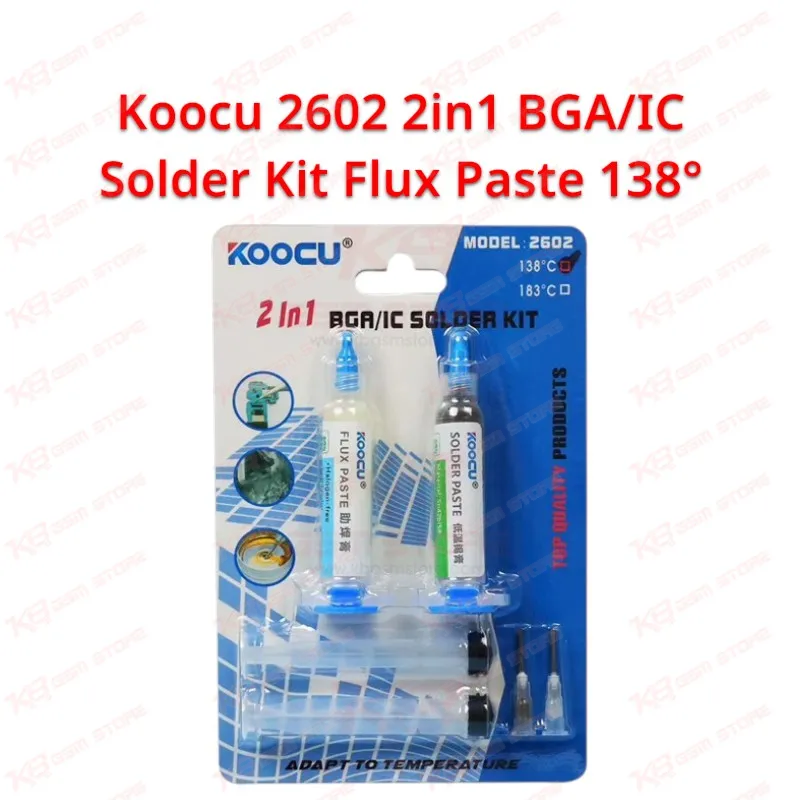
Working on a dead board after a reflow or reballing job comes down to one thing more than any other: the quality of the paste under your iron tip, and the KOOCU 2602 2in1 flux paste is built around that exact need. It runs on a 138°C low-temperature formula, which means you get a controllable melt point that protects sensitive components and fine BGA pads from thermal stress during rework, something every technician handling hang on logo boards or dead after flash boards learns to appreciate the moment a pad lifts from too much heat. The paste itself is a mixture of high-quality alloyed powder and resin pasty flux, and that combination is what keeps the finished joint free of the pale yellow residue that cheaper white flux pastes tend to leave behind on the board surface after soldering, so your rework area stays cleaner and easier to inspect under a microscope once the job is done. Colour is white and the formula is insulated, which matters when you are working close to other live traces on a crowded motherboard and cannot afford stray conductivity between adjacent pads. The paste ships with a needle tip, giving you the kind of precise, drop-by-drop control that fine-pitch IC change and small-pad reballing actually demand, rather than the uneven blobbing you get from bulk paste applied with a spatula. As a 2in1 kit, the 2602 pairs the flux paste syringe with a booster bar setup, so you get the dispensing tool and the paste in one purchase instead of hunting down a separate plunger or booster accessory before you can start a job. On the bench, this translates directly into good immersion and a high-intensity joint, the two things that decide whether a chip actually survives its next power cycle or comes back for a second visit. Function-wise, it is built for PCB, BGA, and PGA rework, which covers the bulk of chip-level repair work technicians see day to day: reballing an eMMC or PMIC after a dead phone diagnosis, resoldering a CPU IC after a board cleaning, or reflowing a charging IC after a charging issue complaint. Within a typical repair workflow, this paste sits at the reflow and reballing stage, right after diagnostics has isolated a faulty IC or a cold joint, and right before you move on to testing and functional verification on the box or test board. It fits naturally alongside hot air rework stations and BGA reballing stencils, since paste quality directly affects how well solder balls form and adhere during the reballing process itself, and a paste that flows poorly under heat can undo an otherwise clean stencil job. For technicians dealing with network issue boards, boot loop issue diagnoses, or board level chip replacement, having a paste that behaves consistently at a known 138°C threshold removes one variable from an already complex repair, letting you focus on placement accuracy and heat profile instead of second-guessing whether the paste itself is causing incomplete wetting. It is equally useful for smaller jumper lagana style repairs, where a needle tip lets you place flux exactly where a trace or via needs it without spreading paste across the whole board. Whether you run a solo repair bench or a full-service center handling volume board work, the KOOCU 2602 gives you a repeatable, low-residue option for chip soldering and reballing that keeps rework quality consistent from one board to the next.