Skip to product information
1 of 4
Brand: KOOCU

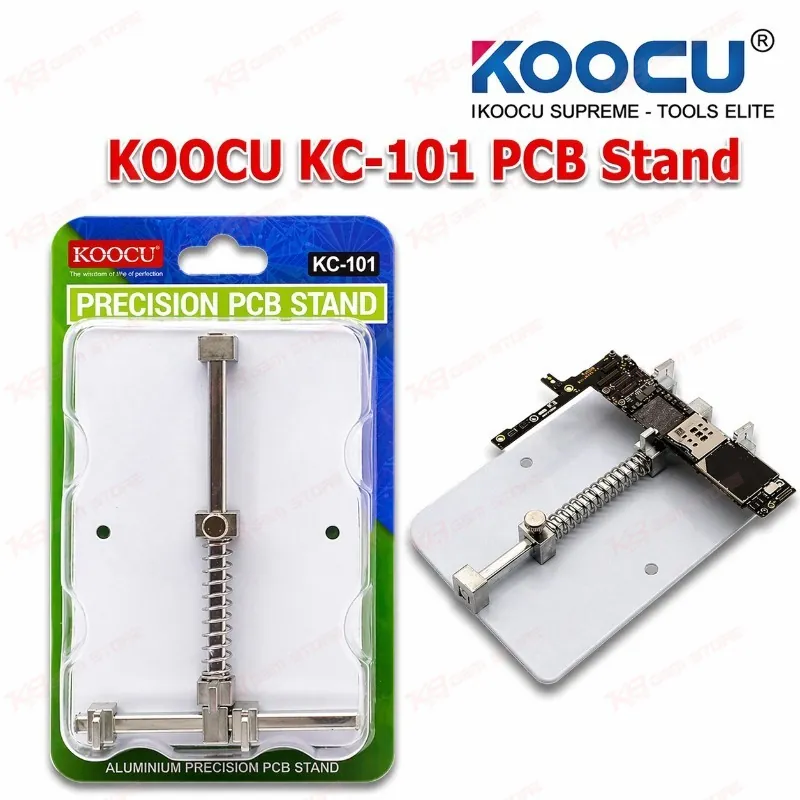
KOOCU KC-101 PCB Stand

KOOCU KC-101 PCB Stand

Regular price Rs.300.00 PKR
Regular price Rs.400.00 PKR Sale price Rs.300.00 PKR
Sale Sold out
Shipping calculated at checkout.
Quantity

The KOOCU KC-101 is an adjustable PCB holder stand built for technicians who need a steady grip on a phone motherboard during soldering, rework, or IC-level repair. The clamp arms hold the board firmly so it doesn't shift when you're working on a dead phone or a board stuck in boot loop. You get a stable platform on your repair bench instead of holding the PCB by hand or balancing it on a mat. It suits daily bench work at mobile repair shops, service centers, and GSM training setups where boards need to stay fixed during flashing, jumper work, or component replacement.

SKU:MST-SOLDERING-ACCESSORIES-528

⚖️ Weight: 0.03 kg

  • Safe & Secure Payment
  • Fast Delivery
  • WhatsApp Support
View full details

Description

Working on a mobile phone motherboard without a proper stand slows down every repair job you take on. The KOOCU KC-101 solves that basic bench problem by giving you a dedicated holder that locks the PCB in place while you solder, reball, or run diagnostics. You place the board between the adjustable clamp arms, tighten the grip, and get on with the actual repair instead of fighting with a board that keeps sliding around. This matters most when you're chasing a hardware fault on a board that's already dead after flash, because any small movement during jumper lagana or IC change karna can undo the work you just finished. A shop that handles a steady stream of charging issue, display problem, and network issue cases needs this kind of holding fixture on every bench, not just one shared unit passed between technicians. The KC-101 gives you that flexibility since it adjusts to different board sizes, so you're not limited to one phone brand or one board layout. Whether the job in front of you is a Samsung board with a charging port fault or an Infinix board stuck on hang on logo, the clamp mechanism adjusts to fit the board you're actually holding. That adaptability is what separates a general-purpose PCB stand from a fixture built for one specific device, and it's why shops that repair multiple brands prefer a stand over improvised clamps or tape. During ISP mode work on a dead phone, having the board fixed at a comfortable angle reduces the chance of a probe slipping off the test point mid-session, which can turn a five-minute job into a repeat visit. The same applies to reballing work, where the board needs to stay level and still while you're reflowing an IC, since any tilt or shift risks solder bridging or a cold joint. A stand like the KC-101 sits early in your repair workflow, right after diagnostics confirm the fault and before you start the actual rework, soldering, or flashing operation. It's not a diagnostic tool and it's not a programmer box, but it's the piece of bench equipment that makes every other tool you use — hot air station, microscope, soldering iron, box software — actually usable on a board that won't stay still. For a service center running multiple technicians on parallel jobs, having a stand at each bench cuts down on wasted time waiting for a shared fixture, and it protects the board from the kind of accidental flex damage that happens when someone tries to hold a PCB steady with their fingers while soldering. If your shop takes on pattern unlock jobs that require opening the board for hardware-level bypass, or you're running board cleaning after a liquid damage case, the same holder keeps the PCB accessible from multiple angles without you needing to reposition it constantly. Technicians who train new staff also find a dedicated stand useful, since it standardizes how a board is held during teaching sessions, reducing the risk of a trainee damaging a customer's board through unstable handling. The KC-101 fits into that everyday bench routine as a support tool rather than a specialized one, which is exactly the role a PCB stand is meant to play in a busy GSM repair shop.

Key Features

Adjustable clamp arms hold PCBs of different sizes securely

Stable base keeps the board fixed during soldering and rework

Works across multiple phone brands and board layouts

Reduces board movement during ISP mode and jumper work

Frees up both hands for soldering, reballing, or probing

Suits daily use on busy repair shop benches

Helps standardize board handling during technician training

Compact footprint that fits alongside other bench tools

Specifications

Brand Entity KOOCU
Product Entity KC-101 PCB Holder Stand
Technology Entity Adjustable Clamp Mechanism
Compatible Device Entities Universal Mobile Phone PCBs
Repair Process Entity Soldering and Rework Process
Industry Entity Mobile Repair Industry / GSM Repair

Compatible Devices

Universal — not device-specific; holds mobile phone PCBs and motherboards across brands and models, adjustable to different board sizes.

Common Repair Uses

Motherboard soldering, IC reballing, jumper wire installation, ISP mode probing on dead boards, board-level diagnostics, and general PCB stabilization during rework.

FAQ

What is the product name?
The product name is KOOCU KC-101 Adjustable PCB Holder Stand.
What is the brand of this product?
The brand of this product is KOOCU.
What is the model of this product?
The model of this product is KC-101.
What is this product used for?
This product is used for holding a mobile phone PCB steady during soldering, rework, IC repair, and diagnostic work.
Which devices are compatible with this product?
This product is compatible with mobile phone PCBs and motherboards across brands, since the clamp adjusts to different board sizes.
Who should use this product?
This product is suitable for mobile repair technicians, GSM repair shops, service centers, and training institutes.
Does the KC-101 stand work with different board sizes?
Yes, the clamp arms adjust to fit different mobile phone board sizes, so it isn't limited to one device or brand.
Can the KC-101 be used during ISP mode or jumper work on a dead board?
Yes, the stand keeps the board fixed at a stable angle, which helps during ISP probing and jumper placement where movement can break contact.