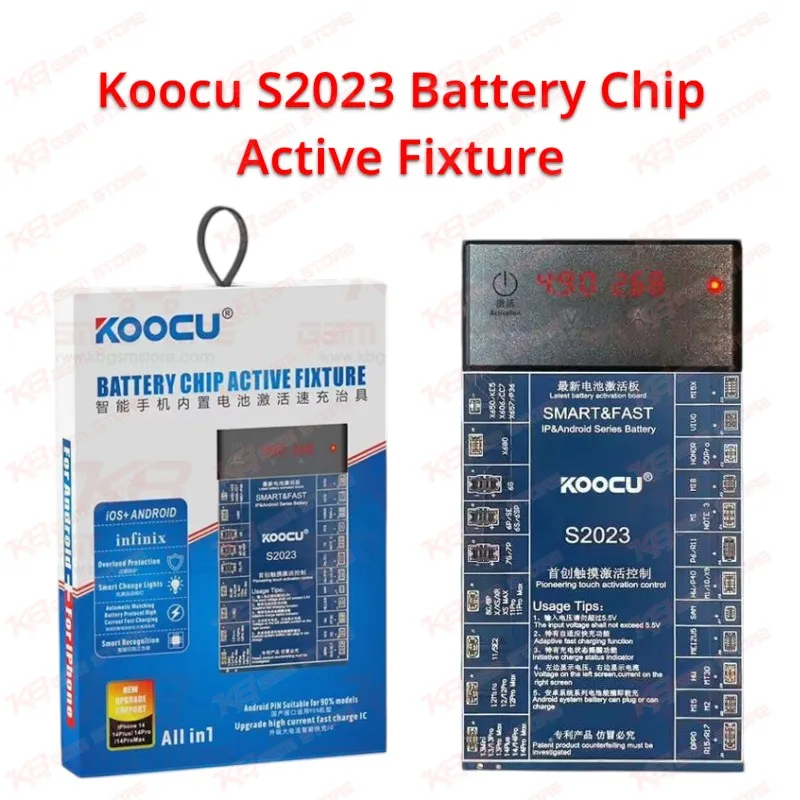
The Koocu S2023 Battery Chip Active Fixture gives you a controlled way to charge and activate smartphone batteries away from the handset, which solves one of the most frustrating situations on a repair bench: a battery that shows zero voltage and will not charge when reinstalled in the phone. You connect the small interface board to a power source, then snap the battery directly onto the activation board, and the fixture takes over from that point by reading the battery's charging protocol and matching output current to it instead of forcing a fixed voltage onto a deeply discharged cell. This matters because different battery brands and production batches use different charge curves, and pushing the wrong current into a battery that has been sitting for weeks or months risks permanent damage or a protection lockout that leaves the cell unusable even after the phone itself is repaired. The S2023 handles this by detecting the battery's condition first and adjusting the activation current in response, keeping the process controlled rather than forcing a one-size-fits-all charge onto every cell that lands on the board. Intelligent polarity identification adds another layer of protection during this process. Battery connectors and flex cables vary across brands, and a reversed connection during activation can destroy the protection IC inside the battery in seconds. The S2023 checks polarity automatically before current flows, which removes that risk from the workflow and lets you move faster between units without stopping to double-check pinouts on every battery you handle. Overload protection sits alongside this, cutting power if current draw exceeds safe limits during either the charging or activation cycle, and the automatic status light gives you a clear visual read on where each battery stands in the process without needing a separate meter connected at the same time. In a typical repair scenario, a customer brings in a phone that will not power on, and diagnosis shows the board itself is fine but the battery has dropped below the voltage threshold the phone's charging circuit needs to begin a normal charge cycle. Rather than assuming the battery is dead and reaching for a replacement, you pull it, connect it to the S2023, and let the fixture bring the voltage back up to a level the phone can recognize and continue charging on its own. This is especially useful with phones that have sat in a drawer or storage for extended periods, stock replacement batteries that ship at very low voltage, and units pulled from water-damage or long-idle repairs where the battery itself was never the actual fault but still needs a jump-start before the phone will boot again. Because the S2023 works independently of the phone's own charging circuit, it also gives you a fast way to isolate the problem: if a battery activates and holds charge normally on the board but the phone still will not power on, you know the fault sits in the board or charging IC rather than the battery, which narrows down diagnostic time considerably. The board supports iOS and Android batteries, including Infinix models, and its connector layout covers the standard flex-style battery interfaces used across most current smartphone lines, which is why it fits into roughly 90% of the batteries a general repair shop sees day to day. For a workshop handling dead-phone cases, battery complaints, and general hardware faults on a regular basis, having a dedicated activation board on the bench cuts down on unnecessary battery replacements, speeds up diagnosis, and keeps low-voltage batteries usable instead of writing them off as scrap the moment they fail to charge inside the handset.