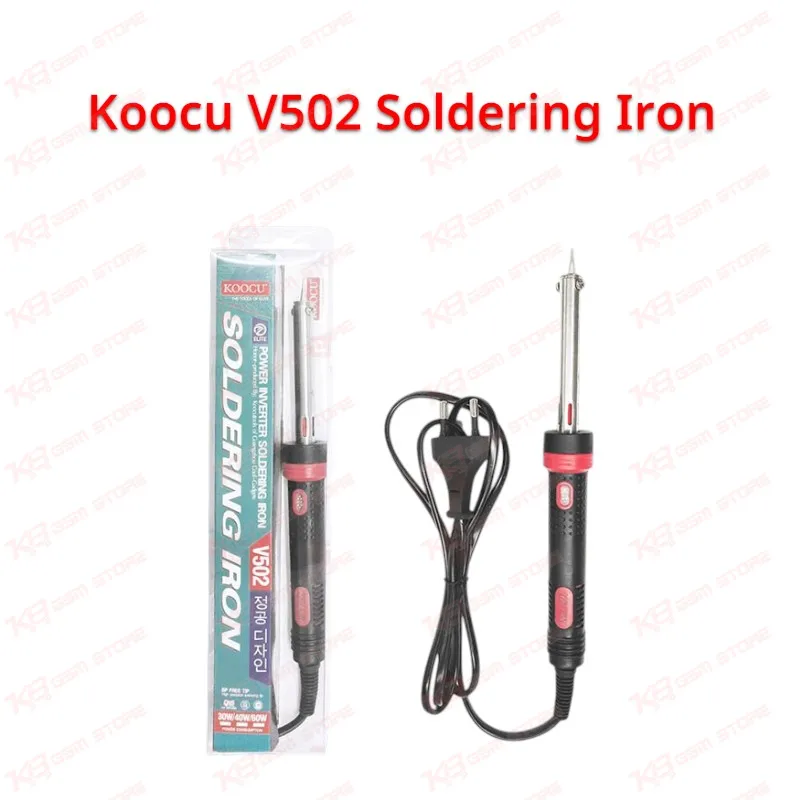
Every mobile repair technician reaches for a soldering iron dozens of times a day, and the Koocu V502 earns its place on the bench by combining fast heat-up, stable temperature control, and a build that survives constant handling in a busy repair shop. At the core of the V502 sits a four-core ceramic heating element, a design that heats up quicker than standard nichrome elements and holds temperature more evenly across the tip. This matters when you're switching between fine SMD soldering on a motherboard and slightly heavier work like resoldering a charging port connector, since the iron needs to recover heat fast without scorching sensitive components nearby. The adjustable temperature range runs from 200°C up to 500°C, controlled through a knob on the handle, so you dial in a lower setting for delicate IC legs and ICs prone to heat damage, then turn it up when working on ground shields, connectors, or components that pull heat away faster. Temperature stability is rated at ±2°C in still air, which keeps your solder flow predictable instead of guessing whether the tip has cooled mid-joint — a common frustration with cheaper irons that swing in temperature under load. The body is built from stainless steel with an iron-plated tip, a combination that resists oxidation and pitting far better than uncoated copper tips, meaning the tip holds its shape and tinning longer even with daily use on flux-heavy repair work. At roughly 135 grams, the V502 stays light in hand through long sessions of board-level repair, reducing the wrist and finger fatigue technicians deal with when working on chip-level jobs for hours. The pencil-style grip keeps the iron balanced close to the tip, giving you better control for tight-tolerance soldering around densely packed components — the kind of precision needed when you're reworking a dead phone motherboard or reattaching a jumper wire after an IC change. This iron is offered in multiple power configurations, letting you match the wattage to your typical workload: lower wattage variants suit fine mobile phone PCB work where excess heat risks damaging nearby parts, while higher wattage options handle bulkier soldering tasks on connectors, shields, and thicker traces without losing tip temperature. In a typical GSM repair workshop, the V502 covers a wide range of daily tasks — reflowing dry solder joints, tacking down loose components after a board clean, repairing charging port pins, fixing broken traces, and general assembly work on both mobile phones and other electronics like cameras and small appliances. Because it runs on standard 220V AC input, it fits directly into existing bench setups without needing a separate power adapter or transformer. For technicians dealing with hang on logo issues, charging issues, or hardware fault diagnosis that traces back to a cold solder joint, having a stable, quick-heating iron on hand removes one more variable from the troubleshooting process. The V502 isn't a rework station replacement for BGA work, but as a primary hand tool for everyday soldering, connector repair, and component-level fixes, it holds up as a solid, dependable choice for repair shops and service centers working through high volumes of devices daily.