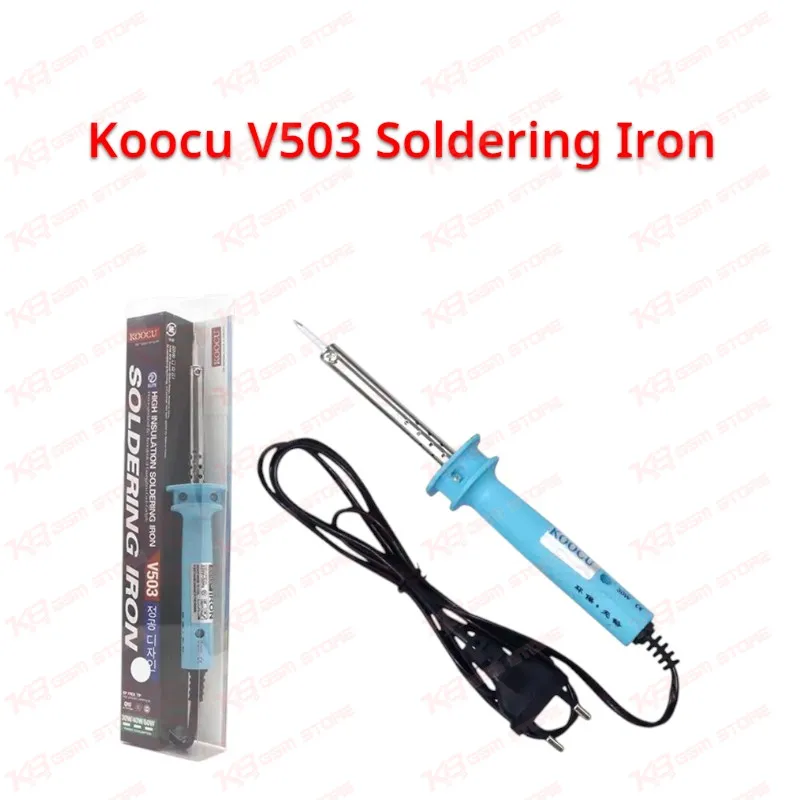
On a busy mobile repair bench, the soldering iron you reach for dozens of times a day needs to heat fast, hold temperature, and not fight you when you're working close to sensitive components — the Koocu V503 is built around that exact workflow. It runs on 220V AC power and gives you a choice of 30W, 40W, or 60W output, so instead of switching irons for different jobs you adjust the same tool: 30W for delicate pad-level work near ICs, 40W for general board soldering, and 60W when you need faster heat recovery on connector or charging port jobs. The ceramic heating core inside the barrel is the part that actually makes this practical — ceramic elements heat up quicker than older wire-wound designs and hold a steadier temperature under load, which matters when you're doing repeated joints on a dead phone board or reflowing a jumper wire after an IC change. The handle is stainless steel with heat-resistant material at the grip, so it stays cool enough to hold through a full repair queue without the fatigue you get from cheaper plastic-bodied irons that transfer heat back to your hand. At around 245mm long and about 0.2kg in weight, the V503 sits light in the hand and gives you the reach and control you need when you're working inside a cramped mid-frame or soldering near a battery connector where clearance is tight. The pencil tip design is what you want for this kind of work — it's not a chunky iron meant for heavy industrial soldering, it's shaped for the fine, controlled joints that phone repair actually demands: reconnecting a broken trace, resoldering a charging port after a charging issue, tacking down a jumper after board-level rework, or touching up a cold joint that's causing a hang on logo situation. Technicians doing FRP lock hardware work, network issue troubleshooting that involves reflow, or display problem repairs where a flex cable needs re-tinning will find the adjustable wattage genuinely useful rather than just a spec on paper — you're not stuck with one fixed heat setting that's either too weak for connector work or too aggressive for IC-level soldering. The AC cord and standard plug setup means it drops straight into an existing repair bench setup without needing a separate power supply or docking station, which keeps the cost and complexity down for shops running multiple stations. Over-current protection on the input side adds a layer of safety against voltage spikes, which is a real consideration on Pakistani mains supply where fluctuation is common and cheap tools without protection burn out fast. This is the kind of iron a technician keeps as either a primary daily tool in a smaller shop or a reliable backup unit alongside a full soldering station in a larger service center — it doesn't try to replace a hot air rework station or a dedicated BGA setup, but for hand-soldering tasks across dead phone repair, charging port replacement, board cleaning touch-ups, and general PCB repair work, it covers the job cleanly. Before plugging in, check that your mains supply matches the rated voltage, and give the tip a few seconds to stabilize at your chosen wattage before starting delicate work — that habit alone extends both tip life and the quality of your joints. For a shop stocking up on bench essentials, the V503 pairs naturally with soldering iron stands, replacement ceramic tips, and lead-free solder wire to round out a complete hand-soldering station.