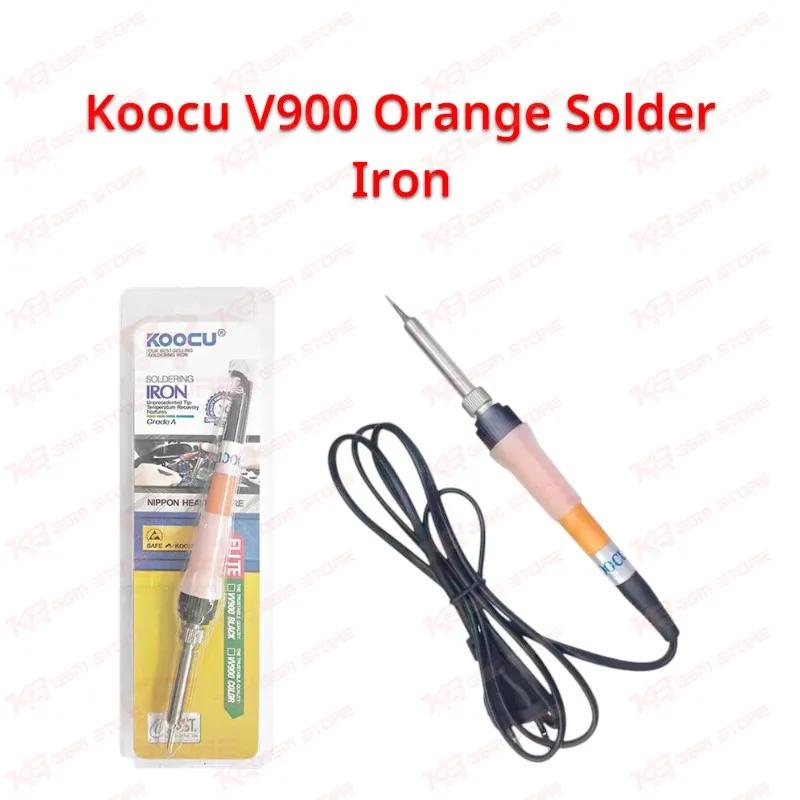
Mobile repair technicians know that inconsistent heat is one of the fastest ways to damage a board during a repair job, and the KOOCU V900 Orange Solder Iron addresses that problem directly through its two-core ceramic heating core, a design that heats faster than standard nichrome elements while holding temperature far more steadily once you reach your working point. You get a 200–450°C range on this iron, wide enough to cover the full spectrum of mobile repair tasks, from low-heat work on delicate flex connectors and small SMD pads to higher-heat jobs like resoldering shields or reworking ground points that pull heat away quickly. Temperature stability sits at ±2°C in still air with no load, and accuracy holds at ±10°C, which matters when you're working millimeters away from ICs, capacitors, and other heat-sensitive components on a crowded logic board. Power consumption stays at just 35W, so the iron warms up quickly at the start of a repair without drawing excessive current on a shared workshop power strip, and it recovers heat fast between solder joints during repetitive work like connector pin resoldering or multi-point jumper repair. One detail that often gets overlooked in soldering tool specs is tip-to-ground impedance and voltage, and this is where the V900 Orange earns its place on ESD-aware repair benches — tip-to-ground impedance stays under 2Ω and tip-to-ground voltage under 2mV, both figures that reduce the risk of static discharge damaging sensitive chipsets, PMICs, or charging ICs while you work directly on the board. That protection matters most during charging port repair, battery connector resoldering, and any jumper wire work near CPU or RAM packages, where a stray static charge can turn a simple repair into a dead board. At 113 grams, the iron stays light in hand through long repair sessions, reducing wrist fatigue when you're running through a stack of dead-after-flash boards, hang-on-logo units, or charging issue phones during a busy workshop day. The input voltage rating covers 220V AC±10% at 50Hz and 110V AC±10% at 60Hz, which means the same iron works across different regional power standards without needing a separate unit for export or cross-border repair operations. This dual-voltage support gives repair shops flexibility if they run equipment sourced from different markets or operate service centers in regions with different mains standards. In day-to-day workshop use, this iron fits naturally into board-level repair workflows: resoldering loose charging connectors, reflowing cracked solder joints on display flex cables, attaching jumper wires after IC removal, repairing broken ground points, and general rework where a stable, low-wattage iron beats a bulky, high-power station that's overkill for phone-sized components. Technicians handling dead phone recovery, boot loop troubleshooting that traces back to a cracked solder joint, or pattern unlock boards that need a connector resoldered will find the V900 Orange sized correctly for the job — powerful enough to melt solder cleanly on copper-heavy boards, but controlled enough not to lift pads on thin mobile PCBs. The two-core ceramic core also means less thermal drift during continuous use compared to single-core designs, so temperature holds steady even when you're running the iron for back-to-back repairs without downtime between boards. For a repair shop stocking bench tools, this iron covers general-purpose mobile soldering work reliably, sitting alongside hot air stations and reballing kits as a core part of any board-level repair setup.