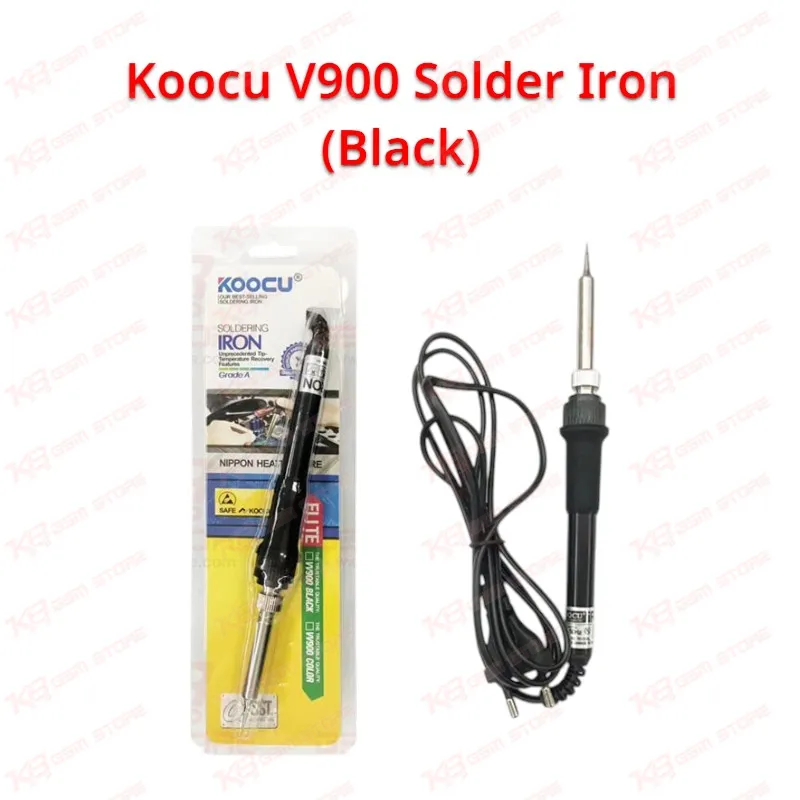
When you're working a busy repair bench, the soldering iron you reach for every single job needs to heat fast, hold temperature, and not fight you while you're trying to free a stubborn charging port pad or reflow a lifted connector leg. The KOOCU V900 Precision Soldering Iron in black is built around exactly that kind of daily-use reliability. Its ceramic heating core brings the tip up to working temperature quickly after power-on, which matters when you're moving between dead phone repairs, network IC checks, and display connector rework throughout the day and don't want to sit around waiting for the iron to catch up. The adjustable temperature range of 200°C to 480°C covers nearly everything a mobile repair technician touches, from delicate SMD passives and connector pins that need lower heat to avoid lifting pads, up to larger ground points and shield frames that need a hotter tip to transfer heat properly before the joint cools. Temperature stability rated at ±2°C in still air with no load means the tip doesn't drift once it settles, so you get a consistent result across a full row of solder joints instead of the first one coming out clean and the fifth one turning into a cold joint because the iron cooled down. Accuracy is rated at ±10°C, which is tight enough for board-level phone repair work where overheating a nearby component is a real risk on dense modern boards. One detail that matters more than most technicians realize is the tip-to-ground impedance and voltage rating. This iron measures under 2Ω tip-to-ground impedance and under 2mV tip-to-ground voltage, both of which protect static-sensitive components like PMICs, audio ICs, and baseband chips from leakage current damage while you're soldering directly on a powered-down board. On a repair bench where you're constantly touching charging ICs, power management chips, and other ESD-sensitive parts, this kind of protection reduces the chance of silently damaging a board while trying to fix a completely unrelated fault. In terms of where this iron fits into your actual repair workflow, it's the tool you use after diagnostics confirm a hardware fault that needs a physical fix rather than a software flash — reattaching a charging port, resoldering a loose connector, replacing a small SMD component, or touching up a cold joint that's causing an intermittent charging issue or hang on logo symptom. It's not built to replace a hot air rework station for BGA reballing or IC removal, but it's the tool you'll use before and after that kind of job, for tacking components in place, cleaning up pads, and finishing joints once the IC change is done. The black handle design is lightweight and shaped for extended grip comfort, which is a real factor when you're doing back-to-back repairs across a full workday rather than a single one-off fix. Power input is standard 220V AC at 50Hz, matching Pakistan's mains supply directly with no converter needed. For a repair shop or service center stocking a soldering station, this iron is a practical everyday tool rather than a specialty item — it covers charging port repair, display connector resoldering, board cleaning after liquid damage, small component replacement, and general PCB touch-up work reliably. Paired with a decent tip cleaner, flux paste, and a soldering stand, it forms the core of a functional repair bench setup without the cost or complexity of a full-featured rework station, making it a sensible pick for technicians building out their toolkit or shops equipping multiple repair stations.