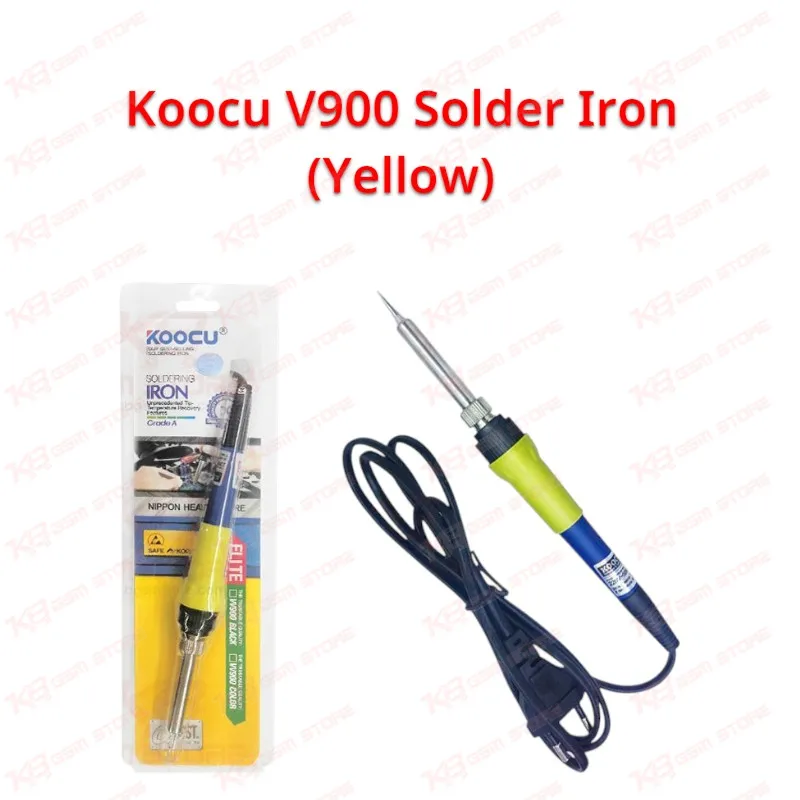
When you handle board-level repair on a busy bench, the iron in your hand decides how clean your joints turn out, and the Koocu V900 Yellow Solder Iron gives you that control through a two-core ceramic heating design that reaches working temperature fast and holds it steady through continuous use. You adjust temperature across a 200~450°C range, which covers everything from delicate SMD rework to heavier connector soldering, and the ±2°C stability means your tip doesn't drift while you work on a dead phone board or chase a boot loop issue caused by a cracked solder joint. Pakistani technicians running IC change, jumper lagana, or charging port repair jobs need consistent heat recovery between joints, and the ceramic core in this iron responds quickly after each contact instead of leaving you waiting for the tip to climb back to temperature. The low tip-to-ground impedance (under 2Ω) and tip-to-ground voltage (under 2mV) matter more than most technicians realize, because modern mobile boards carry ESD-sensitive components, and a poorly grounded iron tip can damage a PMIC or CPU IC the moment it touches a pad. You avoid that risk here, which makes the V900 Yellow a safer daily driver for CPU-level and IC-level rework compared to older uncontrolled irons still floating around on some workshop benches. The 155mm power cord and light 0.113kg body keep the iron easy to maneuver when you're working close to a microscope or hot air station, and the reduced weight cuts down on hand fatigue during long diagnostic or flashing sessions where you might be soldering test points for hours. This iron fits naturally into the workflow around ISP pinout work, eMMC programmer test point soldering, and UFS adapter installation, since all of these tasks demand a stable, low-noise tip rather than raw wattage. You'll also find it useful alongside your hot air rework station and BGA reballing setup — heat the board with hot air, then use the V900 for precision touch-up soldering on individual pads or jumper wires where hot air alone isn't practical. The dual voltage input (220V AC or 110V AC) means the iron works whether your workshop runs on standard Pakistani mains or you're using a stepped-down supply, so you don't need a separate transformer setup just to power it. For technicians who deal with hang on logo issues traced back to a lifted IC leg, or a hardware fault from a shorted charging port, this iron's controlled tip temperature lets you rework the joint without overheating nearby components on a densely packed board. The soldering tip design supports fine-pitch work, which matters when you're doing audio IC or RF IC repair where pads sit close together and a wide, uncontrolled tip would bridge connections. Because the heating core recovers quickly, you spend less time waiting between joints during multi-point jobs like display flex repair or network issue troubleshooting where several small joints need attention in sequence. The yellow housing also makes the iron easy to spot on a cluttered bench next to other tools in similar tones, a small but genuinely useful detail during fast-paced repair queues. Overall, this iron suits technicians who want dependable, ESD-safe soldering performance for daily mobile repair work without stepping up to a full-size rework station, and it pairs well with your existing hot air station, multimeter, and PCB fixture setup for a complete board-level repair bench.