

Lanrui W9 Pen Probe With Replaceable Needle For Multimeter
Lanrui W9 Pen Probe With Replaceable Needle For Multimeter
Regular price
Rs.1,200.00 PKR
Regular price
Sale price
Rs.1,200.00 PKR
Shipping calculated at checkout.
Quantity
Couldn't load pickup availability
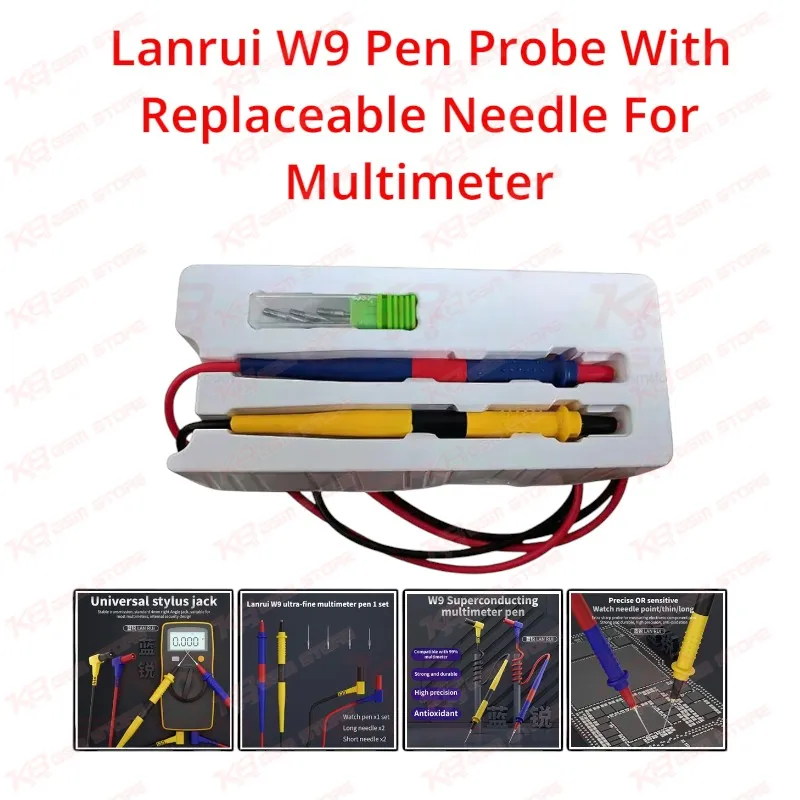
The Lanrui W9 multimeter pen probe is built for technicians and hobbyists who need reliable, high-precision measurements. Featuring a titanium alloy needle tip and pure copper refill, it delivers stable readings with ultra-low resistance. Double-layer insulation and a break-proof, soft-injected body make it safe and durable for daily use. The standard 4mm right-angle jack ensures compatibility with most multimeters, and the replaceable tip means you get long-term value without replacing the entire probe.
SKU:MST-SOLDERING-TOOLS-1237
⚖️ Weight: 0.1 kg
- Safe & Secure Payment
- Fast Delivery
- WhatsApp Support
Description
FAQ
Q1: Is the Lanrui W9 compatible with my existing multimeter?
The W9 uses a standard 4mm right-angle banana plug jack, which is compatible with the input terminals found on the majority of digital multimeters available in Pakistan and internationally. Check your multimeter's input port size before ordering if you are unsure.
Q2: Can I replace just the needle tip without buying a new probe?
Yes. The W9 is specifically designed with a replaceable needle tip, which allows you to swap out a worn or damaged nib independently. This saves you the cost of replacing the full probe and is one of the key advantages of this model.
Q3: What voltage is the Lanrui W9 safe to use with?
The probe is rated for continuous use at 2000V and has been tested at up to 2500V. It is suitable for a wide range of measurement tasks including household circuits, automotive electronics, and general-purpose component testing. Always follow standard safety practices when working with live circuits.
Q4: Why does the internal resistance specification matter in a multimeter probe?
Lower internal resistance means less signal loss between your probe contact and the multimeter input, which results in more accurate readings. The W9 uses a pure copper refill rated below 19 milliohms per meter, keeping resistance minimal and measurement reliability high.
Q5: Is the Lanrui W9 suitable for testing small PCB components and fine-pitch pins?
Yes. The titanium alloy needle tip is designed to be sharp and precise, making it well suited for testing surface-mount components, small test pads, and tight-spaced pins on circuit boards where a broad-tipped probe would cause accidental shorts or missed contacts.
Q6: Does the cable have break protection at the handle connection?
Yes. The W9 features a reinforced tail connection at the point where the cable enters the handle body. Combined with soft injection molding at the flex point, this construction significantly reduces the risk of internal wire breakage from repeated bending during regular use.