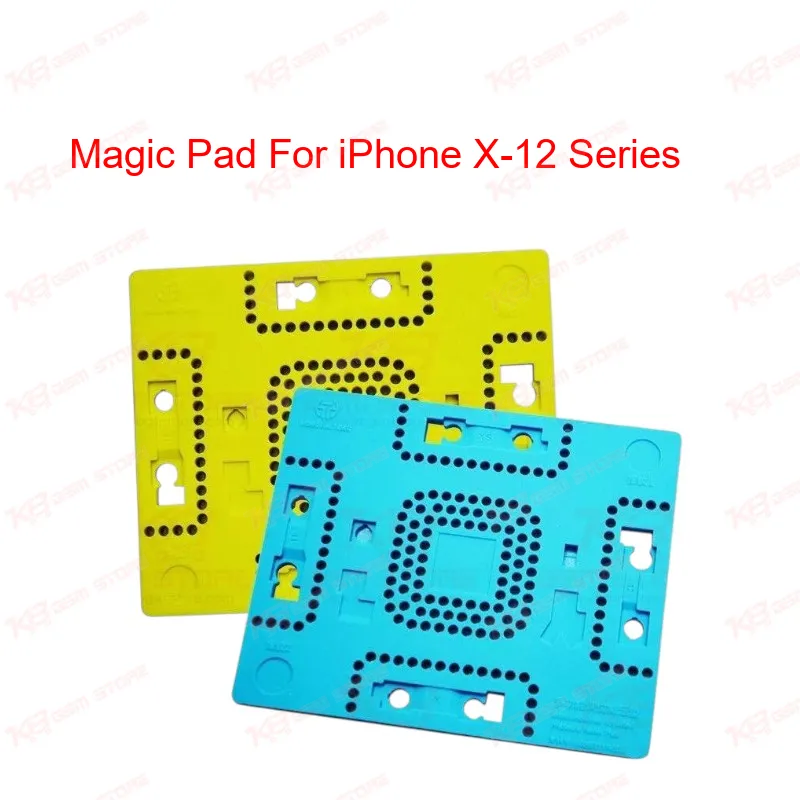
Every technician who has attempted a Face ID dot matrix repair or CPU reballing job on an iPhone X-12 series board knows how easily a rushed tin planting step can ruin the whole repair. The steel mesh shifts, the pressure applied during reballing isn't even, and the result is tin stringing or a damaged pad that turns a simple IC change into a scrapped board. The Magic Pad exists to solve exactly this problem. It is a multifunctional silicone protective mat designed to hold your BGA components steady while you plant tin, giving you consistent, repeatable results on every dot matrix or fingerprint repair.The pad is built around dedicated component grooves. There's a slot for the face dot matrix, a slot for the infrared front camera, two fingerprint grooves, and a CPU placement groove, each shaped to hold the corresponding board component securely during handling and reballing. Instead of balancing a fragile chip on a flat surface while you position your steel mesh, you drop it into the matching groove and it stays put. This alone cuts down the fumbling that leads to dropped components or misaligned solder balls, especially when you're working on a dead phone board where every component still has value if handled right.Heat management is the other half of what this mat does. The silicone material absorbs and insulates against the heat generated during tin planting, so the steel mesh doesn't warp from repeated heating cycles. A warped mesh is one of the most common causes of tin stringing under the pads, and once that happens you're looking at bridged connections or a chip that won't seat properly on reflow. By keeping the mesh flat and the pressure even across the component during tin planting, the Magic Pad helps you get a clean pass on the first attempt instead of reworking the same chip two or three times.This is genuinely useful for the repair scenarios that come up constantly on an iPhone X-12 series bench: Face ID hardware fault after IC change, fingerprint sensor not reading after a board-level repair, CPU reballing after a dead-after-flash situation, or general BGA chip rework where the original solder balls have degraded. If you're running a repair shop that handles iPhone motherboard work regularly, this pad becomes part of your standard reballing workflow alongside your hot air station, BGA stencils, and flux.The silicone construction is flexible and can be rolled or bent without losing shape, so it's easy to store in a tool drawer or repair kit without taking up bench space. It's also reusable across many repair jobs since the silicone doesn't degrade quickly under normal heat exposure from a hot air gun or preheating station. For a workshop doing volume iPhone repairs, having a mat on the bench at all times means you're never improvising a tin planting setup with tape or a flat silicone sheet that doesn't have the right grooves.Pairing this with a decent BGA reballing kit and the correct stencil size for your target chip gives you a complete, low-cost setup for Face ID and CPU repair work. It won't replace a proper hot air station or a soldering iron, but as a positioning and protection accessory it removes one of the most common failure points in dot matrix and CPU reballing: inconsistent pressure and mesh movement during tin planting.