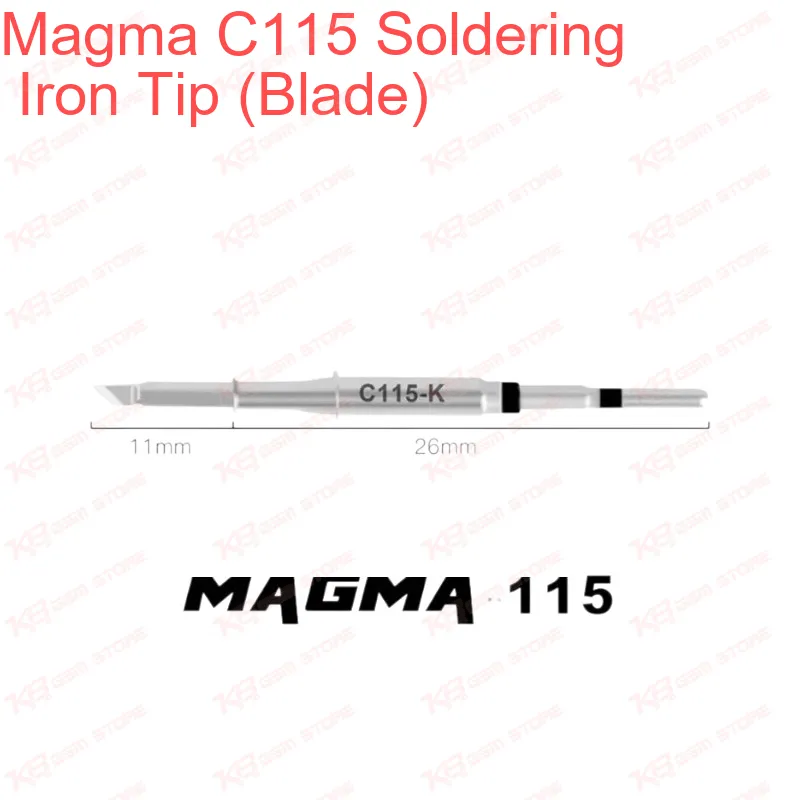
Working on modern mobile phone boards means dealing with pads that are packed closer together every year, and a standard conical tip often does more damage than good in that kind of space. The Magma C115 Blade Soldering Iron Tip solves that exact problem with a flat, blade-style contact edge designed to lay flush against small pads and IC pins, giving you a stable, even heat spread instead of a single hot point that can lift a pad or cook a neighboring component. You get better control when tinning fine pitch legs, running short jumper wires, or touching up a lifted trace on a dead phone board. This tip belongs to the C115 series, which is built for nano-format soldering and desoldering handpieces rather than full-size irons, so it slots naturally into workflows where the technician needs precision over brute heat output. In a busy repair shop, that difference shows up fast — you spend less time fighting the tip and more time finishing the actual repair. For technicians handling board reflow, IC reballing prep, or fine jumper work under a microscope, the blade shape means the heated edge makes contact along the join rather than at a single point, which shortens contact time and reduces stress on the surrounding solder mask. That matters when you're doing hardware fault diagnosis on a board that's already been opened up multiple times and every extra second of heat exposure adds risk. The tip is compatible with C115-series nano soldering and desoldering handpieces, which are commonly paired with nano-format stations used for SMD rework, component-level repair, and micro soldering tasks across mobile repair benches. Because it's a tip rather than a full unit, swapping it in is quick — no re-wiring your station, no relearning your workflow, just a direct fit into the handpiece you already run. Technicians dealing with charging port repair, display flex soldering, or small connector rework will find the flat edge easier to align under magnification compared to a rounded tip, especially when the joint runs along a short straight line rather than a single point. This is also a useful pickup for training institutes and technical workshops teaching PCB repair process fundamentals, since a blade tip forces better technique — you learn to control dwell time and angle rather than relying on tip mass to push heat into the joint. Repair shop owners running multiple benches often keep a few of these on hand as spares, since tips wear out with daily use and having a fresh one ready means less bench downtime. If your current tip has developed a black oxidized edge or stopped tinning evenly after repeated tinning and cleaning cycles, that's usually the sign it needs replacing rather than reconditioning. The Magma C115 Blade Tip gives you that direct swap-in replacement without committing to a new handpiece or station, which keeps ongoing tool costs down for shops running high repair volume. For anyone doing IC change karna on dense boards, jumper lagana on fine traces, or general board-level micro soldering, this tip is a straightforward addition to a nano soldering kit.