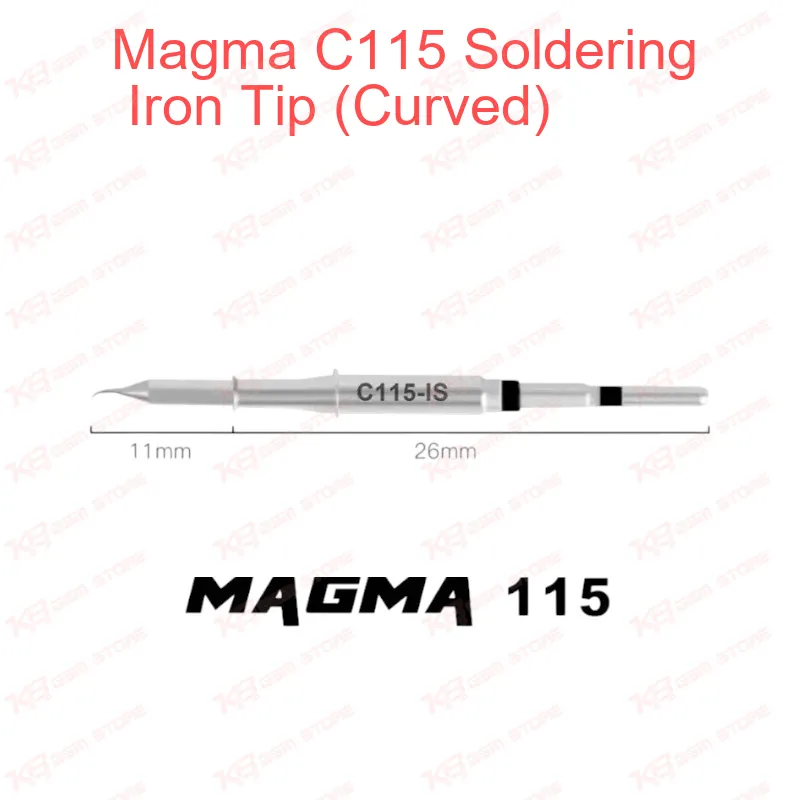
When you're working on a phone board packed with fine-pitch components, a straight soldering tip often gets in your own way, and that's exactly the problem the Magma C115 Curved Soldering Iron Tip solves for you on your repair bench. Built to the C115 tip series format used across nano and micro soldering handpieces, this tip locks onto any handle designed for the C115 standard, which covers genuine JBC-style nano irons as well as the C115-compatible handles fitted to popular clone stations from brands like Sugon, Aifen, and Mechanic that most technicians in Pakistan already run in their shops. The bent, curved shape angles the working tip away from the shaft, so when you're soldering along the edge of a board, near a connector housing, or right up against a raised component, your hand and the tip body stay clear of your own line of sight. You get a direct, unobstructed view of the joint through your microscope, which matters when you're placing a 0.3mm pad or reattaching a shield can corner without disturbing the parts next to it. Technicians dealing with a dead phone after a failed flash, a board with a hardware fault around the power IC, or a unit stuck on hang on logo because of a cracked solder joint will find the curved geometry especially useful, since these repairs usually involve components crammed close together where a straight tip forces you to approach at an awkward angle. The C115 series is built for nano-level precision work, not general soldering, so this tip is meant for board-level repair rather than bulk wire soldering or large connector work. That focus is what makes it valuable for charging port repair, network IC reflow, camera connector reattachment, and small jumper wire work where jumper lagana needs a steady, well-aimed tip rather than a bulky one. Heat transfer on C115-format tips depends on a tight, direct connection to the handle's heating element, and because this tip follows the standard C115 fit, it seats correctly without the wobble or poor contact you get from mismatched aftermarket tips, which is a common complaint technicians raise about cheaper unbranded options. Using the correct tip shape for the job also protects your board: a curved tip lets you approach a pad from the side instead of straight down, reducing the chance of bridging neighboring pins on tightly spaced ICs during rework. For a repair shop running multiple boards a day, tip life matters as much as precision, and this tip is designed to hold its shape through repeated heating cycles rather than deforming or oxidizing quickly, which keeps your soldering quality consistent from the first board of the day to the last. If your workshop already runs a C115-compatible station for BGA-adjacent rework, motherboard-level microsoldering, or fine SMD replacement, adding a curved tip alongside your straight and chisel tips rounds out your kit for the boards where geometry, not heat, is the limiting factor. It's a small addition to your bench, but it's the kind of tool that saves you time on every board where component placement makes the straight-tip approach a struggle.