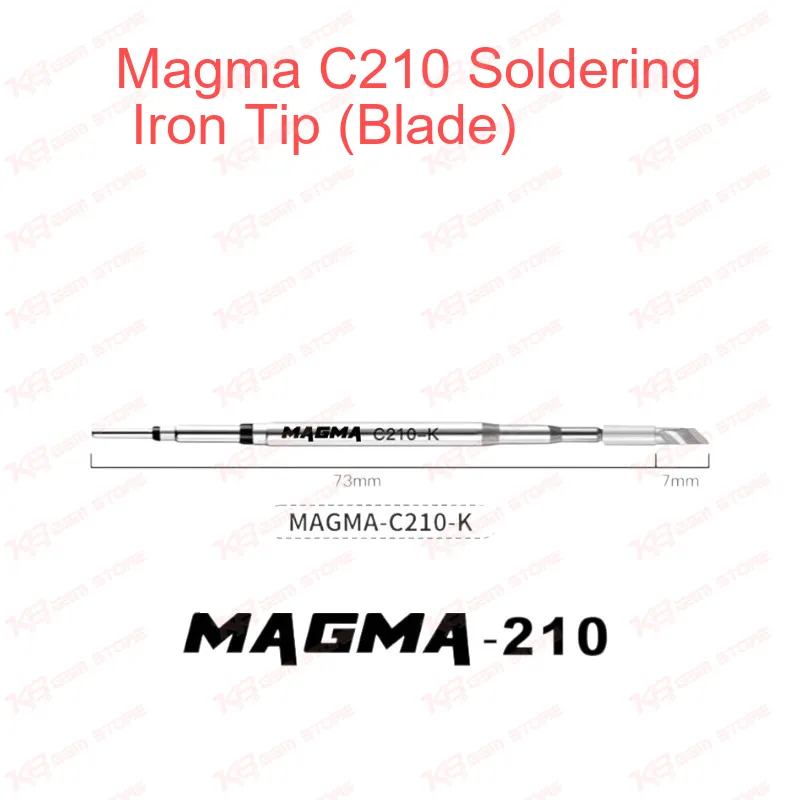
Every mobile repair bench eventually needs a tip that does more than just point-solder single legs, and that is exactly where the Magma C210 Blade earns its place in your tool drawer. This is a 210-series soldering cartridge, meaning the heating element and temperature sensor sit built into the tip itself rather than in a separate barrel, which is why it reaches working temperature within seconds of plugging into your T210 handpiece. On a workshop floor where you are moving between a dead phone board, a charging port repair, and an IC reball job back to back, that instant heat-up saves real time across a full day of bookings. The blade geometry is the actual reason technicians reach for this tip over a standard conical one. A flat blade edge gives you a wider contact surface against the board, so you can drag solder across a row of pins in one smooth motion instead of touching each leg individually. This makes it the tip of choice for reflowing connector pins, leveling solder on IC pads before reballing, and cleaning old flux and solder residue off a board after a chip removal. You get cleaner joints with less risk of bridging because the flat face distributes heat evenly rather than concentrating it at a single point. It also holds up well under repeated contact with lead-free solder, which matters if your shop has already shifted away from leaded alloys for warranty or supplier reasons. The compact cartridge design plugs directly into any handpiece built around the 210-series standard, so if your bench already runs a T210-type iron, this tip drops in without any adapter or modification. That plug-and-play compatibility is a big reason this tip series has become common across repair shops and service centers in Pakistan, where technicians often mix and match tips from different suppliers on the same handpiece to build a kit that covers every repair scenario. Inside the actual repair workflow, this blade tip sits at the PCB cleaning and rework stage rather than the diagnostic stage. Once you have identified a hardware fault, a charging issue, or a board that is dead after flash, this is the tip you bring in to physically fix the joint, not to test the fault. Technicians working on boot loop issues traced back to a loose IC connection use the flat edge to reflow the affected pins without lifting the chip. Others use it during board cleaning after an IC change, running the blade gently over the pad area to clear old solder before placing a new component. The nano-coated surface found on this tip format resists oxidation better than uncoated copper tips, which means the tip stays usable for longer stretches of daily soldering before you need a replacement. For a repair shop running multiple benches, that translates into fewer tip changes and less downtime waiting on new stock. Whether you run a solo repair counter or manage a full-service center handling volume repairs, this tip fills the gap between fine-point work and full desoldering, giving your bench the flexibility to handle SMD components, connector pins, and general board rework with one reliable cartridge.