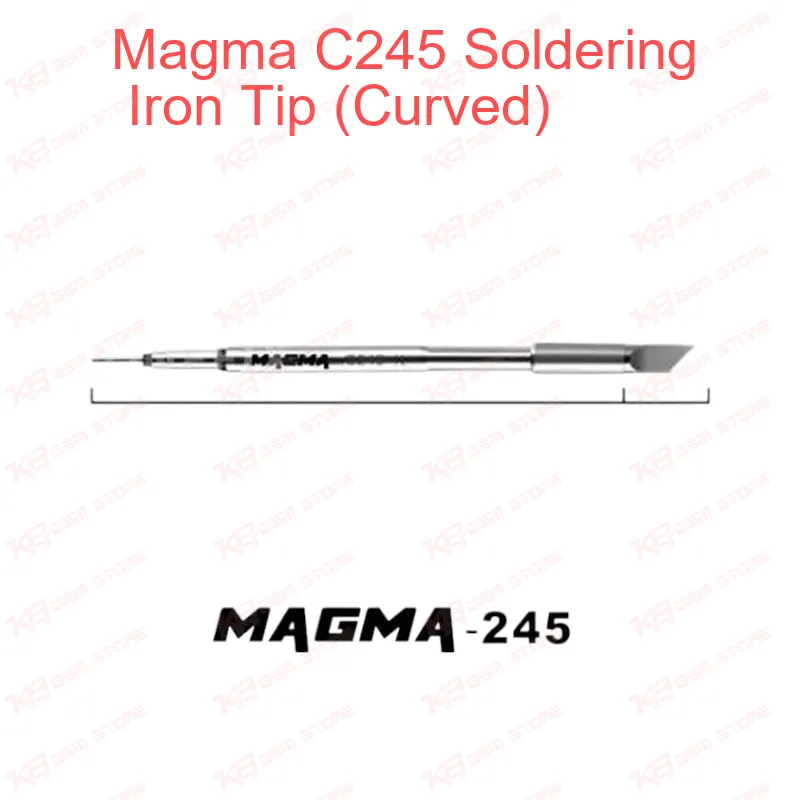
Every technician working on motherboard-level repair knows a tip shape can make or break a job, and the Magma C245 Curved Soldering Iron Tip exists to solve the angle problem that straight tips create on crowded boards. When you're desoldering a charging IC sitting flush against a shield can or reflowing a connector tucked under a camera module, a straight tip forces you to tilt the whole handpiece, which puts uneven heat on surrounding components and raises your risk of lifting pads. The curved geometry on this tip lets you keep the handpiece at a natural angle while still landing heat exactly where you need it, which matters most on dense modern mobile boards where clearance is tight. This tip fits JBC C245-series and T245 handpieces directly, and it also works with the wider ecosystem of C245-compatible stations technicians already run on their bench, including Quicko T245, KSGER T245, Sequre T245, and YIHUA 982 setups. That cross-compatibility matters in Pakistan's repair market, where shops often mix stations from different suppliers rather than sticking to one brand, so a tip that only fits one station type creates unnecessary downtime. Build quality centers on nickel-plated copper, a combination chosen because copper conducts heat fast while the plating slows down oxidation and tip erosion from repeated solder contact. That translates to faster recovery between joints and fewer tip changes during a full day of board work, which is the real cost driver on a busy bench. Board-level technicians reach for a curved tip specifically during IC change karna work, jumper lagana on tight traces, connector reflow, and cleanup around components after board cleaning, since the bent profile clears surrounding parts that a straight tip would bump into. It also helps during reballing prep, where you need to melt old solder off a chip pad without dragging heat across neighboring components, and during general hardware fault diagnosis where you're probing multiple small joints across a board in one session. The tip mounts using the same M5-style fitting common across the C245/T245 tip family, so swapping it onto your existing handpiece takes seconds and doesn't require any station reconfiguration. For shops handling dead phone cases, charging issue repairs, or display problem boards where flex connectors need reflow, having a curved tip ready alongside your straight and chisel tips rounds out a proper tip set instead of forcing every job through one shape. This isn't a tip you keep as a backup; it earns a permanent slot in your daily rotation once you start using it on connector and IC-adjacent work. Technicians who train on GSM repair courses and later run their own service centers usually build their tip collection around exactly this kind of shape variety, because board layouts on newer chipsets keep getting denser and straight-only tip kits stop being enough. Buying a dedicated curved tip instead of forcing a straight one into awkward positions also protects your station's heating element from the extra strain caused by constant repositioning and pressure. If your bench already runs a C245-compatible iron, this tip drops straight in and starts paying for itself on the first tight-clearance job you use it for.