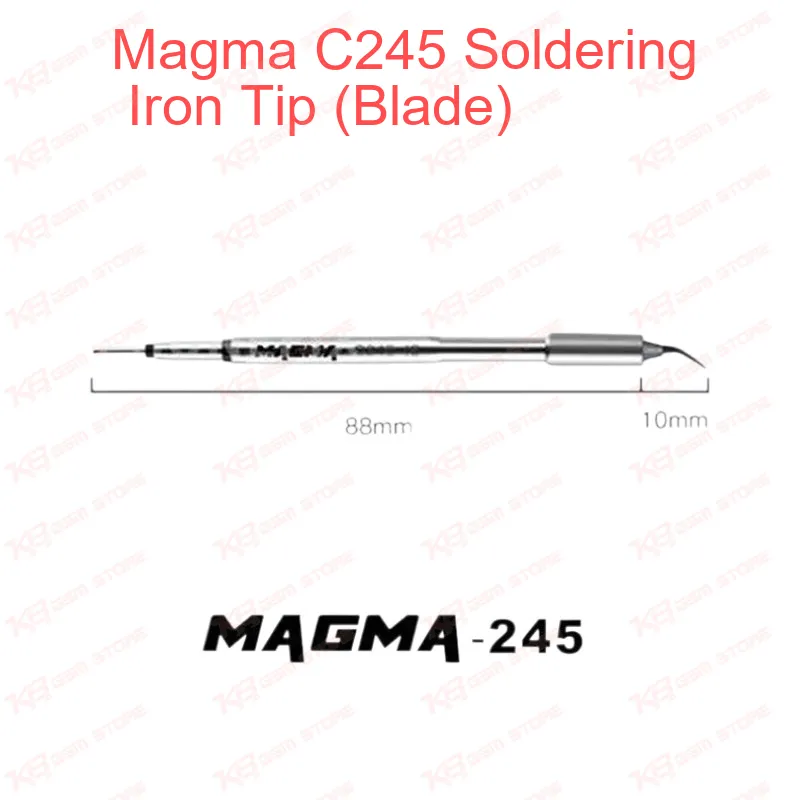
When you're working on a phone board with components packed close together, a straight soldering tip often forces you to tilt the whole iron at an awkward angle just to reach a pad, connector leg, or jumper point. The Magma C245 Curved Soldering Iron Tip solves that problem by building the angle into the tip itself. You slide it into your T245 handle, and the curve does the work of getting you into charging port corners, sub-boards, and stacked connector areas without twisting your wrist or blocking your own line of sight to the joint. This matters a lot on the repair bench where you're constantly moving between charging IC replacement, display flex soldering, and network IC jumper work on the same shift. The tip is built on the C245 platform, which is the same tip series used across a wide range of T245-style soldering iron handles and rework stations already common in Pakistani repair shops, so you get drop-in compatibility without hunting for a special adapter or a different handle. For a dead phone that needs a jumper lagana job on a corroded trace, the curved edge lets you drag solder along the trace path at an angle instead of stabbing straight down, which gives you cleaner joints with less risk of lifting a neighboring pad. On charging port repair, where the connector legs sit low and close to the board surface, the bent tip reaches under the connector housing edge in a way a straight conical tip struggles with. The same advantage carries over to board cleaning after IC removal, where you need to sweep old solder and flux residue off pads at an angle rather than pressing flat against the board. Technicians doing reballing prep also use curved tips like this to apply flux and touch up pad edges around a chip footprint before reflow, since the angle keeps the tip clear of the stencil or shield frame sitting nearby. Heat transfer on this tip follows the same principle as the rest of the C245 lineup: a solid metal core carries heat from the handle element straight to the working point, so you're not waiting around for the tip to catch up after touching a cold ground plane or a large copper pour, which is common on network IC and PMIC areas of modern phone boards. Because the tip mounts the same way as every other C245 profile, swapping between a straight tip for general soldering and this curved one for tight-access work takes seconds, so your workflow doesn't slow down mid-repair. Repair shop owners running multiple benches also find this useful because one T245 handle can serve several tip shapes depending on the job queued up, cutting down on how many separate iron setups you need to stock. Over time and repeated heat cycles, tip material matters for how long the plated surface holds up before it needs replacing, and the copper-based construction used in this tip series is chosen specifically because it balances heat conduction with wear resistance under daily rework shop use. For a workshop handling charging issues, display problems, hang on logo cases, and general hardware fault diagnosis back to back, having the right tip shape on hand reduces the number of times you have to force a repair with the wrong tool, which in turn cuts down on accidental pad lifts and repeat visits from the same customer.