


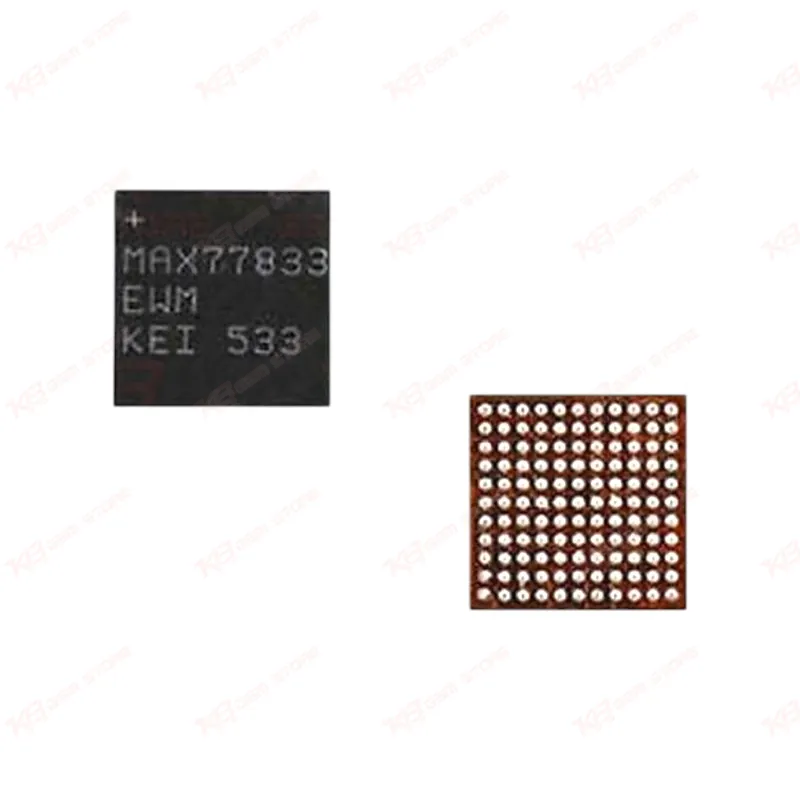
MAX77833 Power IC
MAX77833 Power IC
Regular price
Rs.250.00 PKR
Regular price
Sale price
Rs.250.00 PKR
Shipping calculated at checkout.
Quantity
Couldn't load pickup availability
The MAX77833 is a power control IC used in Samsung Galaxy S6, S6 Edge, S6 Edge Plus, Note 4, and Note 5 boards. It works alongside the main MAX77843 PMIC to manage secondary power rails on the motherboard. Technicians reach for this chip when a phone shows dead after flash symptoms, no power, boot loop, or charging issues traced back to the power management section. It's a fine-pitch BGA part, so it demands a steady hand, proper reballing, and hot air control during removal and placement. Stock this chip if your bench regularly handles Samsung S6-series and Note 4/5 power faults.
⚖️ Weight: 0.01 kg
SKU:MST-IC-78
- Safe & Secure Payment
- Fast Delivery
- WhatsApp Support


Description
FAQ
What is the product name?
The product name is MAX77833 Power Control IC.
What is the brand of this product?
The brand of this product is Maxim Integrated (OEM).
What is the model of this product?
The model of this product is MAX77833.
What is this product used for?
This product is used to repair power distribution faults on Samsung S6-series and Note 4/5 boards, including dead-after-flash, no-power, and boot loop issues.
Which devices are compatible with this product?
This product is compatible with Samsung Galaxy S6 (G920), Galaxy S6 Edge (G925), Galaxy S6 Edge Plus (G928F), Galaxy Note 4 (N910F), and Galaxy Note 5 (N920F).
Who should use this product?
This product is suitable for mobile repair technicians, repair shops, service centers, and professional BGA rework technicians.
Does the MAX77833 work independently or with another power IC?
It works alongside the MAX77843 main PMIC, handling secondary power rail regulation rather than acting as the board's primary power chip.
Is reballing required to install this IC?
Yes, the MAX77833 is a fine-pitch BGA chip that requires reballing with the correct ball size and controlled hot air reflow for proper installation.