


MAX77843 Power IC
MAX77843 Power IC
Regular price
Rs.350.00 PKR
Regular price
Sale price
Rs.350.00 PKR
Shipping calculated at checkout.
Quantity
Couldn't load pickup availability
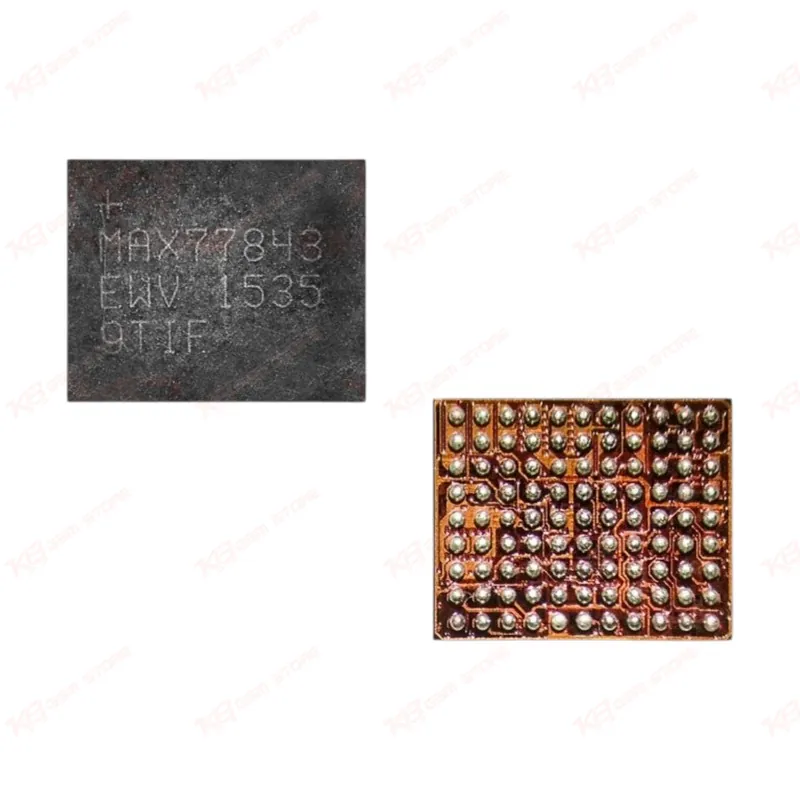
The MAX77843 is a Maxim Integrated power management IC (PMIC) built for Samsung Galaxy S6 and Galaxy Note 4 boards. It handles battery charging, fuel gauge readings, and USB/MUIC detection on a single chip. When a phone shows dead after flash, charging issue, or hang on logo linked to power rail failure, this IC replacement restores normal charging and boot behavior. Technicians use it for board-level power IC repair, reballing, and jumper-free replacement on Samsung PMIC circuits. Supplied as a genuine BGA package IC ready for direct SMD rework on your repair bench.
⚖️ Weight: 0.01 kg
SKU:MST-IC-72
- Safe & Secure Payment
- Fast Delivery
- WhatsApp Support


Description
FAQ
What is the product name?
The product name is MAX77843 Power IC.
What is the brand of this product?
The brand of this product is Maxim Integrated.
What is the model of this product?
The model of this product is MAX77843EWV+T.
What is this product used for?
This product is used for power management, battery charging, and fuel gauge functions on supported Samsung boards.
Which devices are compatible with this product?
This product is compatible with Samsung Galaxy S6, Galaxy S6 Edge, Galaxy S6 Duos, and Galaxy Note 4.
Who should use this product?
This product is suitable for mobile repair technicians, repair shops, service centers, and professional users.
Does this IC control fast charging on the Galaxy S6?
Yes, the MAX77843 runs the Smart Power Path charger circuit that manages fast charging and USB Charging Specification 1.2 detection on Galaxy S6 boards.
Can a faulty MAX77843 cause wrong battery percentage readings?
Yes, since this IC hosts the ModelGauge fuel gauge function, a faulty chip commonly causes incorrect battery percentage or sudden shutdown before 0%.