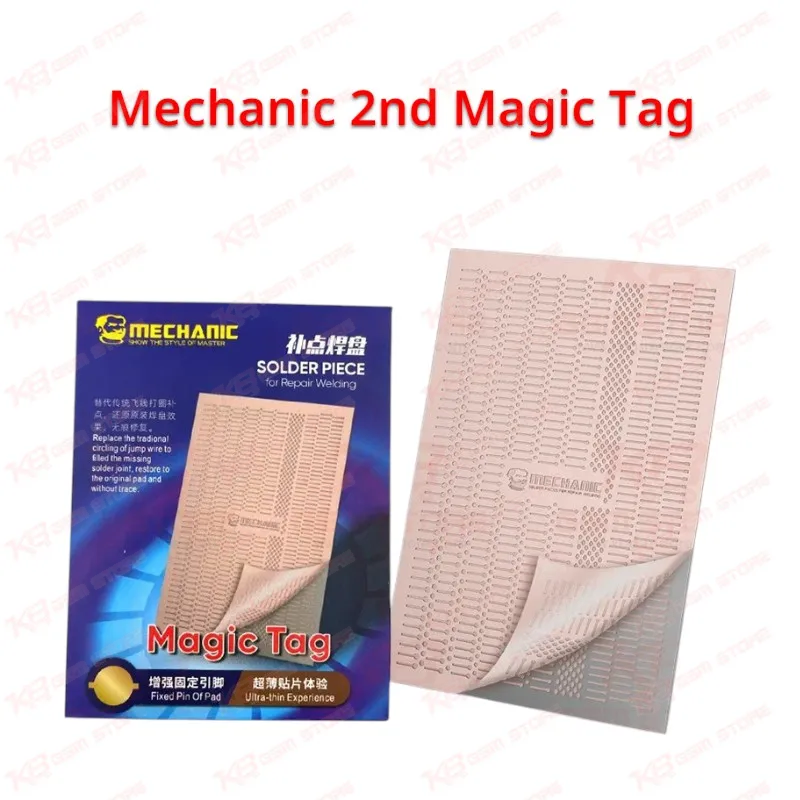
When a pad lifts off a motherboard during IC removal, reballing, or a rough reflow, the old-school fix was always the same — cut a thin copper wire, shape it, and solder it across the damaged spot as a jumper. It worked, but it left visible flying wires, took extra time, and often caused a false connection if the loop wasn't perfectly seated. The Mechanic 2nd Generation Magic Tag removes that whole process. You get a pre-cut, industrial-grade copper foil dot that sits directly on the missing pad and restores it to its original shape and position, so the board looks and functions like the pad was never damaged.The 2nd generation version improves on the original Magic Tag with a fixed-pin base. This pin anchors the pad into the board so it does not shift or lift while you're soldering nearby components or reinstalling the board into a test fixture. On the older style pads, technicians often had to hold the dot steady with tweezers through the whole reflow — that risk of movement caused pseudo soldering, which shows up later as an intermittent charging issue, a hang on logo, or a random hardware fault that's hard to trace back to the pad. The fixed pin solves that problem at the source.The copper foil itself is cut to 30 micrometers, thin enough to sit flush with the surrounding board surface without creating a raised bump that interferes with reballing or chip reinstallation. This flatness matters more than it sounds — any unevenness under a BGA chip becomes a weak joint that can cause boot loop issues or a dead-after-flash board once the phone is reassembled. Because the Magic Tag sits flat and reinforced, the BGA bonding surface keeps stable electrical performance and doesn't drop out under normal use.Another practical advantage is how the pad interacts with the green solder mask (UV curing ink) on the board. The fixed connection joint bonds tightly with this layer, so the repair holds even when the board goes through repeated heating cycles during future software marna sessions, IC changes, or additional rework on the same section. You're not fighting the pad lifting every time you touch the board with a hot air station again.For day-to-day bench work, this tool fits naturally into IC repair, CPU reballing, eMMC/UFS chip removal, and general PCB pad restoration. If a pad tears off while removing a stubborn IC, you don't need to break out jumper wire and start looping — you place the Magic Tag dot, tack it down with your soldering iron or hot air station, and move straight into reinstalling the chip. It works across single-layer and multi-layer motherboards, which covers the vast majority of smartphone boards technicians handle in a repair shop, whether it's a budget Android board or a more compact iPhone-style multilayer PCB.Because this is a small consumable-style tool rather than a powered device, there's no calibration or setup involved — the skill is entirely in placement and soldering technique. For technicians running a busy repair bench, keeping a stock of these pads on hand means fewer delays when a pad damage shows up mid-repair, and it keeps the repair looking clean enough that it won't raise questions if the customer or a senior technician inspects the board later.