Skip to product information
1 of 4
Brand: MECHANIC

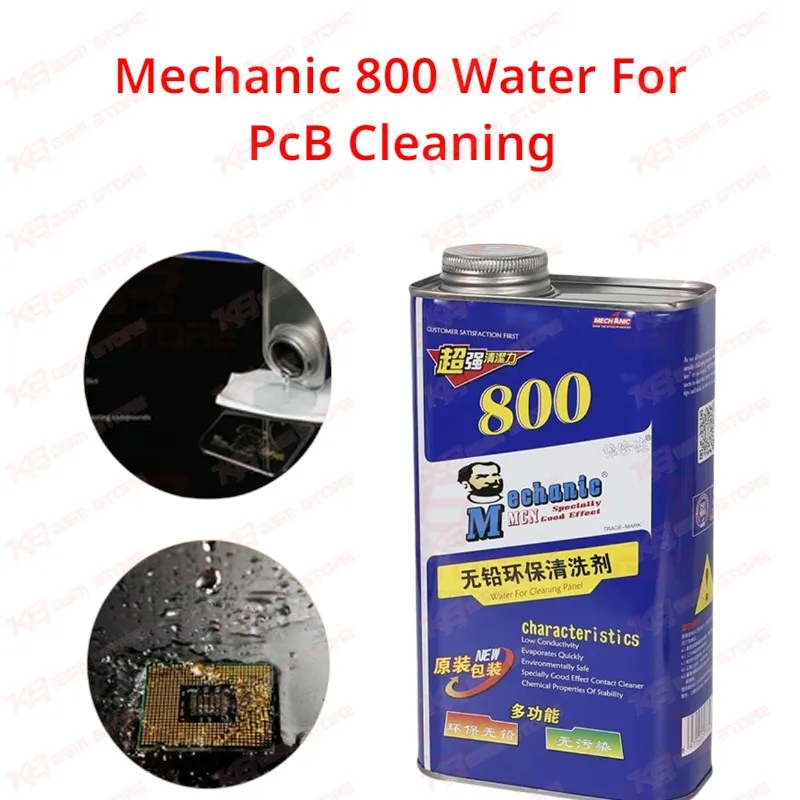
Mechanic 800 Water For PcB Cleaning

Mechanic 800 Water For PcB Cleaning

Regular price Rs.950.00 PKR
Regular price Sale price Rs.950.00 PKR
Sale Sold out
Shipping calculated at checkout.
Quantity

Mechanic 800 Water For PcB Cleaning is a lead-free circuit board cleaner that strips flux, rosin, solder residue, grease, and liquid-damage corrosion from mobile phone motherboards and other electronic PCBs. Its low-conductivity formula reduces the risk of stray shorts while you scrub around sensitive components, and it evaporates quickly, so your board is ready for microscope inspection in minutes. The 800g MCN-800 container suits daily use in busy repair shops that handle water damage sets, dead phones, and post-soldering cleanup. Keep it on the bench as a core consumable next to your flux, solder wire, and hot air station.

SKU:MST-SOLDERING-ACCESSORIES-813

⚖️ Weight: 0.8 kg

  • Safe & Secure Payment
  • Fast Delivery
  • WhatsApp Support
View full details

Description

Every water damage set that lands on your repair bench tells the same story once you open the back cover: green corrosion around the charging IC, white mineral crust under the PMIC shield, and sticky flux left behind by the last technician who touched the board. Mechanic 800 Water For PcB Cleaning gives you a lead-free circuit board cleaner built for this workshop reality, a liquid that lifts flux, rosin, solder residue, grease, and liquid-damage deposits from mobile motherboards without leaving a sticky film behind. Mechanic supplies it under the MCN-800 code in an 800g container, which gives a busy shop enough volume for regular board washing. The formula has low conductivity, so a stray drop running under a BGA chip or across a capacitor row does not create a new conduction path while you work, and it evaporates quickly, so you move from wash to inspection in minutes instead of waiting on a damp board. Fast drying matters most on a dead phone that came in after rain or a fall into a bucket, because moisture trapped under shielding cans keeps feeding corrosion long after the customer switched the handset off. A typical workflow starts once you remove the board and pull the shields: brush away loose particles first, pour a small amount into a pump-style dispenser bottle, then dip an anti-static brush and scrub the affected area in short strokes until the corrosion and flux break loose. If the board still shows white patches, sticky spots, or a dull haze after drying, the residue has not cleared, so run a second pass with a clean brush and fresh liquid. Once the board dries, put it under your microscope and check for eaten pads, lifted traces, and damaged filter components, because cleaning exposes the real fault the corrosion was hiding. From there the board moves to whatever the fault demands: a hot air station to lift a shorted IC, a soldering station for jumper work on a broken line, a reballing kit to refresh a CPU or eMMC, or a multimeter to trace a short on the main power rail. Software technicians keep this cleaner near their ISP pinout tools, eMMC programmers, and UFS adapters too, because ISP test points need to be spotless before you solder fine wires onto them, and a clean point gives a stable connection when you run the box for a read or a flash. After reflow jobs, a quick wash removes baked flux around the chip edges so you can inspect the joints properly and avoid leftover residue that can later show up as a phone that hangs on logo, a charging issue, or an intermittent network issue. Keep a PCB holder on the bench so the board stays steady while you scrub, and wipe the contacts on your test boxes and fixtures when they start giving unreliable readings. The cleaner handles broad electronics work, so the same bottle covers mobile phone motherboards, computer boards, TV logic boards, automotive modules, and general electronic circuit boards across your shop. Its stable chemical properties keep the cleaning behavior consistent from the first pour to the last, and its lead-free, environmentally friendly profile fits the standard most service centers now follow. For shop owners in Lahore, Karachi, Islamabad, Multan, or any city where water damage phones arrive daily during monsoon season, a reliable board wash liquid belongs alongside flux and solder wire as a basic consumable rather than an occasional purchase. Always disconnect the battery before cleaning, let the board dry completely before you reconnect power, and work in a ventilated area during long repair sessions. If you want dependable PCB cleaning water that fits straight into board-level repair, water damage recovery, and post-soldering cleanup at a practical price in Pakistan, Mechanic 800 earns a permanent place on your bench.

Key Features

  • Lead-free, environmentally friendly cleaning formula suited to modern repair standards
  • Low conductivity reduces short-circuit risk when liquid runs under chips and components
  • Fast evaporation takes the board from wash to inspection in minutes
  • Strong contact cleaner action for connectors, pads, and test points
  • Removes flux, rosin, and solder residue after soldering and hot air reflow work
  • Clears corrosion, oxidation, and mineral deposits from liquid-damaged motherboards
  • Stable chemical properties deliver consistent cleaning results throughout the bottle
  • 800g container sized for regular daily use in repair shops and service centers

Specifications

Brand Entity Mechanic
Product Entity Mechanic 800 (MCN-800) PCB Cleaning Water
Technology Entity Lead-free, low-conductivity, fast-evaporating circuit board cleaning formula
Compatible Device Entities Mobile phone motherboards, computer boards, TV logic boards, automotive electronic modules, general PCBs
Repair Process Entity Water damage board cleaning, flux removal, post-reflow cleanup, ISP point preparation
Industry Entity Mobile phone repair, PCB repair, electronics maintenance

Compatible Devices

  • Universal — not device-specific; works on any printed circuit board
  • Mobile phone motherboards, brand-independent (Samsung, Oppo, Vivo, Infinix, Tecno, iPhone boards included)
  • Computer boards and panels
  • TV logic boards
  • Automotive electronic modules
  • General electronic circuit boards

Common Repair Uses

  • Cleaning corrosion and mineral deposits from water damage motherboards
  • Removing flux and rosin residue after soldering and hot air reflow
  • Post-reballing cleanup around CPU, eMMC, and UFS chip areas
  • Preparing ISP test points and pads before wiring for flashing work
  • Stripping grease, dirt, fingerprint marks, and metal dust from boards
  • Cleaning connectors, contacts, and test fixture pins

FAQ

What is the product name?
The product name is Mechanic 800 Water For PcB Cleaning.
What is the brand of this product?
The brand of this product is Mechanic.
What is the model of this product?
The model of this product is MCN-800.
What is this product used for?
This product is used for cleaning flux, rosin, solder residue, grease, and water damage corrosion from mobile phone motherboards and other electronic circuit boards.
Which devices are compatible with this product?
This product is compatible with mobile phone motherboards of any brand, computer boards, TV logic boards, automotive modules, and general electronic PCBs.
Who should use this product?
This product is suitable for mobile repair technicians, repair shops, service centers, and professional users.
Can Mechanic 800 clean a water damaged phone motherboard?
Yes. It removes corrosion, oxidation, and mineral deposits from liquid-exposed boards. Remove the shields, scrub with a brush dipped in the liquid, and repeat the wash if white patches or sticky spots remain after drying.
Will Mechanic 800 cause a short if it runs under a BGA chip?
The formula has low conductivity and evaporates quickly, which reduces short risk during cleaning. Always disconnect the battery and let the board dry completely before you power it on.
What is the difference between Mechanic 800 and Mechanic 850 cleaning water?
Mechanic 800 targets PCB and motherboard cleaning. Mechanic 850 Pro adds a formula aimed at removing OCA/LOCA glue from LCD and touch screen assemblies alongside board cleaning.