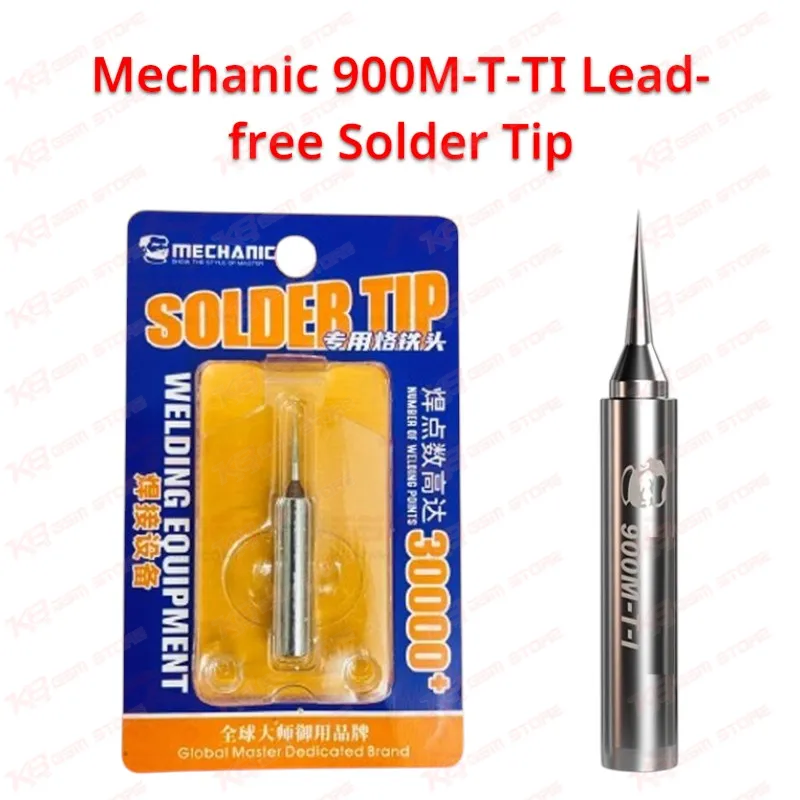
When you're doing flying wire repair on an iPhone or Android motherboard, the tip you use decides whether the joint holds or lifts off on the next touch. The Mechanic 900M-T-TI solves this with a 0.2mm superfine straight profile, built specifically for the kind of micro-soldering where a normal tip simply can't reach the pad without bridging the next track over. You get a tip fine enough to land a single strand of jumper wire on a BGA pad, then move to the next point without disturbing what you just soldered.The tip body is made from oxygen-free copper, which matters more than most technicians realize when they're comparing solder tips. Oxygen-free copper conducts heat faster and more evenly than standard copper, so your tip reaches working temperature quickly after you touch it to a cold board, and it recovers heat fast between joints. On a busy repair bench where you're jumping between five or six boards a day, that recovery speed is what keeps your workflow moving instead of waiting on the iron to catch up.Weighing around 50 grams, the 900M-T-TI is light enough that it doesn't tire your hand during long sessions of fine work, which is exactly when hand fatigue starts causing shaky joints and cold solder. The straight, vertical tip design lets you approach a pad from a consistent angle every time, which builds muscle memory faster than a curved or angled tip would. This matters directly if you do a lot of hang on logo or dead after flash boards where the fault traces back to a lifted trace or broken continuity that only flying wire can fix.Compatibility is where this tip earns its place across different brands of soldering stations. It's built to the 900M-T series standard, so it drops straight into heater blocks used by Hakko, Quick, ATTEN, TENMA, Aoyue, and Yihua stations without any adapter. If your shop runs a mixed set of soldering irons across different benches, this tip gives you one part number you can stock instead of chasing brand-specific tips for every station.Being lead-free, the tip meets the environmental compliance most workshops now expect, without giving up tinning performance. Lead-free tips sometimes get a reputation for being harder to tin cleanly, but the oxygen-free copper core and fine geometry on this one let solder wet the tip surface evenly, so you're not fighting a dry tip mid-repair. Proper tinning before storage and light cleaning between joints keeps the point sharp through repeated use, and the copper core resists the kind of pitting that dulls cheaper tips after a few weeks of daily work.In terms of where this fits your repair workflow, the 900M-T-TI belongs at the fine end of your soldering process, after board-level diagnostics have identified a broken trace, lifted pad, or open circuit that needs a physical jumper wire fix rather than a software or IC-level solution. It's the tool you reach for once a multimeter or boardview has pointed you to the exact pad, and you need to lay a hair-thin wire across a gap without cooking neighboring components. For technicians doing fingerprint sensor repair, charging port trace fixes, or backlight circuit jumpers on tightly packed phone boards, this level of tip precision is what separates a clean repair from a rework job you'll be redoing next week.Stock this tip alongside your existing 900M-T-series accessories, and keep a spare on hand — fine tips like this see heavier wear per hour of use than general-purpose tips, simply because of how often the point makes contact during flying wire work.