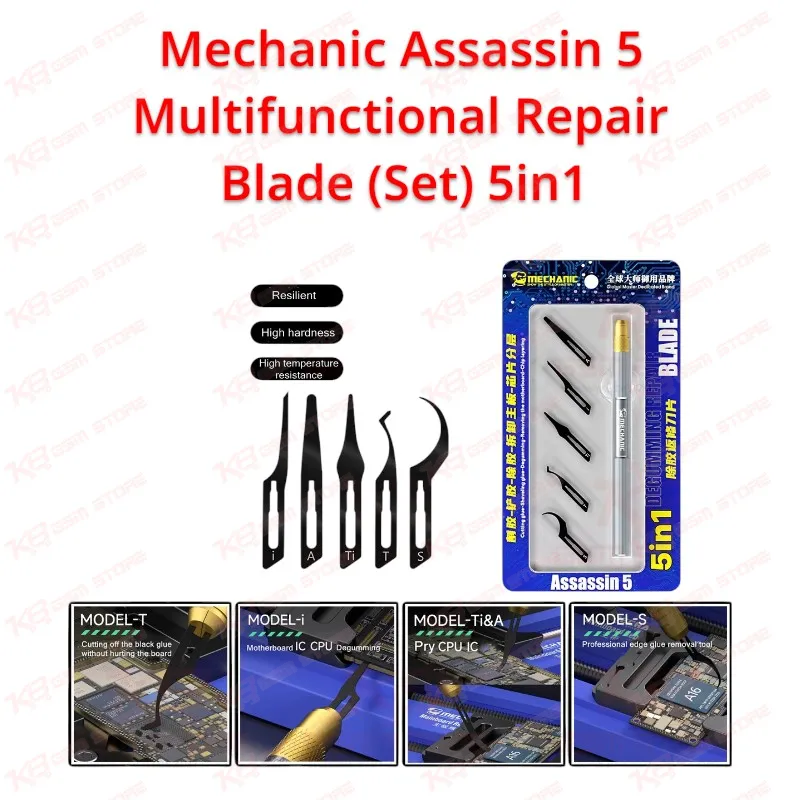
Every technician knows the moment: a dead phone lands on your bench, the diagnosis points to a faulty CPU, eMMC, or PMIC, and a thick layer of black underfill glue stands between you and the IC change. The Mechanic Assassin 5 Multifunctional Repair Blade (Set) 5in1 exists for exactly that moment. Mechanic packs five dedicated rework blades and one handle into this set, and each blade handles a specific stage of the degumming and chip lifting workflow, so you stop forcing one generic scalpel to do five different jobs. The set includes the Ti and A blades for prying CPUs, ICs, and storage chips; the i blade for cleaning glue from motherboard ICs and CPUs; the S blade for edge glue removal; and the T blade for cutting through black glue without damaging the board. Mechanic hand-polishes each blade to achieve layered hardness and lasting edge retention, and the 301 stainless steel body stays thin yet tough, so the edge flexes under pressure instead of snapping when you work under a CPU corner. A vacuum-plated surface resists corrosion and high-temperature wear, which matters when your blade sits next to a hot air nozzle for most of the day and touches flux, IPA, and heated glue on every job. Think about how a typical board-level job runs in a Pakistani repair shop. A customer brings a phone stuck on a hang on logo or boot loop issue after a failed flash, software solutions run out, and the fault traces back to the storage chip. You clamp the board in a PCB holder, set your hot air station to soften the underfill, and start with the S blade to clear the glue line along the chip edge. Next, the T blade cuts the black glue around the package without lifting nearby capacitors or scratching the solder mask. Once the glue gives way, the Ti or A blade slides under the chip and lifts the CPU, IC, or storage chip with controlled leverage instead of brute force, which protects the pads underneath. After removal, the i blade cleans leftover glue from the motherboard and the chip surface so your reballing kit and soldering station can do their job on a clean, flat pad area. That sequence covers the core of CPU repair, eMMC and UFS chip replacement, and PMIC or charging IC change work, the jobs that bring in the real money for hardware technicians in Lahore, Karachi, Islamabad, and every city in between. This set also fits naturally into the rest of your bench. Technicians who reprogram storage chips with eMMC programmers or UFS adapters need a clean chip lift first, and a damaged pad from a rough pry turns a simple job into a jumper wire repair. Pair the blades with a microscope so you can see the glue line clearly, and keep a multimeter and test box ready to confirm the fix after the new chip goes down. When ISP pinout tools fail to read a storage chip on a dead phone, chip-off becomes the next option, and that path starts with clean degumming. Shop owners who train juniors will appreciate the clear role of each blade, because a new technician learns faster when each tool has one job instead of guessing which edge to use. The handle gives you steady grip control for fine scraping strokes under the microscope, and the blades swap in quickly when you move from cutting to prying to cleaning. Because the set works on underfill and glue rather than on any specific phone model, you can use it on iPhone and Android motherboards alike whenever a hardware fault calls for chip removal. Blade technique still matters: let the hot air soften the glue first, use light passes instead of digging, and choose the blade shape that matches the area you are working on. Order the Mechanic Assassin 5 at the best price in Pakistan from KB GSM Store and give your board-level repair bench a dedicated degumming toolkit that handles glue removal, chip lifting, and pad cleaning with the control that professional hardware repair demands.