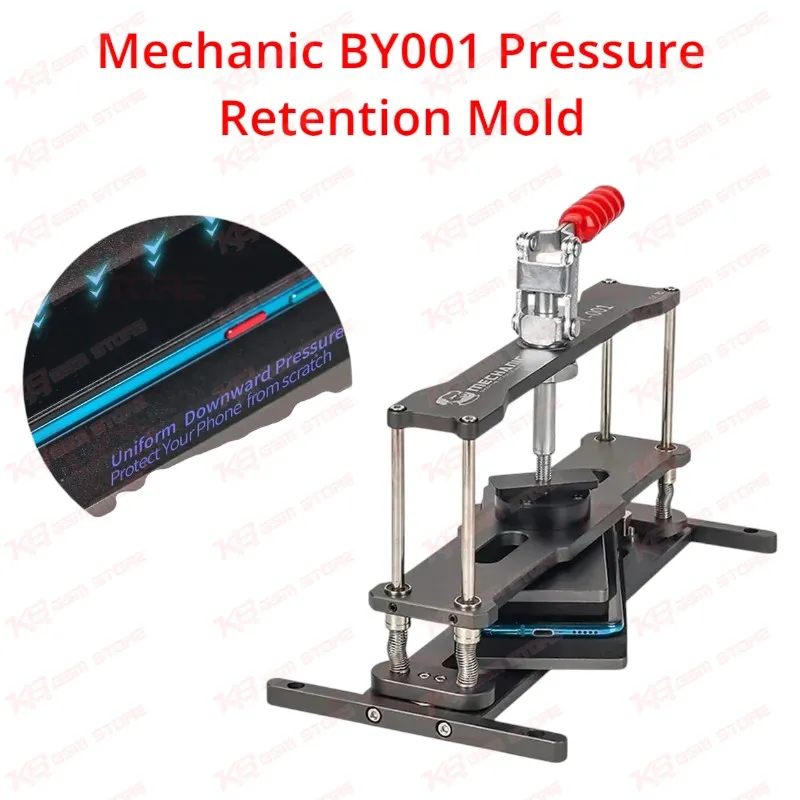
Every screen replacement ends the same way: you lay the adhesive, seat the new panel, and then the phone needs firm, even pressure while the glue cures, and that final stage decides whether the customer walks back in a week later with a lifted display, dust under the edge, or a back glass that pops open in a hot pocket. The Mechanic BY001 Pressure Retention Mold handles exactly that stage of the mobile phone repair workflow. Mechanic built this fixture around a curved-surface rotary pressure plate that turns through 360° with no end stop, so you can rotate the clamped handset and inspect every edge of a curved display or rounded back cover without releasing pressure or lifting the phone off the base. That matters most on curved-edge panels, where a flat press plate touches the center and leaves the sides floating. The frame uses high-strength steel with a tight mechanical fit between parts, so the mold does not wobble or creep across the bench while the adhesive sets, and the metal construction keeps the phone exactly where you placed it. Beneath the pressure plate, a metal retaining spring supports the plate and delivers consistent rebound, and the manufacturer rates this spring for 50,000 pressing cycles, which translates into long daily service for a counter that closes up ten or twenty handsets a day. Where the plate meets the glass, an anti-wear sponge pad conforms to the panel so force spreads across the whole surface instead of concentrating on one point, and a silicone pad protects the screen from scratches and pressure marks. For a technician, uniform force means the adhesive line spreads to an even thickness, the display sits flush with the frame, and you avoid the uneven gap that later lets moisture and dust in. The BY001 covers both jobs that follow a housing or display repair: gluing the main screen back into the frame and gluing a replacement back cover onto the chassis. Pakistani repair shops handle a steady flow of cracked back glass and display problem cases on mid-range and flagship phones, and a proper pressure retention stage separates a clean, factory-looking finish from a job that looks improvised. The stainless steel rail and removable chassis make setup quick: you set the phone on top of the base, slide it into position, and keep a clear view of the device throughout, so you can confirm alignment of the camera cutout, earpiece slot, and edges before and during the press, then remove the chassis whenever you need to clean off stray glue. Think about where this tool sits in your bench layout. A typical display or back glass job starts with one of your Hot Air Stations softening the old adhesive, moves to cleaning under one of your Microscopes to clear old glue and debris from the frame, and then goes to new adhesive and panel fitting. The BY001 takes over at the final curing stage, freeing your hands and your other equipment for the next job instead of leaving a technician holding a phone together with clips and rubber bands. It also finishes jobs that start deeper in the board: when a dead phone comes back to life after IC replacement at your Soldering Stations with the board clamped in PCB Holders, after chip work with Reballing Kits, or after data recovery through ISP Pinout Tools, eMMC Programmers, or UFS Adapters, the housing still has to close up cleanly. Confirm the fix with your Test Boxes and Multimeters before you glue, because once the BY001 has set the back cover, reopening means another round of heat and fresh adhesive. This mold suits anyone who replaces displays, reseals phones after water damage cleaning, or replaces back glass as a regular service, from single-counter shops in local mobile markets to busy service centers and training institutes that teach screen replacement, and a new trainee picks up proper pressure holding technique quickly because the workflow stays simple: place, press, rotate, check. The universal format means you do not need a separate fixture for every model, since the mold works with the back covers and screens of multiple mobile phones and handles the mixed traffic of brands that crosses a Pakistani repair counter daily. Compared with clips, binder clamps, or stacks of books, the difference shows in consistency: the spring delivers the same force every cycle, the pads protect the glass, and the steel body keeps everything square. If your shop keeps dealing with lifted displays, back glass that separates after a few weeks, or edge screens that refuse to sit flush, the Mechanic BY001 Pressure Retention Mold gives you a dedicated, repeatable finishing step that raises the quality of every screen and back cover job you close.