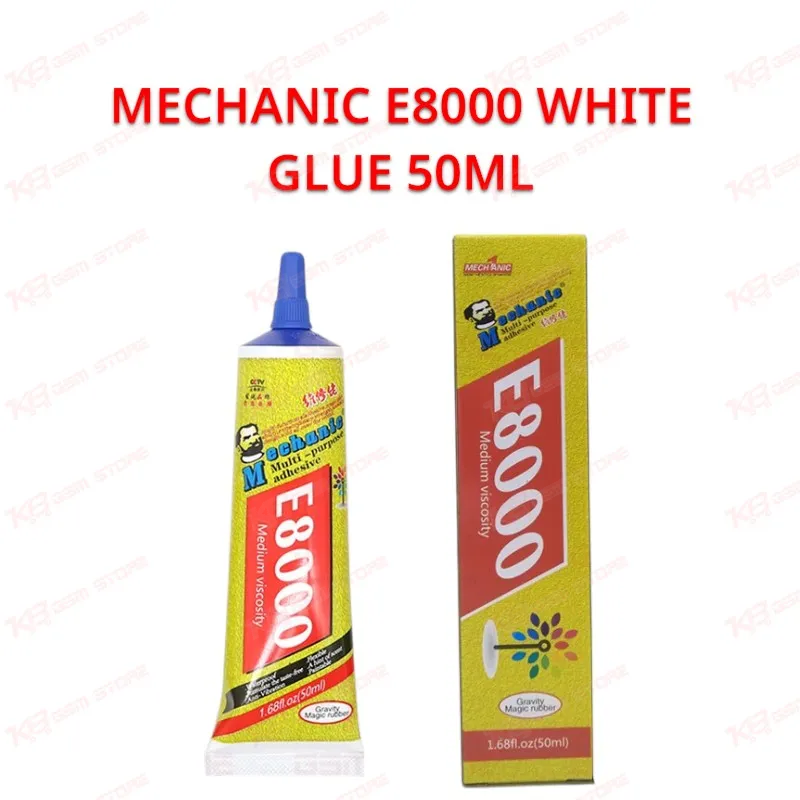
A repair bench sees plenty of jobs where soldering or flashing tools have no role, and bonding parts back together correctly still decides whether a repair holds up. MECHANIC E8000 fills that gap as a single-component adhesive that cures at room temperature once you open the bottle, so you skip mixing ratios or activator steps and apply it directly to the surface. The glue carries a solid content of 28% to 35%, which gives it enough body to stay in place on vertical or angled surfaces instead of running off before you position the part. Surface drying happens in 3 to 6 minutes, and that window matters on a busy bench because it gives you time to seat a back cover, camera lens, or frame piece accurately before the bond starts to grab. Full curing takes 24 to 48 hours, after which the bond reaches its rated hardness of roughly 65 to 85A on the shore scale, putting it in a flexible but firm range that absorbs minor shocks instead of cracking under stress. You get a bond that works across dissimilar materials without extra prep — plastic to plastic, plastic to metal, and even PP or PE plastic types that normally resist adhesion without surface treatment. That range covers most of what a phone chassis is built from, including polycarbonate frames, aluminum mid-frames, glass back panels, and acrylic lens covers. On acrylic specifically, E8000 avoids the corrosion and clouding you get from stronger solvent-based glues, so lens surfaces and clear panels stay optically clean after bonding instead of turning hazy at the joint. Store the bottle between 10°C and 28°C to keep the viscosity consistent; a bottle left in direct heat thickens faster and gets harder to control through the precision tip. Cap it right after each use, since an open nozzle left exposed to air starts curing inside the tip and blocks the next application. For workshop use, E8000 covers a wide set of repair scenarios beyond screens: sensor flex fixing, speaker mesh reattachment, SIM tray component repair, camera module lens seating, back glass reattachment after a cracked panel replacement, and general frame-to-body bonding where screws aren't practical. Technicians dealing with a loose back panel after a battery swap, a display problem where the lens has separated from the frame, or a hardware fault involving a cracked camera cover reach for this type of glue instead of tape, since tape doesn't hold up to daily handling the way a cured adhesive bond does. The cured layer resists water exposure after full curing, which matters for back cover and frame seams that face daily contact with moisture, sweat, and cleaning wipes. Because the bond stays flexible rather than turning brittle, it also tolerates the flexing a phone chassis goes through during drops or pocket pressure, instead of cracking at the seam the way a rigid cyanoacrylate glue would. On a repair bench working through multiple jobs a day, the 50ml bottle and precision tip design let you dispense small, controlled drops instead of flooding the joint, which keeps excess glue off flex cables and connectors nearby. That control matters most on tight board-level work where a stray drop can land on a connector pin or FPC contact and cause problems later. MECHANIC E8000 fits naturally alongside T7000 and B7000 in a technician's glue lineup, with E8000 taking the role of general bonding work where flexibility and clarity matter more than maximum bond strength.