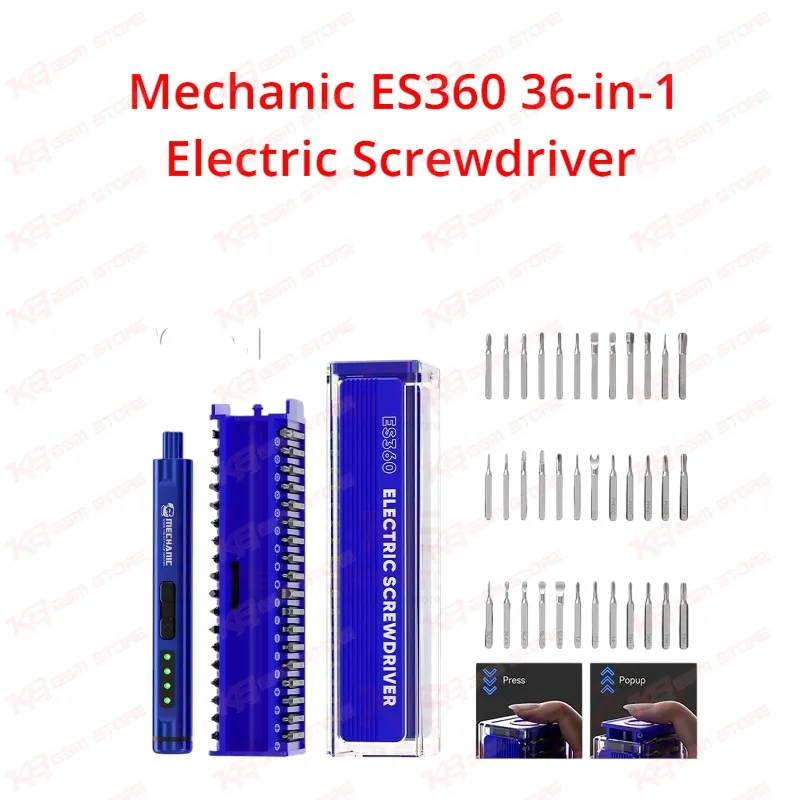
Every repair job on your bench starts and ends with screws, and the Mechanic ES360 36-in-1 Electric Screwdriver turns that repetitive opening and closing work into a fast, controlled routine. A technician handling ten or fifteen phones a day in a busy Pakistani repair shop spends a large share of working hours removing bottom screws, shield plate screws, battery bracket screws, and display connector covers, and a manual driver alone slows that rhythm while straining your wrist. The ES360 combines a motorized driver and a manual handle in one compact body, so you switch between powered speed and hand-controlled feel without picking up a second tool. In electric mode the driver delivers 0.3 N.m of torque, a deliberately low output that spins out tiny screws quickly while staying gentle on the delicate threaded standoffs inside modern smartphones. When a screw refuses to move because of thread locker, corrosion from water damage, or a previous technician over-tightening it, you turn the driver by hand and apply up to 3.5 N.m of manual torque to break it free. That dual-torque design matters on real jobs: the low motor torque protects the phone during reassembly, and the high manual torque rescues you from stubborn fasteners during disassembly. Forward and reverse rotation switch instantly, so you remove a screw, place the part, and drive the screw back in with the same grip and no wasted motion. The kit ships with 36 precision bits cut from S2 steel, a hard, wear-resistant tool steel grade widely used for precision bits, and an anti-rust surface treatment keeps them clean in humid workshop conditions. The bit selection covers the fasteners you actually meet on the bench: Phillips PH000, PH00, PH0, and PH1 for Android phones from Samsung, Oppo, Vivo, Infinix, Tecno, and Xiaomi; pentalobe 0.8, 1.2, and 1.5 for iPhone bottom screws and Apple laptops; tri-point Y0.6, Y2.0, and Y2.5 for iPhone internal brackets and consumer electronics; Torx T2, T3, and T4 plus security Torx T5H through T20H for laptops, hard drives, and tablets; hex H0.9 to H2.5; slotted SL1.0 to SL4.0; square S0 and S1; U2.5 and U2.6; a triangle 2.0 bit; a 2.5 centre plate bit; and a 0.8 through-pin bit. With that range in one box, you open a dead phone, a tablet with a charging issue, or a laptop with a display problem without searching through drawers for the right tip. The storage case uses a push-to-open sliding cover that keeps the bits sealed when closed, and each slot carries a printed size marking so you grab the correct bit on the first try. Magnetic holding in the case keeps each bit seated in its slot, which stops bits from spilling across your work mat when you carry the kit between benches. The ES360 belongs to the disassembly stage of the mobile repair workflow, the step before diagnosis and board-level work. Once you open the phone and lift the motherboard, you move on to Multimeters for short and voltage checks, Microscopes for inspecting damaged traces, PCB Holders to lock the board steady, Hot Air Stations and Soldering Stations for IC removal and replacement, and Reballing Kits for BGA chip work. Software-side jobs follow the same path: a phone stuck in boot loop, hang on logo, dead after flash, or an FRP lock that needs a test point still requires you to open the device and expose the board before connecting ISP Pinout Tools, eMMC Programmers, UFS Adapters, or Test Boxes, and a fast electric driver shortens that preparation time on every job. Shop owners who train junior technicians benefit too, because the low electric torque reduces the chance of a trainee stripping a screw head or cracking a frame during reassembly. For a service center handling volume, the seconds you save on each device add up to more completed repairs per day, which makes the Mechanic ES360 a practical upgrade from a basic manual screwdriver set and a dependable companion for any professional repair bench.