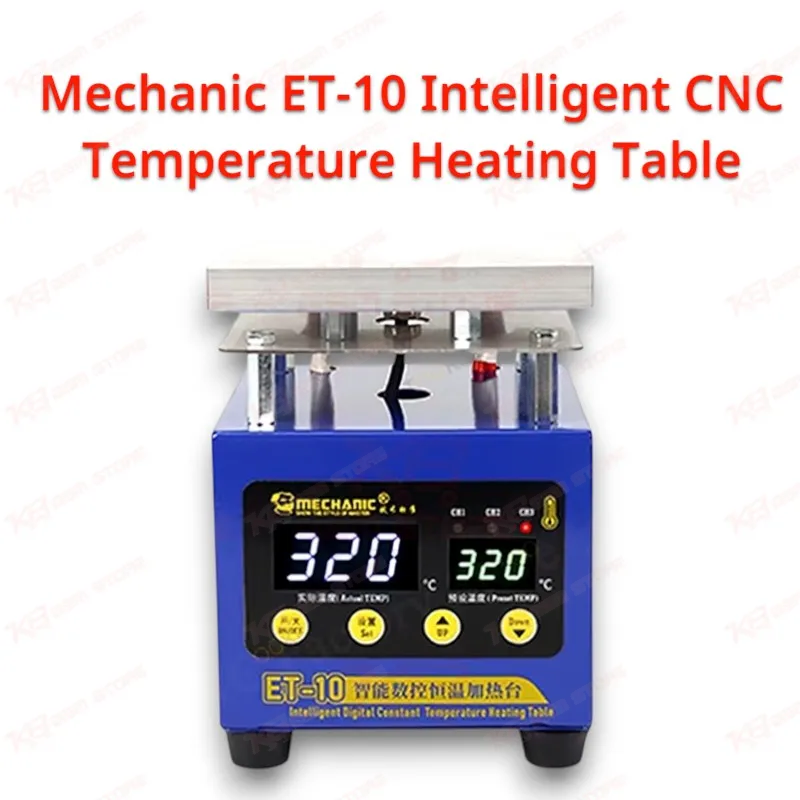
Every Pakistani repair bench eventually runs into the same problems: a cracked OLED glued to a middle frame, a board that will not release its PMIC, or a back glass that snaps the moment you push a pick under it. The Mechanic ET-10 Intelligent CNC Temperature Heating Table is built for exactly those jobs on a busy workshop counter. A hot air nozzle heats one corner of a board while the rest stays cold. This heating table instead brings the whole workpiece up to a controlled temperature from below, so the adhesive softens evenly and the solder under large components gets close to melting point before you pick up your hot air handle. The working surface measures 100 × 100 mm and the heating plate uses aviation-grade aluminum. That metal spreads heat across the plate quickly and loses it fast once you switch the unit off, which matters when you go from screen separation to a delicate IC job on the same bench within minutes. The 260W heater covers 20°C to 320°C, giving you low temperatures for softening glue and enough headroom at the top for serious board preheating. A double digital display lets you set your target temperature and watch the plate climb toward it, and the protected edges reduce the chance of burning your wrist when you lean over the plate during a long session. Think about how this fits into your daily workflow. A customer walks in with a dead phone after a drop, the display shows nothing, and you suspect a fault around the power section. You open the device, clean the board, check the rails with your multimeter, and find a shorted capacitor or a PMIC that needs an IC change. Without a preheater, most technicians in Lahore, Karachi, or Islamabad blast the area with high-airflow hot air and hope the neighboring components stay in place. With the board resting on the heating table at a moderate preheat, your hot air station only needs to supply the final push. You work with lower air temperature and shorter exposure, and you run far less risk of lifting pads, blowing away tiny resistors, or delaminating the PCB. The same principle applies to CPU and memory work. Say a board comes in with a boot loop issue or hangs on logo, and you trace it to a cracked joint under the eMMC or UFS chip. Preheating from below lets the whole BGA area heat evenly before reflow or removal, and that even heat is the foundation of every reliable reballing job. Pair it with a quality reballing kit and a good stencil set, and your success rate on chip-level repairs goes up noticeably. Most shops will use this table for screen and frame work every single day. Samsung, Oppo, Vivo, Infinix, and Tecno handsets hold their displays with strong adhesive, and forcing a pick or wire under cold glue is the fastest way to crack an expensive panel. Set the ET-10 to a moderate temperature and rest the phone face-down, or the frame section you want to release, on the plate. Give the glue time to soften, then work your separation wire or opening tools around the edge with steady, controlled pressure. The 100 × 100 mm plate heats one area rather than the full length of a phone, so you rotate the device and treat one zone at a time, which gives you finer control over where the adhesive lets go. Middle frame removal, back glass work, LCD backlight LED bead soldering, general circuit board repair, and preheating special materials all fall within this heating table's everyday job list. Charging port replacement on boards with heavy ground planes is another job where the table pays for itself quickly. Large copper areas pull heat away from your soldering iron tip, so the joint never flows properly and you end up overheating the connector plastic. Preheat the board, and your soldering station handles the job at a normal tip temperature, leaving a clean joint and an undamaged port housing. The same benefit applies to charging IC, audio IC, and network IC replacements: a board with a charging issue or a network issue sits on the plate while you work the chip with hot air and flux. Practical bench advice matters here because every heating table behaves a little differently. Give the plate a few minutes to settle after it reaches your set temperature. If your work demands tight thermal accuracy, check the actual surface reading with a thermocouple probe on your multimeter before you place a board down. This habit protects sensitive components and teaches you how your specific unit behaves across its range. Start low, increase in small steps, and never leave a board on high heat longer than the job requires, because batteries, plastic connectors, and camera modules do not tolerate prolonged heat. Always remove the battery and any heat-sensitive parts before you preheat a logic board. For shop owners building a complete repair setup, the ET-10 sits naturally alongside the rest of your rework and diagnostic gear. Your hot air station and soldering station handle precise localized heating, and a microscope lets you inspect joints after the board cools. PCB holders keep smaller boards steady during component work, and a reballing kit completes the BGA workflow. Boards that came in dead after flash often need more than hardware work once the fault is sorted. Technicians move on to ISP pinout tools, eMMC programmers, UFS adapters, and test boxes, because a board that powers up after a hardware repair frequently still needs software work, an FRP lock removal, or a firmware rewrite before it goes back to the customer. Treat the heating table as the first step in a chain that runs from physical repair to final testing. In the Pakistani repair market, buying decisions usually come down to whether a tool earns its bench space. A compact preheater earns it through the number of daily jobs it touches: screen separation, frame work, board preheating, connector replacement, and BGA preparation. The small footprint fits even a crowded counter in a mobile market shop, and the 220V version runs on standard Pakistani mains power. The controls are simple enough for a junior technician to learn in a single afternoon. You might run a single-counter repair shop, a busy service center, or a training institute teaching new technicians to handle board-level faults safely. In each case, the Mechanic ET-10 Intelligent CNC Temperature Heating Table gives your team a controlled, repeatable heat source that cuts down on damaged screens, lifted pads, and repeat repairs, and that reliability is what keeps customers coming back to your shop.