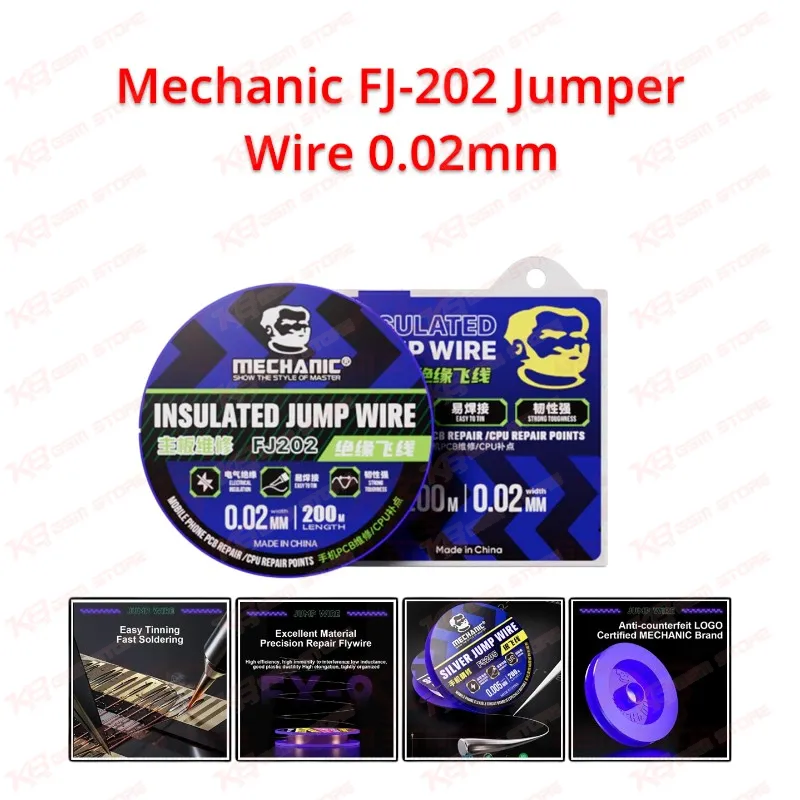
Mechanic FJ-202 Jumper Wire 0.02mm gives you a precision flying wire for the jobs where a normal jumper wire is simply too thick to work. When a motherboard pad lifts during rework, when a screw hole tears a trace, or when a fingerprint FFC stops reading after a drop, you need a conductor fine enough to bridge the gap without bridging into the pad next to it. This wire measures 0.02mm in diameter, roughly the thickness of a strand of hair, and it stays that thin along the full length of the spool, so every cut you make keeps the same precision you started with. The core is pure copper, not the enameled wire you find in cheaper alternatives, and the surface carries a conductive layer that solders cleanly on the first pass. On your bench, that means less time reheating a joint and more first-attempt connections that hold under normal handling. A thin insulation coating wraps the copper, and this is what separates a usable flying wire from a liability in tight spaces. When you're routing a jumper through a dense FFC connector area or bridging two points that sit a few tenths of a millimeter apart, bare copper touching a neighboring pad turns a five-minute fix into a dead board. The insulation on the FJ-202 keeps the conductor isolated until you strip the section you actually need, so you can run it through crowded zones on an iPhone logic board or an Android PCB without second-guessing every pass. Technicians reach for this wire on jobs like motherboard pad drop recovery, where the copper pad has lifted off the board and needs a jumper straight to the trace underneath, and on fingerprint FFC repair, where the flex cable's fine pads need a conductor that won't add bulk under the connector. It also covers screw hole broken wire repair, a common failure point on boards where a screw has cut through an internal trace, and CPU rework where a jumper needs to sit flush under a reballed chip without lifting it off the pad. The wire's toughness matters as much as its thinness. It resists stretching during handling, so you don't end up with a jumper that thins out unevenly or snaps mid-solder, and it holds its shape once you've straightened a section for placement. Low welding resistance means the tin flows onto the copper quickly, cutting down the number of times you need to reheat the same joint, which matters when you're working under a microscope and heat exposure time affects nearby components. For dead-after-flash boards where the fault traces back to a broken pad rather than a software issue, this wire lets you confirm continuity is the real problem and fix it directly instead of re-flashing a board that was never going to boot. The 200m length on a single spool covers a repair shop's jumper wire needs across dozens of boards before a reorder, and because the wire ships on a compact spool, it stores easily next to your soldering station without tangling. Whether you're patching a motherboard CPU point, running a jumper across a damaged FPC, or restoring a fingerprint cable connection, the FJ-202 gives you a conductor built for the tolerances mobile repair work actually demands.