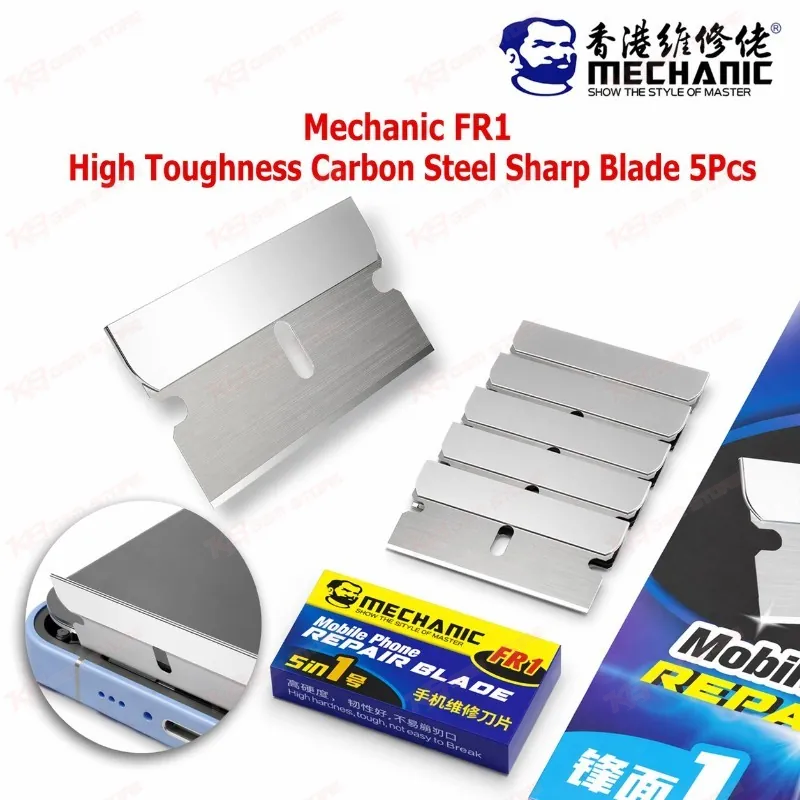
Every screen replacement job starts with getting the old panel off cleanly, and that step depends entirely on the blade in your hand. The Mechanic FR1 blade solves the exact problem technicians face when a phone frame won't separate cleanly from the display: a blade that's either too soft and bends on the first prying attempt, or too brittle and chips before the job is half done. Cut from carbon steel and hardened for toughness, this FR1 blade holds a sharp single edge through repeated flexing against glass, metal frames, and hardened OCA adhesive. You feel the difference the moment you start shoveling glue off a mid-range Android chassis or lifting a tightly bonded iPhone frame — the edge doesn't fold under load, and it keeps cutting cleanly instead of dragging and tearing the adhesive layer. At roughly 1.0mm thick and finished in silver carbon steel, the blade slides into narrow gaps between the frame and display without forcing the opening wider than it needs to be, which matters when you're trying to avoid stressing the digitizer flex or cracking a rear glass panel that's already fragile. Pakistani repair shops handling high screen-replacement volume know that a blade snapping mid-pry costs more than the tool itself — it costs the display you're trying to save. This is where the FR1's toughness earns its place on the bench: it resists snapping when you're levering against a stuck frame, and it keeps its edge sharp enough for repeat use across several units before you retire it. The blade isn't limited to screen jobs alone. Technicians pull it out for wire cutting during board-level rework, for scraping polarizer film off a display before a re-lamination, and for light process trimming on flex cables and adhesive strips where a bulkier tool would only get in the way. That versatility is why it sits in the same drawer as your spudgers and pry tools rather than getting swapped out job to job. Each small box holds 5 blades, sized for a single technician's bench rather than a bulk stock order, which makes it easy to keep a fresh blade within reach without committing shelf space to a 100-piece box. Because the blade is thin and single-edged, you get a controlled point of contact rather than a wide scraping surface, so you can work close to connectors, cameras, and battery seals without the risk a wider utility blade would carry. In a workshop doing frame removal, glue scraping, and screen dismantling back-to-back through the day, having a blade that doesn't need constant re-sharpening or replacement keeps your repair queue moving instead of stalling on tool changes. The FR1 earns its spot in a technician's kit not through marketing claims but through repeated use on the actual problems a repair bench deals with daily — stuck frames, hardened OCA glue, and displays that need to come off in one piece.