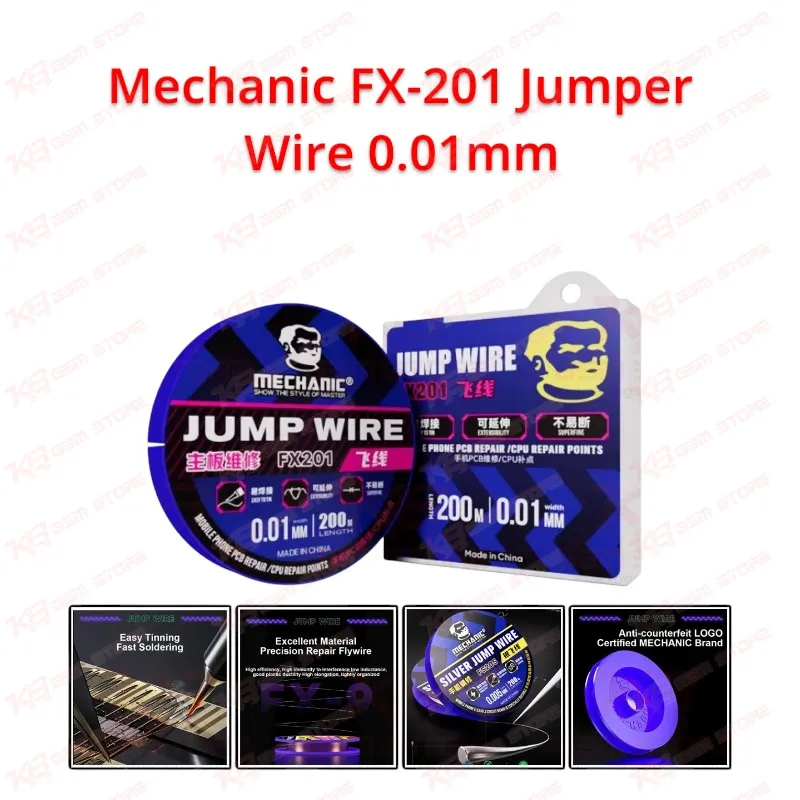
Every technician knows the moment: you lift a PMIC or pull a CPU off with hot air, clean the board with the soldering iron, and one pad comes away with the solder wick, leaving a dead line that no amount of reflow will fix. That job needs a jumper, and on a modern mobile motherboard the jumper has to be thinner than the track it replaces, which is exactly where the Mechanic FX-201 Jumper Wire 0.01mm earns its place on your repair bench. Mechanic builds this fly line at a 0.01mm wire diameter and packs 200m on one roll, so you get enough ultra-fine copper wire for months of pad repair, trace bridging, and flex line recovery without buying small packets every week. The 0.01mm size matters because modern iPhone and Android boards pack BGA pads, test points, and signal tracks so tightly that a standard jumper wire simply blocks neighboring pads or lifts the moment you touch it with tweezers; a hair-thin wire lets you route the jumper along the board surface, tack it onto the remaining track, and land the other end directly on the ball point or via without disturbing anything nearby. Copper construction gives the wire solid conductivity for signal and data lines, and the fine gauge bends and lays flat easily, which helps when you need to follow a curve around a shield frame mount or a screw hole. Fingerprint flex repair stands out as one of the most common jobs for this wire, since Touch ID and side-key fingerprint cables often lose a track after liquid damage or a careless screen separation, and a 0.01mm jumper lets you restore the line instead of telling the customer to replace the whole part. The same applies to screen flex cables, charging flex lines, and FPC connectors where a single cut track causes a display problem, a touch fault, or a charging issue that looks like a much bigger hardware fault on the first diagnosis. On the motherboard side, you reach for this wire when a CPU ball pad drops during reballing, when a screw hole crack cuts a track, or when corrosion eats a line next to a power IC on a phone that came in with a hang on logo or boot loop issue. Working with wire this thin rewards a clean setup, so pair it with a good stereo microscope, a temperature-controlled soldering station with a fine conical or knife tip, a stable PCB holder, and quality flux; for pad prep and BGA work, a hot air station and a reballing kit complete the workflow, and a multimeter lets you confirm continuity in diode mode before you close the phone. Practical technique keeps your success rate high: scrape the solder mask off the track with a fine blade, tin the exposed copper lightly, tin the wire end with a touch of flux, then tack both ends at low iron temperature with a short dwell time so the wire does not burn through. Once the jumper holds, many technicians seal it with UV solder mask to lock it in place and prevent shorts, especially in dense areas around the CPU and PMIC. Because the FX-201 sits at the finest practical size for most phone board jumpers, it also fits naturally in an upgrade path: technicians who start with thicker 0.02mm jumper wire for general track repair move to 0.01mm once they take on CPU pad work, fingerprint flex lines, and other fine-pitch jobs, while heavier power-line jumpers and ISP pinout connections for eMMC programmers, UFS adapters, and test boxes usually call for a thicker gauge that carries more current and survives repeated handling. For repair shop owners in Lahore, Karachi, Islamabad, and every city in between, a roll of Mechanic FX-201 sits in the same drawer as flux, solder wick, and tweezers, a small consumable that turns a "board is dead, change the board" verdict into a repaired phone and a paid job.