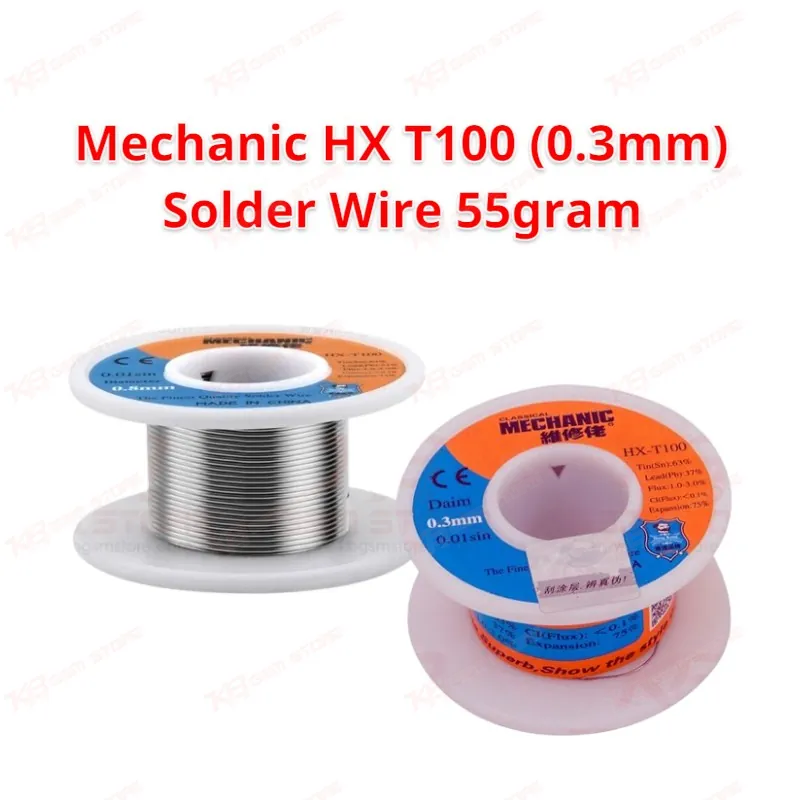
Mobile repair technicians working on modern smartphone motherboards need a solder wire that matches the scale of today's components, and the MECHANIC HX-T100 Solder Wire in 0.3mm diameter and 55g spool size is built exactly for that demand. Manufactured with a Sn63/Pb37 tin-lead alloy, this wire melts at a stable 183°C, which means it flows quickly under the tip of your soldering iron without overheating nearby components or lifting pads on delicate boards. For anyone handling IC change work, jumper lagana tasks, or board-level repairs on iPhone, Samsung, Oppo, Vivo, and other smartphone motherboards, the low melting point translates directly into shorter dwell time and less heat stress on surrounding SMD parts. The rosin core running through the center of the wire carries a flux content of 1.0-3.0%, active enough to break down oxidation on copper pads and IC legs instantly, so you get proper wetting on the first pass instead of dragging the tip repeatedly across a pad trying to get solder to stick. A low chlorine content under 0.1% keeps the flux non-corrosive, which matters when you're working close to sensitive components like PMICs, audio ICs, or charging ICs where any residue left behind could eventually cause a hardware fault or intermittent charging issue weeks after the repair. The 0.3mm diameter itself is what separates this wire from general-purpose soldering wire. At this thickness, you can lay down a precise, small amount of solder exactly where it's needed, whether that's tacking down a single leg on a fine-pitch IC, repairing a lifted pad, reinforcing a charging port pin, or building a jumper wire connection after a board has been damaged by a boot loop issue or dead phone fault. Thicker wire in the 0.6mm-0.8mm range simply carries too much mass for this kind of micro-soldering work, forcing technicians to either waste material or risk bridging adjacent pads, which is a common cause of network issue or display problem complaints coming back after a repair. With HX-T100 at 0.3mm, the wire feeds naturally under a fine tip, giving you the control to place a single small sliver of solder on a pad and move on, rather than fighting excess buildup. This solder wire fits directly into standard GSM repair workflows: it's used during CPU reballing prep, IC removal and reinstallation, PCB trace repair, charging port resoldering, and general board-level rework across ISP, eMMC, and UFS repair operations where hardware and software tools eventually hand off to physical soldering work. Technicians running a repair shop or service center in Pakistan will recognize this as one of the core consumables that sits alongside your hot air station, soldering iron, and flux paste on every workbench, since almost every hardware-side repair job eventually calls for adding or reflowing solder somewhere on the board. The 55g spool size is a practical middle ground for shops doing regular repair volume, large enough to last through weeks of daily board work without needing constant reordering, but not so bulky that it goes to waste if you're a smaller service center or independent technician. Because the alloy composition, melting point, and flux percentage are all fixed manufacturing specifications rather than variable claims, this wire performs consistently spool after spool, which matters when you're relying on repeatable solder joint quality across dozens of repairs a week. For anyone building out a professional repair bench, pairing a 0.3mm HX-T100 spool with a temperature-controlled iron gives you one of the most dependable combinations for handling today's densely packed smartphone motherboards.