Skip to product information
1 of 4
Brand: MECHANIC

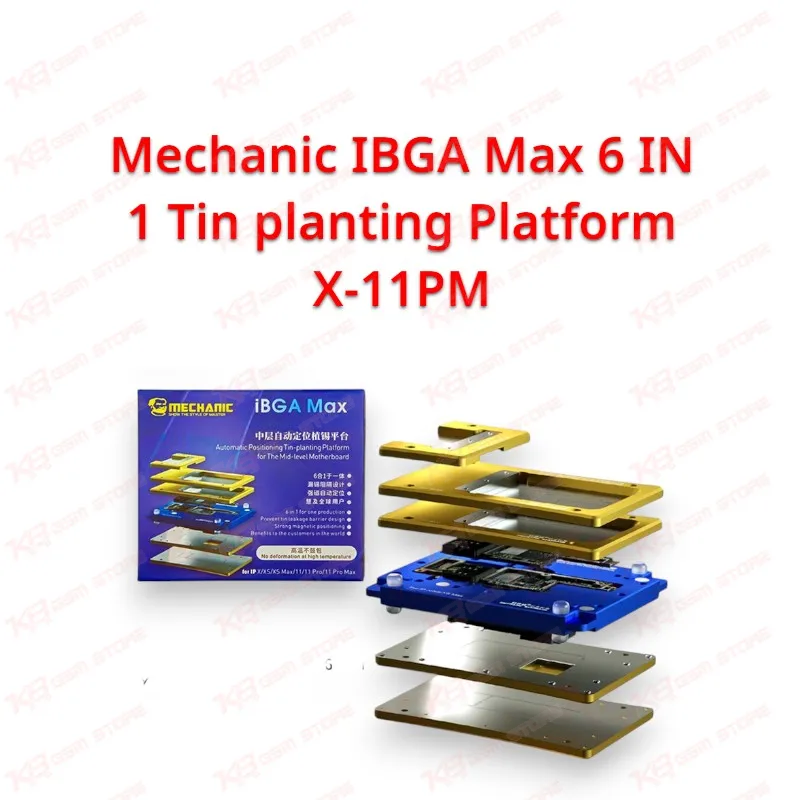
Mechanic IBGA Max 6 IN 1 Tin planting Platform X-11PM

Mechanic IBGA Max 6 IN 1 Tin planting Platform X-11PM

Regular price Rs.1.00 PKR
Regular price Sale price Rs.1.00 PKR
Sale Sold out
Shipping calculated at checkout.
Quantity

The Mechanic IBGA Max 6 IN 1 Tin planting Platform X-11PM is a middle-layer BGA reballing fixture for iPhone X, XS and XS Max motherboards and the RF small board of the iPhone 11, 11 Pro and 11 Pro Max. Strong magnets lock the board into its positioning slot, the stencil lines up with the pads automatically, and an anti-leakage barrier keeps solder paste on target. The heat-resistant stencil stays flat under hot air, so you get even solder balls for a clean sandwich board rejoin. A smart buy for Pakistani repair shops fixing drop-damaged iPhones with no network, boot loop or dead phone faults.

SKU:MST-SOLDERING-TOOLS-312

  • Safe & Secure Payment
  • Fast Delivery
  • WhatsApp Support
View full details

Description

When an iPhone X, XS Max or 11 Pro Max lands on your bench as a dead phone after a drop, or shows no service right after a back glass job, the fault very often sits between the two layers of the sandwich board, and the Mechanic IBGA Max 6 IN 1 Tin planting Platform X-11PM gives you a stable, repeatable way to rebuild those middle-layer solder joints instead of fighting a loose stencil with tweezers. Apple stacked the logic board on these models, so once you separate the layers on a preheater or hot air station, every pad on the interposer side needs fresh, even solder balls before the board can go back together, and that is exactly the job this fixture handles. Mechanic built the platform around six board profiles in one base: the X, XS and XS Max motherboard, plus the RF small board of the iPhone 11, 11 Pro and 11 Pro Max, so a single tool covers the layered iPhones that still regularly come into Pakistani repair shops. The base uses strong magnets to pull the board into its positioning slot automatically, which means the stencil holes line up with the pads without you nudging the board millimetre by millimetre under the microscope. Double-sided positioning slots let you seat the board in the correct orientation for the side you are working on, and the board stays put while you spread solder paste and heat it, so you never chase a sliding PCB around the bench. A raised anti-leakage barrier around the stencil area keeps paste where you put it, so you avoid stray balls bridging neighbouring pads or rolling under nearby components, a problem that turns a simple reball into a second round of cleaning. Mechanic designed the stencil to resist warping under hot air, so it does not bulge in the middle when you apply heat, and a flat stencil means even ball height across the whole pad array, which matters when the two layers need full contact to restore network, Wi-Fi, charging and boot. The tin planting section is integrated yet removable, so you can plant balls with the stencil in place, lift it off cleanly once the paste reflows, and move straight to inspection. In a typical workflow you clean old solder off the separated board with a soldering station and desoldering wick, apply flux, mount the board on the platform, spread a thin layer of solder paste with a scraper, heat with your hot air station until the paste melts into round balls, let it cool, then remove the stencil and check every ball under a microscope before you rejoin the layers. That routine saves real time on a busy counter in Lahore, Karachi or Islamabad, where a sandwich board repair often decides whether a customer's iPhone comes back to life or goes into the dead-board box. The fixture measures 97 × 76 × 20 mm, so it sits comfortably on a standard repair mat beside your PCB holders and reballing kits without hogging space. For a complete layered-board setup, pair it with a quality hot air station for separation and reflow, a soldering station for pad cleaning, a stereo microscope for inspection, and a multimeter to check the board for short circuits before and after the rebuild; when the fault turns out to be in storage rather than the interposer, you can move on to ISP pinout tools, eMMC programmers, UFS adapters and test boxes from the same KB GSM Store catalogue. Shop owners who handle iPhone board work regularly will find this platform earns its place quickly, because a correct middle-layer reball avoids repeat jobs, reduces wasted solder paste and protects fragile pads that tear easily when you rework them twice. If you are building up your iPhone board repair section, or you want to stop losing jobs on drop-damaged X to 11 Pro Max units with hang on logo, boot loop or no network faults, the Mechanic IBGA Max 6 IN 1 Tin planting Platform X-11PM is a practical, workshop-ready addition that keeps your reballing accurate, clean and fast.

Key Features

  • Six board profiles in one base covering iPhone X, XS and XS Max motherboards plus the iPhone 11, 11 Pro and 11 Pro Max RF small board
  • Strong magnetic automatic positioning that pulls the board into place and aligns stencil holes with the pads
  • Double-sided motherboard positioning slots for correct board orientation on either side
  • Anti-leakage tin barrier that keeps solder paste inside the stencil area and prevents stray balls
  • Heat-resistant stencil design that does not bulge under hot air, giving even ball height
  • Integrated, removable tin planting section for clean stencil lift-off after reflow
  • Built for middle-layer (sandwich board) reballing, the key step in drop-damage iPhone board repair
  • Compact 97 × 76 × 20 mm footprint that fits easily on any repair bench or mat

Specifications

Brand Entity Mechanic
Product Entity Mechanic IBGA Max 6 IN 1 Tin planting Platform X-11PM (middle-layer BGA reballing platform)
Technology Entity Magnetic automatic positioning, BGA stencil reballing, solder paste tin planting
Compatible Device Entities iPhone X, iPhone XS, iPhone XS Max, iPhone 11, iPhone 11 Pro, iPhone 11 Pro Max
Repair Process Entity Sandwich board separation, middle-layer reballing, interposer solder ball planting, hot air reflow
Industry Entity Mobile phone repair, iPhone motherboard repair, PCB rework

Compatible Devices

  • iPhone X (motherboard middle layer)
  • iPhone XS (motherboard middle layer)
  • iPhone XS Max (motherboard middle layer)
  • iPhone 11 (RF small board)
  • iPhone 11 Pro (RF small board)
  • iPhone 11 Pro Max (RF small board)

Common Repair Uses

  • Reballing the middle-layer pads after separating an iPhone sandwich board
  • Repairing drop-damaged iPhones showing no service, no Wi-Fi or dead phone symptoms caused by cracked interposer joints
  • Fixing boot loop and hang on logo faults linked to poor contact between board layers
  • Planting fresh solder balls before rejoining the logic board and RF board
  • Redoing a failed or uneven reball from a previous repair attempt

FAQ

What is the product name?
The product name is Mechanic IBGA Max 6 IN 1 Tin planting Platform X-11PM.
What is the brand of this product?
The brand of this product is Mechanic.
What is the model of this product?
The model of this product is iBGA Max 6 in 1 (X-11PM).
What is this product used for?
This product is used for positioning and reballing the middle layer of iPhone X to iPhone 11 Pro Max sandwich boards with solder paste and hot air.
Which devices are compatible with this product?
This product is compatible with the iPhone X, XS and XS Max motherboard and the iPhone 11, 11 Pro and 11 Pro Max RF small board.
Who should use this product?
This product is suitable for mobile repair technicians, repair shops, service centers, and professional users.
Does the Mechanic IBGA Max 6 IN 1 support iPhone 12 or iPhone 13 boards?
No. Its verified support covers iPhone X through iPhone 11 Pro Max only. For iPhone 12 and 13 series sandwich boards, you need a newer platform such as the Mechanic iBGA 13 Max, which covers iPhone X to 13 Pro Max.
How do you plant solder balls on an iPhone 11 RF board with this platform?
Clean the old solder from the separated RF board, apply flux, seat the board in its slot so the magnets lock it under the stencil, spread a thin layer of solder paste, heat with a hot air station until the paste melts into balls, let it cool, then lift the stencil and inspect the balls under a microscope before rejoining the board.

Ask any Query