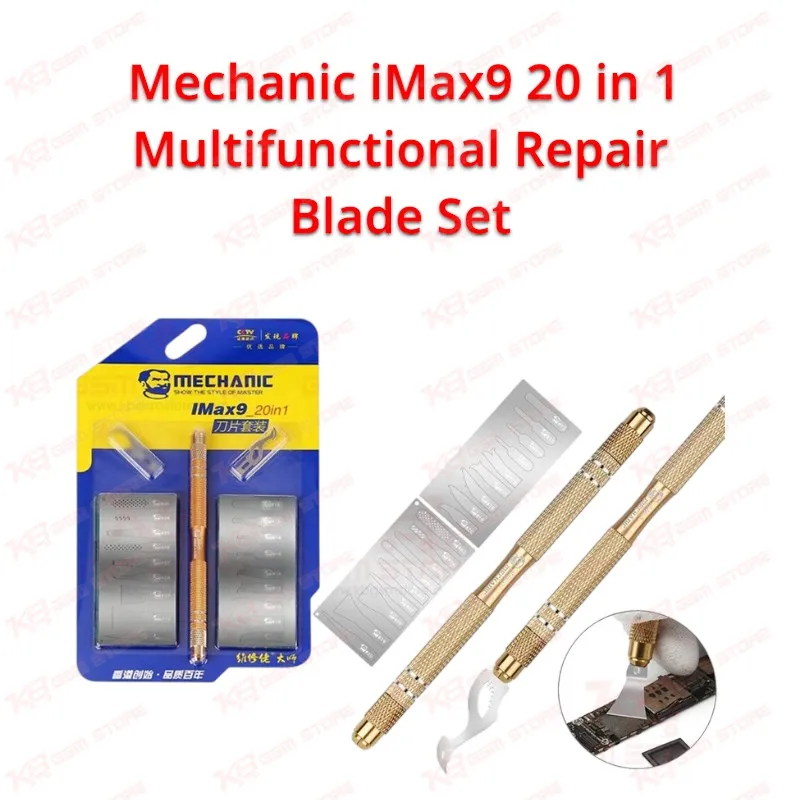
When you pull a logic board apart for CPU reball or IC change karna, the glue and rubber shields underneath the chip are usually what slow you down, and the Mechanic iMax9 20 in 1 Multifunctional Repair Blade Set solves exactly that problem. Every blade in the set comes from heat-treated alloy steel, quenched at controlled temperatures so the edge stays sharp and holds its shape even after you use it on a hot board straight off the hot air station. You get 20 blades, each cut into a different profile, so you always have the right angle for the job — thin curved tips for working around BGA chip edges, flat wide blades for peeling large adhesive pads off the motherboard, and narrow pointed shapes for reaching into tight spots near connectors and small ICs. The set ships with a single double rotary head handle, and that handle is where this kit earns its place on a busy repair bench. Instead of unscrewing a blade holder every time you need a different shape, you rotate the head and clamp in a new blade in seconds, and the high-temperature-resistant tip on the handle keeps a firm grip on the blade even when the board underneath is still warm from soldering. This matters most during UV glue removal on modern smartphone boards, where manufacturers use adhesive that hardens fast and grips the shield can or CPU shim tightly. A soft or dull blade either slips and scratches the PCB or bends under pressure, and either mistake turns a simple glue removal job into a hardware fault you now have to explain to the customer. The alloy steel in this set resists that kind of deformation, so you can apply steady pressure without worrying about the blade twisting mid-cut. Corrosion and oxidation resistance also mean the blades don't degrade from flux residue or cleaning solvents that sit on your bench between jobs, so the set stays usable for a long stretch of daily work rather than needing replacement after a few weeks. On a typical repair, you'll reach for this kit before CPU removal, using the thinner blades to lift the UV glue around the chip edges without disturbing the pads, then switch to a wider blade to clear rubber shields off nearby components before reflow. It works just as well during board cleaning after a liquid damage repair, where dried adhesive and corrosion residue need to come off without gouging the solder mask. Because the blades aren't tied to any single phone brand or chipset, you use the same set whether you're working on a Qualcomm-based Android board or an Apple logic board — the tool responds to the glue and the board material, not the device model. For a repair shop handling a mix of dead phone units, screen separation jobs, and board-level rework, having 20 blade shapes under one handle cuts down the time spent hunting for the right tool mid-repair, and the compact size means it sits in a drawer or tool roll without taking up much space. This is a bench tool built around a task every GSM technician deals with constantly, and it holds up to that daily use instead of wearing out after a handful of jobs.