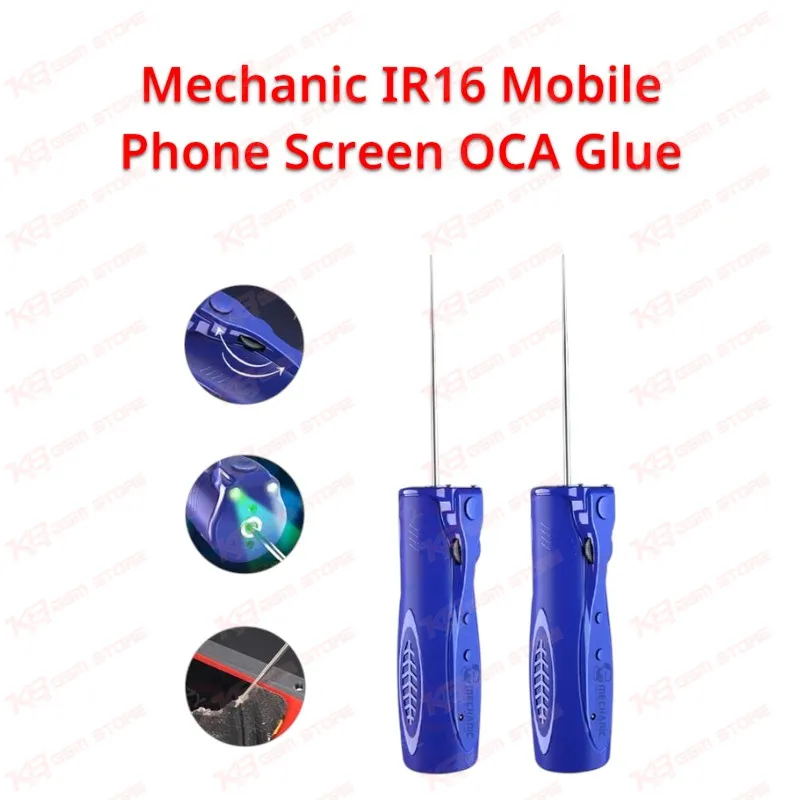
Every repair shop that handles screen replacement, glass-only refurbishing, or panel salvage work eventually runs into the same bottleneck: manual glue scraping is slow, inconsistent, and risky on curved-edge or OLED panels where one wrong scrape ruins the display. The Mechanic IR16 solves that bottleneck by putting a motorized, adjustable-speed grinding head in your hand instead of a blade or a heat gun. Its pure copper imported motor spins at speeds up to 7000rpm and rotates in both directions, which means you can match the tool's action to the glue type in front of you rather than fighting a single fixed speed across every job. Thick, stubborn OCA layers respond better to higher speeds and steady bi-directional passes, while thinner residue on delicate OLED edges calls for a slower, more controlled pass — the IR16 lets you dial that in on the fly instead of switching tools mid-job. Because the head clears adhesive mechanically, you skip the liquid glue removers, alcohol soaks, and hand-rubbing that eat up bench time and leave streaky residue behind; this alone changes how many panels a single technician can turn around in a shift. The motor housing runs on a detachable 18650 lithium-ion cell rated 3.7V and 2000mAh, charged through a standard Type-C port, so you're not locked into a proprietary charging brick that goes missing in a busy workshop. When the battery does run low mid-job, you're not stuck waiting on a charge — pull the cell and drop in a spare, or plug straight into an external 9V supply and keep working without touching the battery compartment at all. That flexibility matters most during high-volume days when panel replacement jobs stack up back-to-back and downtime directly costs you money. Build quality shows in details that matter for repeated daily use: the motor core stays balanced and non-tremble at full speed, which keeps your hand steady over an OLED edge where a single jolt can crack a flex cable or gouge the panel surface. A white illumination light sits built into the head so you can actually see what you're grinding instead of working blind under a desk lamp, and a separate green light activates specifically to highlight fine glue dust — a small feature that saves you from missing patches of residue that would otherwise show up as air bubbles or uneven adhesion once the new screen goes on. The one-key start keeps the workflow simple: pick up the tool, press once, and start working the glue line without hunting for a mode switch, and if you set it down mid-task, a 10-second idle timeout shuts the motor off automatically so the battery isn't draining while it sits on your workbench between panels. At 150g and roughly 246 x 58 x 45mm in its packaging, the tool stays light enough to control precisely during extended sessions without the hand fatigue that comes from bulkier degumming machines, making it practical for technicians running through multiple screen jobs in a single day rather than an occasional one-off repair. In terms of where this fits into your actual repair workflow, the IR16 belongs in the screen separation and refurbishing stage — after you've split the frame and lifted the old glass or LCD assembly, and before you clean the frame and lay down fresh OCA film or adhesive for reassembly. It's equally useful for prepping a frame for a full screen replacement, cleaning up a glass-only repair where you're reusing the original LCD, or clearing adhesive off a mid-frame during a battery or charging port job that requires you to lift the screen out of the way first. Technicians who do glass-only replacement in particular rely on tools like this daily, since separating the glass from a working LCD without damaging the digitizer underneath depends entirely on controlled, even glue removal rather than aggressive scraping. Compared to manual methods, the motorized approach also produces more consistent results across a batch of repairs, which matters if your shop handles volume work for other repair centers or resellers rather than one-off customer jobs — a more even surface after glue removal means fewer air bubbles and adhesion failures on the reassembled unit, which translates directly into fewer comebacks and warranty claims. The tool doesn't require any software pairing or firmware setup; it's a purely mechanical-electrical device, so there's no learning curve beyond getting a feel for how much pressure and speed a given screen type needs, which most technicians pick up within their first few panels. For a repair bench that processes screens regularly, whether that's a dedicated GSM parts and repair shop or a service center handling walk-in glass replacements, the IR16 removes one of the more time-consuming and error-prone manual steps in the process and replaces it with a controlled, repeatable motorized action.