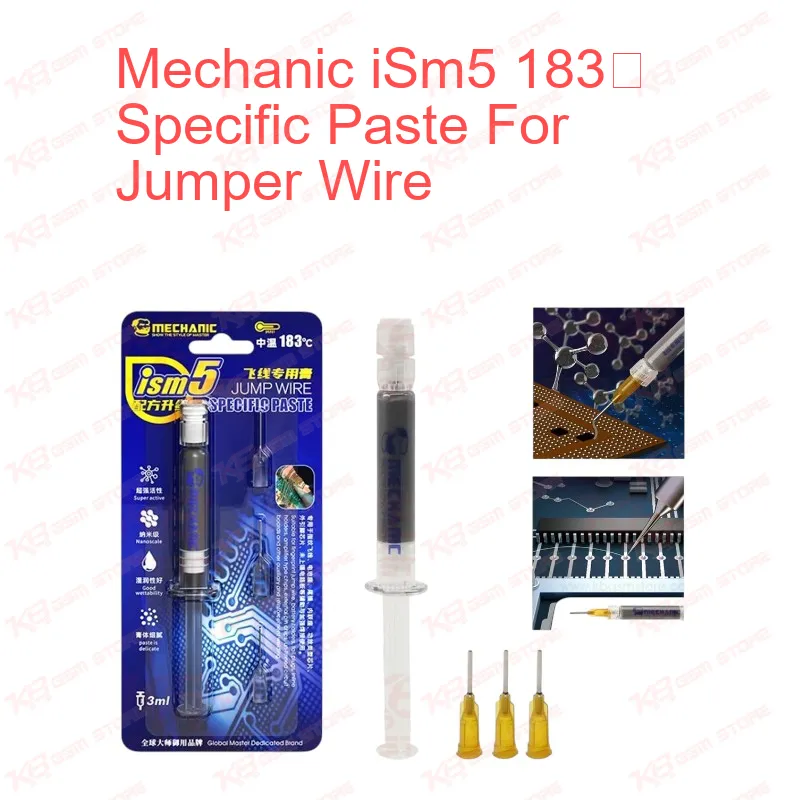
Every board-level technician knows the moment a trace lifts, a pad tears away during IC removal, or a fingerprint line goes open, and the fix comes down to a jumper wire thinner than a hair, which is exactly the job the Mechanic iSm5 183℃ Specific Paste For Jumper Wire handles on your repair bench. Mechanic built this 3ML paste specifically for jump wire and flying line soldering, so it behaves differently from the general-purpose solder paste you use for reballing or stencil work. The nano compound formula gives the paste a high activity factor, so the flux attacks oxidation quickly and lets molten solder wet the copper instead of balling up on the surface. Moderate viscosity keeps the paste exactly where you place it, so a tiny pick on the solder point stays put while you bring the iron in, and a single touch of the tip tins the joint completely. That single-touch behaviour matters on a crowded phone board where every extra second of heat puts nearby capacitors, resistors, and underfilled chips at risk. The paste works in a 183℃ to 210℃ range, which places it in the medium-temperature class and gives you a practical middle ground: the joint holds firmly for handling, testing, and reassembly, while you avoid the high heat that lifts neighbouring pads or damages flex connectors. For a heat-sensitive area that needs an even lower melting point, Mechanic offers the iSm3 at 138℃ as a companion option, and many technicians keep both syringes on the bench. The iSm5 fills the pad fully, so the finished solder point looks round and complete rather than thin or grainy, and the residue stays clear and transparent. Clear residue sounds like a small detail until you try to align a hair-thin jumper under a microscope, where cloudy flux hides the wire path and forces you to guess where the next joint sits. With the iSm5 you see the copper, the wire, and the pad clearly, so you shift and align the flying line with confidence. The paste earns its place on stubborn jobs too: after you remove underfill glue from a chip, the exposed pads often refuse to take solder, and the high-activity formula helps them accept tin again without aggressive scraping. The same strength helps on untinned circuit boards, external pin chips, battery connector pads, and charging port pads where old solder, glue, or corrosion blocks a clean joint. In a typical Pakistani repair shop, this paste becomes the go-to consumable for fingerprint not working complaints, charging issue cases where a torn charging port pad breaks the path, dead phone cases where an open line cuts the power supply, and network issue repairs where a lifted RF trace needs a bridge. It also suits the fine wires you solder onto ISP pinout points when you program eMMC or UFS storage on a dead board. Your workflow stays simple: clean the area, expose the copper with a scraper or fiberglass pen, place a small amount of iSm5 on each end point, tin the pads with your soldering station, lay the jumper wire, and touch each end once. Check the line with a multimeter in continuity mode, then seal the repair with UV solder mask so the wire stays protected. The pack includes three dispensing needles, which let you control the quantity precisely and switch to a clean needle when one clogs. For a complete jumper setup, pair the paste with a fine-tip soldering station, a stereo microscope, a PCB holder to keep the board steady, and a hot air station for removing shields and chips before the trace work begins. KB GSM Store supplies the Mechanic iSm5 to repair shops, service centres, and training institutes across Pakistan, so you keep a reliable jumper paste in stock and close board-level jobs faster with fewer customer returns.