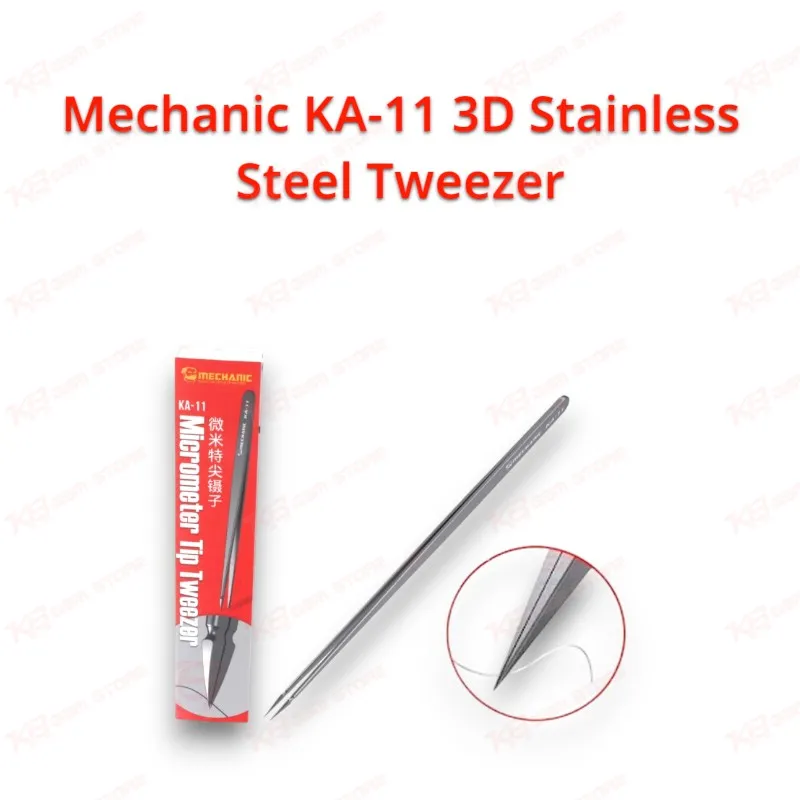
When a charging IC pad lifts on a Tecno or Infinix board and you need to run a jumper wire thinner than a hair, the Mechanic KA-11 3D Stainless Steel Tweezer becomes the tool your hand reaches for first. Every technician in Pakistan knows the moment: the customer wants the phone back by evening, the board sits under the microscope, and a cheap tweezer tip keeps slipping off the wire or flicking a tiny capacitor across the bench. Mechanic hand-polishes the tip of every KA-11, and that finishing gives you tight tip closure that grips silver jumper wire down to 0.008 mm without crushing or dropping it. That single detail decides whether your jumper work on a broken charging line, a cut network trace, or a damaged display connector track goes smoothly or turns into another hour of rework. The body uses imported 304 high-hardness stainless steel, a grade that balances toughness with spring elasticity, so the arms open back cleanly after each squeeze and the tip holds its alignment through daily bench use. Because the steel stays non-magnetic, small SMD parts and shield screws never jump toward the tip, and the anti-adsorption finish lets a coil or capacitor release exactly where you place it. On a dead phone where you trace a short with a multimeter and then swap a filter capacitor near the PMIC, that clean release saves you from hunting for a tiny part on the mat. Workshop chemicals destroy weak tweezers fast. Rosin flux, PCB cleaning solution, and IPA attack cheap plated steel and leave rust spots around the tip within weeks, but the corrosion resistance of 304 stainless lets the KA-11 handle board washing and flux cleanup every day without pitting, which matters for shops in Karachi and Lahore where humidity already pushes tools toward rust. The fine pointed profile reaches into tight spaces between RF shields, under connector housings, and around crowded CPU and eMMC areas where a broad tip simply blocks your view. Pair it with a stereo microscope and you get controlled placement for micro-soldering, fine wire routing, and lifting tiny components during IC change jobs. During reballing, the KA-11 helps you position the stencil, nudge a BGA chip into alignment on its pads, and pick off stray solder balls before reflow with your hot air station. When a phone shows a boot loop issue or hangs on logo and the fault points to hardware rather than software, the repair often ends in micro-level work around the eMMC or UFS area, and a precise tweezer keeps that work clean whether you later move to an eMMC programmer, a UFS adapter, or an ISP pinout tool for the data and firmware side. Software technicians who run a test box all day still need one dependable tweezer, because soldering a thin wire to an ISP test point on a dead phone demands the same tight grip as any hardware job. The KA-11 also sits naturally beside your soldering station and PCB holder: hold the wire with the tweezer, tin the point with the iron, and lock the board steady in the holder so your hands stay focused on control. Students at technical training institutes benefit from a tweezer that never fights them, and experienced shop owners value a tool that keeps its tip geometry after months of service. Watch repair and general electronics work suit it too, since the same non-magnetic, fine-tip qualities protect delicate movements and small parts. If you run a busy counter handling charging issues, network issues, and display problems every day, keep the KA-11 as your dedicated jumper and SMD tweezer, and protect the tip by storing it closed in a stand or pouch away from the hot air nozzle. Order the Mechanic KA-11 from KB GSM Store and give your repair bench a precision tweezer that handles the finest work a modern mobile board throws at you.