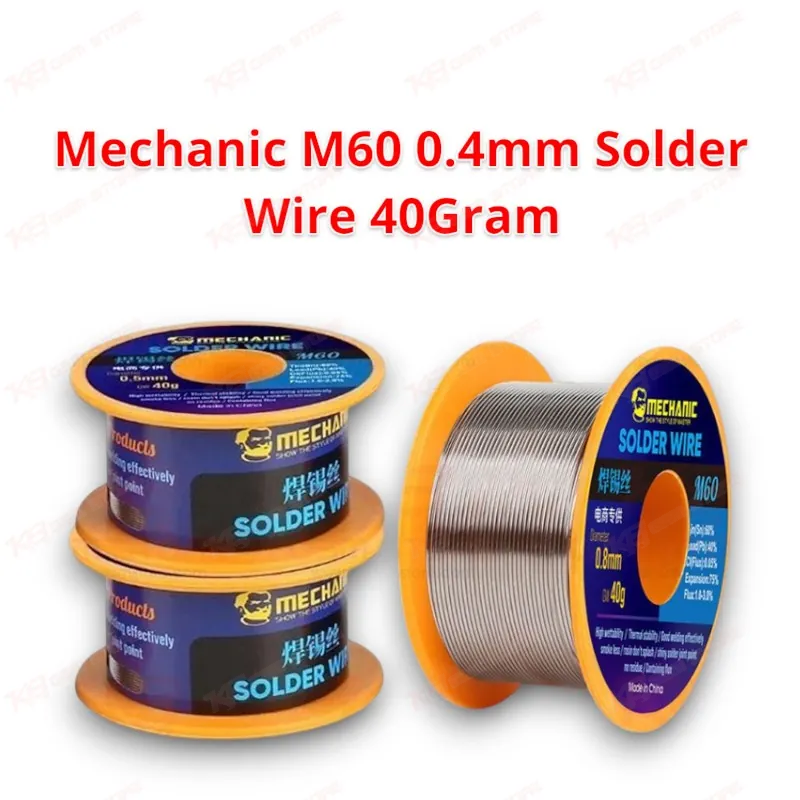
Every GSM technician knows that solder quality decides whether a repair holds or comes back to the bench a second time. Mechanic M60 0.4mm Solder Wire addresses that problem directly with a Sn-Pb alloy formulated around a roughly 60% tin to 40% lead ratio, giving it a melting range of about 200–300°C that suits standard soldering irons, hot air rework stations, and precision tip soldering alike. That melting behavior matters most when you are working on dead phone boards where excess heat can lift pads or damage nearby components; the M60 flows fast enough to bond cleanly before heat spreads into the surrounding circuit. The 0.4mm diameter is the wire's defining trait. It is thin enough for fine-pitch work like small IC legs, connector pins, jumper wires, and closely packed SMD pads, letting you control exactly how much solder lands on the joint instead of fighting with a thick wire on a tiny pad. This level of control is what separates a clean, reliable joint from a bridged or cold one, especially on boards populated with 0201 and 0402 class components where a single misjudged deposit can short adjacent traces. Inside the wire, the rosin flux core is the working part of the formula. Rated in the 1.0–3.0% flux range, it activates as soon as heat reaches the joint and immediately improves wettability, meaning molten tin spreads evenly across copper pads and IC legs rather than beading up. This is the difference technicians notice when a jumper lagana job or a IC change karna repair produces a smooth, shiny joint on the first attempt instead of a dull, grainy one that has to be reworked. The rosin is also engineered as no-clean, so it does not leave the sticky, corrosive residue that older flux formulas are known for, which means boards stay visually clean under a microscope and do not need a heavy alcohol wash after every joint. Thermal stability is another area where the M60 earns its place on a busy repair bench. Repeated heating and cooling cycles, which are unavoidable when reworking multiple points on the same board, can degrade weaker solder formulas and lead to brittle, cracked joints down the line. The M60's alloy composition resists that kind of premature oxidation, holding its structural integrity through sustained exposure to a hot air station or iron tip during longer rework sessions such as reballing prep, board cleaning, or multi-point charging port repair. Low smoke output is a practical benefit that shows up during long shifts rather than in a single joint. Rosin-based wires can produce heavy fumes when overheated, which is both uncomfortable and a workplace hazard in a small repair shop. The M60's flux formulation is built to minimize this, so technicians working through stacks of boards in a day are not dealing with a haze building up around the workbench. The formula also resists splashing during application, which protects delicate components sitting next to the joint you are working on; splatter is a real risk during ISP pinout work or IC removal, where a stray drop of hot solder can bridge two pins that were never meant to touch. On the visible end result, the M60 consistently produces a bright, shiny solder joint with a full, rounded profile rather than a dull or pitted one. That shine is not cosmetic; it is a direct visual indicator of a proper metallurgical bond, letting you verify joint quality under a microscope without needing a continuity test on every single point. For repair shops handling network issue boards, hang on logo faults, charging problems, or general PCB repair, having a wire that gives instant visual confirmation of joint quality speeds up quality control across a busy day of intake. Packed in a practical 40g spool, the M60 in 0.4mm is sized for everyday shop use rather than industrial production runs, making it easy to keep multiple spools on hand for different stations without excess waste. It pairs naturally with fine-tip soldering irons, hot air rework stations, PCB holders, and microscopes already common on a mobile repair bench, fitting directly into existing ISP, eMMC, and UFS repair workflows without requiring any change in technique. Whether the job is a quick jumper repair, IC reballing prep, or general board-level soldering, this wire is built to keep pace with the volume and precision that professional GSM repair work demands.