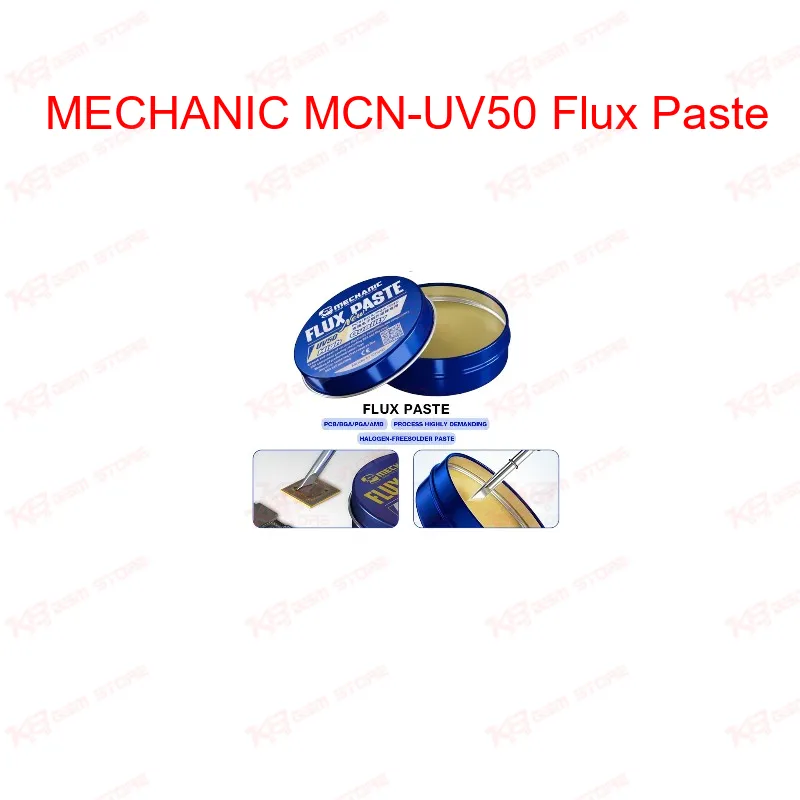
When you're soldering on a mobile phone board, the flux you use decides whether the joint comes out clean or turns into a mess of black residue and cold joints. Mechanic MCN-UV50 solves that problem with a rosin-based paste that stays neutral in pH, so it doesn't eat into your IC legs or PCB copper while you're working under the hot air station or soldering iron. The paste has a butter-like, semi-solid texture. You scoop a small amount onto the joint, and it stays exactly where you place it instead of spreading across the board. This matters when you're doing fine-pitch BGA work or reballing a CPU, where one wrong drop of flux can bridge two pads you never meant to connect. The granularity of the paste (0.22um) keeps it smooth enough to flow into tight BGA ball gaps without leaving lumps. On the soldering bench, this flux earns its place during IC change jobs — power IC, charging IC, audio IC, or any chip that needs to come off and go back on. Apply a thin layer before you heat the chip, and the paste helps the old solder melt evenly, which means fewer failed lifts and less risk of lifting a pad. For jumper work on a dead board, a small dab under the wire keeps the joint bright and avoids the dull, grainy look that comes from dry soldering. Because it's a no-clean formula, the residue left behind is light and non-conductive, so you don't have to scrub the board with isopropyl alcohol every time you finish a repair. This is a real time-saver when you're running multiple boards through your workshop in a day. That said, for boards going into humid environments or long-term use, a quick wipe with IPA still gives you a cleaner finish. The rosin base also protects against a common headache in Pakistani repair shops — corrosion showing up weeks after a repair because of leftover acidic flux. Mechanic MCN-UV50's mild, neutral formula reduces that risk, which matters when a customer comes back complaining about a new fault on a board you already fixed once. This flux fits naturally into ISP reballing, eMMC IC reballing, UFS chip work, and general SMD component soldering — anywhere you need the solder to flow without damaging the surrounding components. It works with lead and lead-free solder wire alike, so you don't need a separate flux for different solder types on your bench. For a repair shop juggling dead phone boards, boot loop issues, charging faults, and display problems side by side, having a flux that behaves consistently across all these jobs cuts down the guesswork. Mechanic MCN-UV50 gives you that consistency, along with a formula that's gentle enough to keep expensive ICs and boards intact through repeated rework.