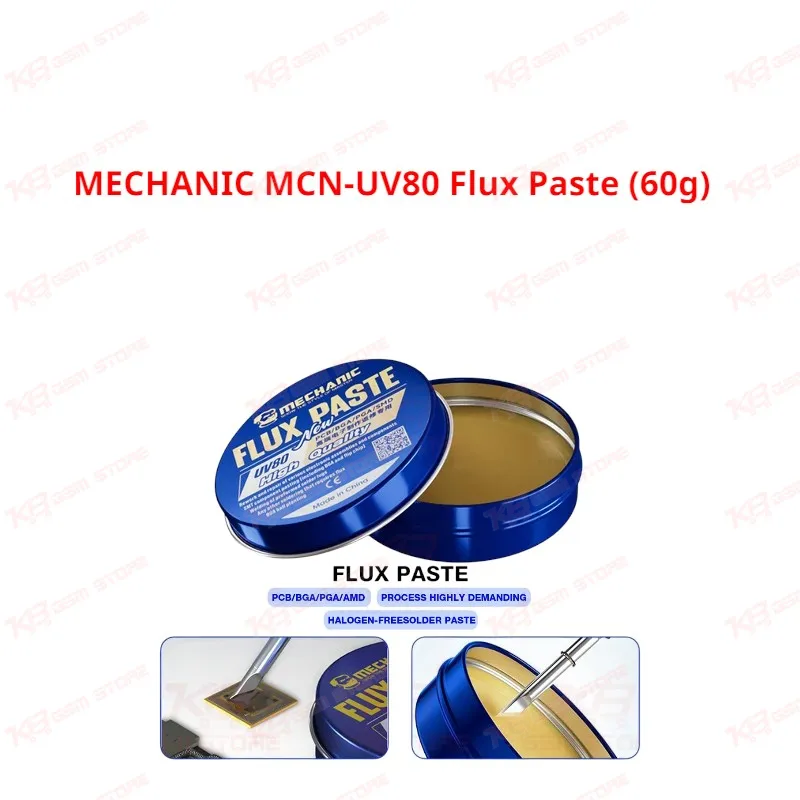
Every technician working on modern smartphone motherboards knows that a clean solder joint starts with the right flux. The MECHANIC MCN-UV80 is a rosin-based, no-clean flux paste engineered specifically for chip-level repair work on PCB, BGA, PGA, and SMD components. Packaged in a 60g jar, it gives your repair bench enough working volume for repeated IC reballing sessions without frequent restocking. This flux paste uses a highly synthetic, halogen-free rosin formula that keeps the solder surface smooth while protecting against oxidation during heating. The PH-neutral composition means it won't corrode fine copper traces or damage sensitive board components, which matters when you're working millimeters away from other ICs on a densely packed motherboard. Unlike aggressive acid-based fluxes, the MCN-UV80 stays gentle on the board while still activating properly under heat to promote strong wetting. Viscosity is rated at 0.2Pas with a granularity of 0.22μm, giving the paste a smooth, controllable spread when applied with a scraper or squeegee during reballing work. This consistency helps you lay down an even layer across BGA pads before placing a stencil, reducing the chance of solder bridging or uneven ball formation. The fine particle size also helps the paste settle into tight pad gaps on newer chipsets where pad pitch keeps shrinking. Because it's a no-clean formula, there's no need to wash the board with isopropyl alcohol after soldering in most cases, which speeds up your workflow when you're handling back-to-back repair jobs. The boiling point sits just above the melting point of typical solder, so the flux activates and burns off cleanly during reflow instead of leaving a sticky or hardened residue on the board surface. In daily repair shop use, this flux paste shows up across a wide range of jobs — reballing CPU and PMIC chips after a dead-after-flash issue, reworking charging IC pads on a phone with a charging issue, reseating a WiFi or audio IC during a network issue diagnosis, or prepping pads before an IC change on a board stuck in boot loop. It pairs naturally with hot air rework stations and soldering irons alike, making it a flexible addition next to your existing stencils, BGA reballing kits, and PCB holders. For technicians who do steady volumes of board-level work, the difference between a good flux and a poor one shows up in first-attempt success rate. A paste that spreads unevenly or leaves residue behind means more rework, more cleaning time, and higher risk of a failed joint on a customer's device. The MCN-UV80's rosin-based, halogen-free chemistry is formulated to reduce those failure points, giving you cleaner boot-ups after IC change and fewer callbacks for cold joints. Storage is straightforward — keep the jar sealed between uses to prevent the paste from drying out, and use a small scraper to apply only what's needed for each job rather than exposing the full jar to air repeatedly. A little goes a long way across most chip-level repairs, so a single 60g jar typically covers a substantial volume of reballing and rework sessions before it needs replacing. Whether you're running a solo repair bench or a full-service GSM workshop, the MCN-UV80 fits into the core toolkit alongside your soldering station, microscope, and BGA fixtures as a reliable, no-clean flux option for everyday chip-level repair work.