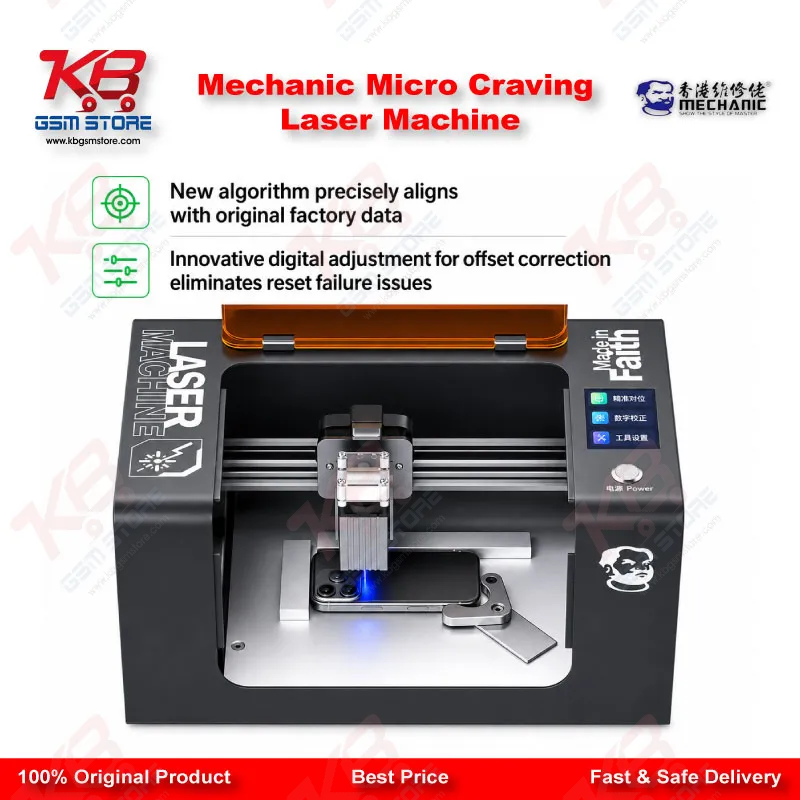
The Mechanic Micro-Carving Laser Machine changes how a repair bench handles back glass removal, screen separation, and board-level marking work by replacing heat, scraping, and guesswork with a controlled fiber laser beam. At the core of the machine sits a high-frequency fiber laser source running at a 1064nm wavelength, a wavelength chosen because it reads metal and PCB surfaces cleanly while also breaking down the cold-press adhesive layers used under smartphone back glass, camera lens covers, and mid-frame glass panels. Rather than heating a panel until the glue softens, the laser carbonizes the adhesive layer directly underneath the glass, so the glass lifts away without transferring heat into the wireless charging coil, the flex cables, or the frame sensors sitting close by. That non-contact approach matters most on flagship devices where a slipped scraper or an overheated frame turns a routine back glass swap into a board repair. On the board side, the same laser head handles IC and shielding can etching, marking a chip for identification or thinning a shielding can so it lifts off without dragging solder pads or neighboring components with it. Technicians working reballing and IC change jobs get a way to prep a board before touching it with a hot air station, cutting down on the trial-and-error that usually comes with cutting or prying a shield by hand. The marking range covers 175mm x 175mm, wide enough for a full smartphone back panel, a mid-frame, or a cluster of ICs on a motherboard without repositioning the workpiece mid-job. Positioning relies on red light focus paired with dual-dot alignment, a setup built to get height calibration right in seconds rather than the slow manual jogging older laser units require. A digital offset correction layer sits behind that alignment step, matching the laser path against factory reference data so repeat jobs land in the same spot every time instead of drifting after a few uses. Running the machine day-to-day goes through a dedicated control software package rather than a fixed set of preprogrammed cuts. The software carries a blueprint library covering current iPhone, Samsung, and Huawei frame and back glass geometries, and that library updates over time as new device models reach the market, which keeps a shop from needing a new machine every time a new flagship launches. Because the blueprints map out exactly where the camera lens, flash module, and wireless charging coil sit, the laser path stays clear of those zones automatically, cutting the risk of a technician eyeballing a cut too close to a sensor. Frame and glass compatibility currently runs from the iPhone X body style through the iPhone 16 Pro Max for screen and frame separation work, and from iPhone 8 through iPhone 16 Pro Max for rear glass panel removal, with the newest Pro-series frames carrying a 0.2mm flexible section where drilling operations are best avoided even though laser separation still applies. Continuous operation on a busy repair bench depends on heat management, and the machine handles that with a built-in high-speed air cooling system that keeps the laser diode within its working temperature range through back-to-back jobs, avoiding the mid-shift thermal shutdowns that slow down lower-grade laser units. Power comes through a universal AC 110V-220V input, so the machine drops into a Pakistani repair shop's existing power setup without a separate transformer or voltage conversion step. The chassis itself uses a heavy-duty aluminum alloy build, giving the laser head a vibration-free platform during high-speed engraving passes, which matters directly for engraving accuracy since even small chassis flex shows up as a wavy or off-center cut on the finished panel. Inside a repair shop's workflow, this machine sits at the diagnostics-to-disassembly stage for back glass and frame jobs, and at the board-prep stage for IC and PCB work, meaning it usually comes into play right after a dead phone or display problem gets traced to a hardware fault that needs the back cover or a shielded chip exposed. For a service center handling volume, cutting a 45-minute manual back glass removal down to a 10-15 minute automated pass changes how many boards or panels a single technician can move through in a shift, and the one-button start with automatic focusing means a newer technician can run the machine safely without months of manual scraping experience behind them. Beyond repair work, the same laser head doubles as a branding tool, engraving logos, serial numbers, or custom text onto metal frames, plastic housings, and leather accessories, which gives a shop a way to offer a paid customization service on top of standard repair jobs using equipment that's already on the bench. For a shop weighing this against a heat gun and manual scraper setup, the trade-off comes down to consistency: a laser path guided by verified blueprints repeats the same result panel after panel, while manual removal depends on how steady a given technician's hands are that day, and that consistency is usually what separates a shop that can safely offer premium refurbishment work from one that sticks to basic repairs.