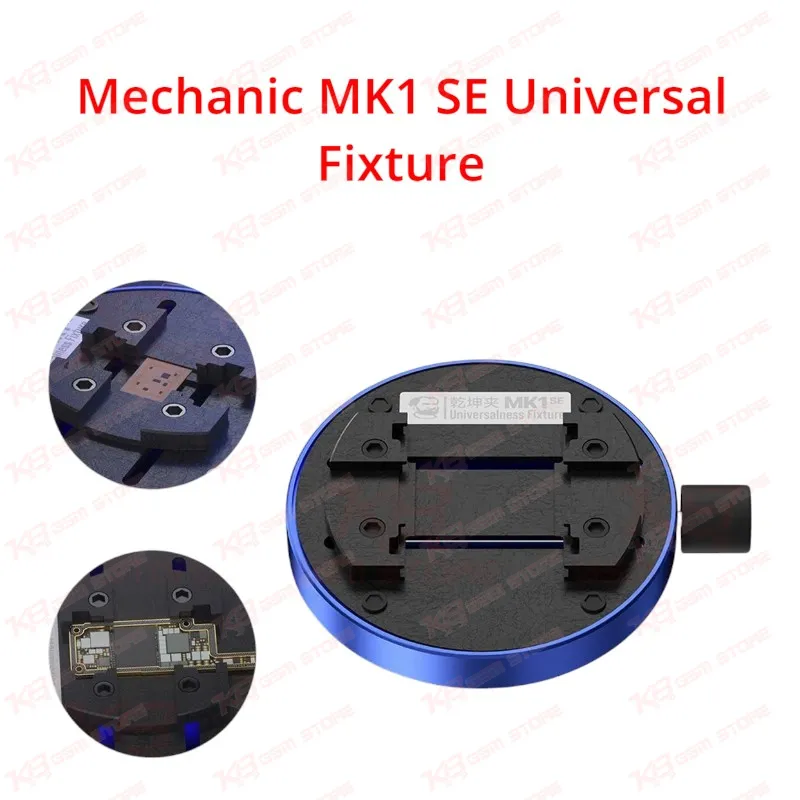
Every CPU swap, eMMC replacement, or baseband reball starts with one question at the bench: will the board or chip stay put when the heat and the blade arrive? The Mechanic MK1 SE Universal Fixture answers that question with a 50mm large-stroke clamping area that grips a full phone motherboard or a single loose IC with the same steady pressure. Mechanic builds the body from a nano-composite synthetic stone material that tolerates temperatures up to 500°C, so you can aim your hot air station directly at the work area without warping the holder or losing grip halfway through a job. The same material resists static buildup and corrosion, which protects sensitive memory and processor chips during long sessions, and its wear-resistant surface holds up to the daily scraping a busy Pakistani repair shop puts it through. The clamping jaws handle mobile phone CPUs, baseband ICs, storage chips, power supply ICs, tablet processors, and even computer CPUs, graphics memory chips, and GPUs, so one fixture covers most of the chip-level work that reaches your counter. Where this tool really earns its place is underfill and glue removal. Modern Android and iPhone logic boards bond the CPU and memory stack with epoxy underfill, and cleaning that layer after an IC change takes patience and a stable grip. The MK1 SE uses a dedicated chip de-gumming slot and a quadrilateral non-blocking slot layout, so your blade or scraper moves across all four edges of the chip without hitting a jaw. You skip the constant loosening, rotating, and re-clamping that older holders force on you, and you clean the whole chip surface in one go. A deepened concave groove with offset fixing angles supports the chip precisely while leaving clearance underneath, which helps prevent chip deformation from excessive heat during rework. In real shop terms, think about a dead phone that arrives after a failed software flash, or a handset stuck on hang on logo where your diagnosis points to a faulty eMMC or UFS chip. You lift the storage chip with hot air, clamp it in the MK1 SE, remove the old glue and solder, reball it with a stencil from your reballing kits, and then program or repair it through your eMMC programmers, UFS adapters, or ISP pinout tools. The fixture sits at the center of that workflow because every step between removal and reinstallation needs a flat, locked, heat-safe base. The same logic applies when you tackle a charging issue that points to a power IC, a network issue that leads back to the baseband, or a boot loop that ends in a CPU replacement. Pair it with a soldering station for tinning pads, a microscope for inspecting ball alignment, and a multimeter for checking lines before and after the job. Technicians who already own standard PCB holders for board-level work often add the MK1 SE specifically for chip cleaning and CPU jobs, since a regular board clamp rarely offers the clearance or heat tolerance that direct IC work demands. If you run test boxes for software repair and want to move into hardware-level chip work, this fixture makes a practical first upgrade because it removes the most frustrating part of the job: chasing a sliding chip across the mat. The unit ships as a single fixture with a gross weight of about 280 grams, light enough to move around the bench yet solid enough to stay stable during scraping. It carries no brand or model restriction, so it works with boards and chips from any manufacturer as long as they fit within the 50mm clamping range. For repair shops, service centers, and training institutes in Pakistan that handle chip-level repair every day, the Mechanic MK1 SE Universal Fixture turns glue removal, de-tinning, and reballing into a faster and cleaner routine, and it protects the expensive chips you cannot afford to damage.