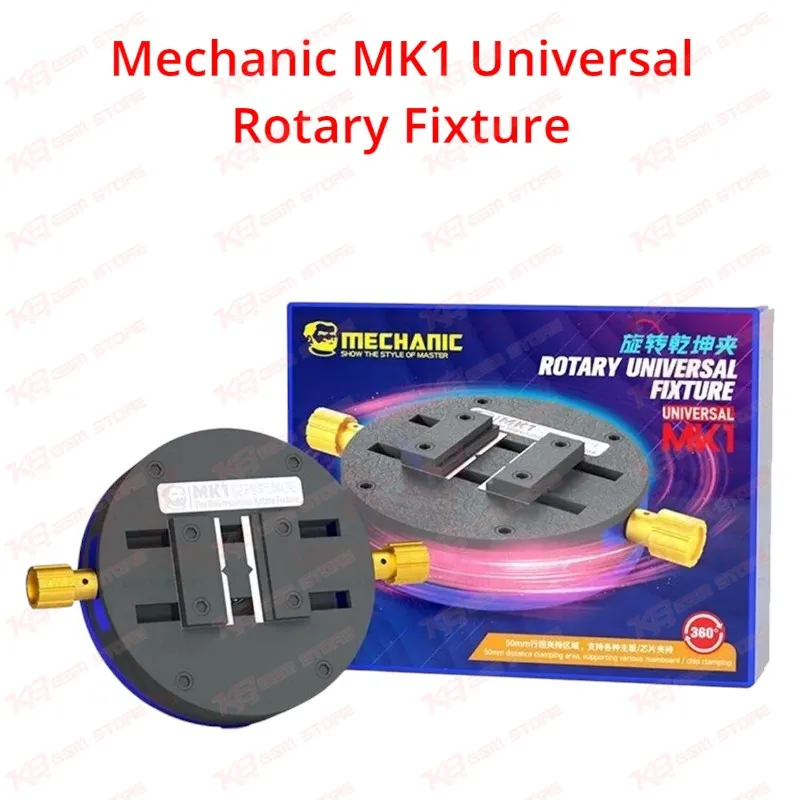
Board-level repair depends on how still the motherboard sits, and the Mechanic MK1 Universal Rotary Fixture solves that problem at the very base of your workflow. Mechanic built this fixture around a self-centering clamp: you turn a single knob that uses positive and negative threads with hidden screws, and both sliders travel toward the middle together, so the board or chip always lands in the center of the base. That centering matters under a microscope, because the part stays inside your field of view every time you load a new board. The clamp opens across a 50mm stroke, which holds smartphone logic boards and individual chips such as eMMC, UFS, and CPU packages that you need to secure for reballing, regardless of phone brand. Under the clamp sits a built-in rotary bearing paired with a damping turntable. You rotate the fixture a full 360 degrees, and the damping holds whatever angle you choose instead of letting the base spin loose, so you can approach a PMIC from the connector side, swing the board around to reach the shield pads, and keep your tweezers and soldering iron at the most comfortable wrist position. Think about a typical dead phone on your counter: you find a short on the main power line, lift the power IC, clean the pads, apply fresh flux, and seat a new chip. The MK1 keeps that board locked through every step, from hot air removal to solder wick cleanup to final reflow, and you never re-clamp between stages. The same applies to a phone stuck with a hang on logo fault from a failing eMMC, a charging issue that traces back to the charging IC, or a network issue that points to an RF chip. Mechanic uses high-temperature-resistant synthetic stone in the build, which lets you run your hot air station close to the board without deforming the fixture, and it handles the heat that spreads from a soldering station tip during long rework sessions. The base carries non-slip silicone feet, so the fixture grips a microscope base, an anti-static mat, or a bare workbench without sliding when you press a blade down to scrape underfill glue. The unit measures 135 x 95 x 30mm and weighs 334g, which gives it enough mass to stay planted while keeping it compact enough for the working area of most repair microscopes. For CPU and memory work, the MK1 pairs naturally with reballing kits and BGA stencils: you clamp the chip, align the stencil, spread solder paste, and heat it without the chip drifting out of position. Technicians who run ISP pinout tools on a dead board also use the fixture to hold the motherboard steady while soldering fine jumper wires to eMMC or UFS test points, which lowers the risk of lifting a pad before you connect your eMMC programmers, UFS adapters, or test boxes. After the repair, the board stays clamped while you check power rails with a multimeter, so you confirm the fix before the phone goes back together. If your bench currently relies on a basic sliding PCB holder, the MK1 gives you a clear upgrade path: you keep universal board compatibility and gain rotation, automatic centering, and heat resistance in one base. For repair shops, service centers, and training institutes in Lahore, Karachi, and Islamabad, the Mechanic MK1 Universal Rotary Fixture delivers a practical, low-maintenance holder that fits every stage of the PCB repair process, from diagnosis to rework to final testing, and it keeps both your hands free for the work that actually earns money on the bench.