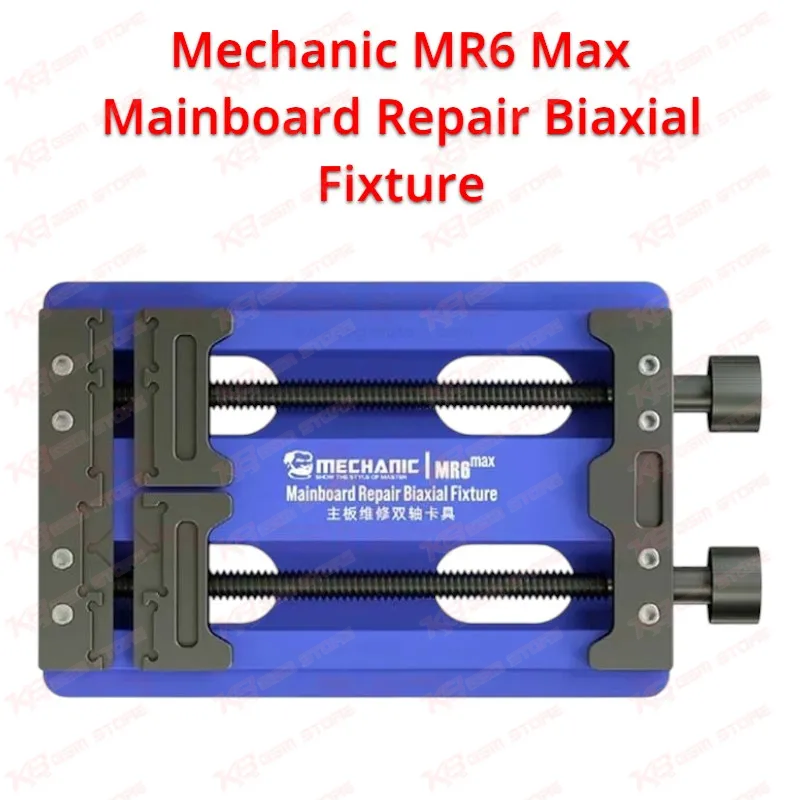
Every motherboard repair job depends on how well the board stays put while heat, force, or precision tools are applied to it, and the Mechanic MR6 Max Biaxial Fixture is built around solving exactly that problem. When you're removing a CPU that's dead after flash, reballing an IC, or cleaning glue off a board that's hanging on logo, a shaky or poorly clamped PCB turns a five-minute job into a frustrating one. This fixture uses a dual-axis clamping system with independent screw knobs on two sides, letting you adjust and lock the jaws along both axes at the same time instead of fighting with a single clamp point. That means you can position a motherboard, a CPU, or a hard disk exactly where you need it and keep it there through the whole repair, whether you're running a hot air station over an IC or working under a microscope for fine pad-level soldering. The jaws themselves combine V-slot and trapezoidal slot structures, and this dual-geometry design is what sets the MR6 Max apart from basic single-groove holders. The V-slot grips rounded or curved board edges more tightly, while the trapezoidal slot locks onto flatter, wider sections without letting the board twist or lift under pressure. Technicians working across mixed brands – Samsung, Oppo, Vivo, Infinix, Tecno, and iPhone boards – get a holder that adapts to different PCB shapes instead of needing separate fixtures for each device family. Beyond just holding motherboards flat, the fixture is also designed to clamp CPUs and hard disks directly, which matters during eMMC and UFS chip-level work where the chip itself needs to be isolated and secured for reballing or programming. This flexibility fits naturally into ISP diagnostics, eMMC programmer workflows, and UFS adapter setups, where a technician moves a chip between multiple tools and needs it to sit securely at every stage. Material choice matters just as much as clamping geometry on a repair bench that regularly sees hot air guns and soldering irons running at high temperatures. The MR6 Max uses a high-temperature synthetic stone body for the clamping structure, chosen specifically because it resists heat without warping, doesn't corrode from flux or cleaning solvents, and holds its shape after repeated use near heat sources. This is a meaningful upgrade over standard plastic or low-grade alloy holders that soften or crack after a few months of daily hot air exposure. For a repair shop running through boards constantly, that durability translates directly into fewer tool replacements and more consistent clamping accuracy over time. In terms of workflow placement, this fixture sits at the diagnostics and rework stage of the mobile repair process, right where boards move from initial fault-finding into IC-level intervention. Whether you're doing a jumper lagana job on a shorted line, preparing a board for reballing, or holding a component steady while running continuity checks with a multimeter, having a fixture that doesn't shift mid-task keeps your repair accuracy tight and reduces the chance of damaging surrounding components. It also pairs well with other bench tools already common in a GSM workshop – microscopes for visual inspection, hot air stations for chip removal, and PCB test boxes for post-repair verification – functioning as the stable base that all of those tools work around. The package is straightforward: one Mechanic MR6 Max fixture, ready to set up on any flat workbench without additional assembly. For technicians who repair phones daily and need a holder that won't loosen its grip halfway through a soldering job, the dual-axis, dual-slot design combined with heat-resistant construction makes the MR6 Max a practical upgrade from single-clamp or fixed-slot holders. It's built for the reality of a repair bench – mixed board shapes, constant heat exposure, and the need to reposition components quickly without losing clamping pressure.