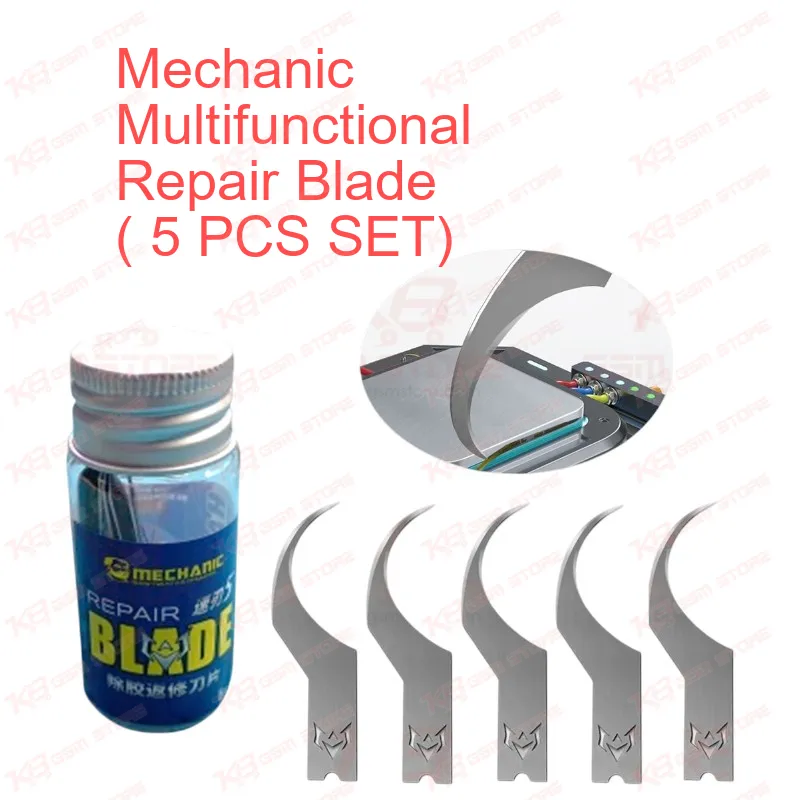
Every board-level job follows the same rhythm: you heat the area, you soften the underfill, and then a blade decides whether the chip lifts cleanly or takes pads with it. The Mechanic Multifunctional Repair Blade ( 5 PCS SET) gives your repair bench five dedicated edges for that exact moment, so you stop forcing one worn scraper through every task from screen glue to CPU underfill. MECHANIC builds this set, sold as the Speed Blade 5, from high carbon steel, finishes each edge by hand polishing, and treats the blade surface with a vacuum plating process. On the bench, that combination gives you an edge that bites into hardened black glue and UV adhesive without skating across the board, and a body that holds its shape when you lever under a component. The core job of this set sits in glue work: you remove adhesive around ICs, shovel softened underfill off the motherboard, scrape residue from pads after a chip comes off, and pry chips free once heat has done its part. Picture a typical dead phone that lands on your counter with a suspected power IC fault, or a charging issue you traced to the charging IC. Your multimeter readings point to the faulty section, you mount the board in a PCB holder, bring your hot air station up to working temperature, and then reach for a thin edge to cut the glue line around the chip. With five blades in one set, you choose a profile that suits the gap instead of grinding a single blade into a shape it never had. The same logic applies when a phone shows a boot loop, hangs on logo, or throws a network issue that points toward a CPU, eMMC, or RF section fault. Most modern boards seal their processors and storage chips under underfill, and you cannot lift those packages safely until you clear that adhesive. A sharp, controlled edge lets you work along the chip perimeter under a microscope, lift the package without dragging it across neighbouring components, and clean the board side down to bare pads so your reballing kit and stencil produce a flat, even ball grid. Once an eMMC or UFS chip comes off, the blades keep working on the chip itself: you scrape old glue from the package before you seat it in an eMMC programmer or UFS adapter for reading, writing, or data recovery, and you clean the landing area before reinstallation. When you prefer direct access through ISP pinout tools on a dead phone, clean test points matter just as much, and a fine edge clears glue and coating residue around those points without lifting traces. Hardware repair and software work meet at this stage, because after chip-level rework you move the board to a test box or flash tool, and a clean joint lowers the risk of a phone that ends up dead after flash. Outside chip work, the set handles everyday bench tasks such as clearing adhesive from frames during display problem repairs, trimming excess glue after back glass jobs, and scraping flux or solder paste residue after work at your soldering station. The blades target general board and frame work rather than one handset, so they serve Android and iPhone motherboards alike, wherever adhesive stands between you and the component. MECHANIC ships the five blades in a compact storage bottle of roughly 28 × 28 × 64 mm, which protects the edges in a drawer or tool case and stops loose blades from dulling against other hand tools. For shops in Lahore, Karachi, Islamabad, and across Pakistan that handle daily repair volume, a dedicated blade set shortens each chip-removal job and cuts down the pad damage that turns a simple IC replacement into a jumper-wire repair. If you are building a workstation from scratch, pair this set with a hot air station, a soldering station, a microscope, and a PCB holder for complete rework coverage, then expand into reballing kits, test boxes, and programmers as your chip-level work grows.