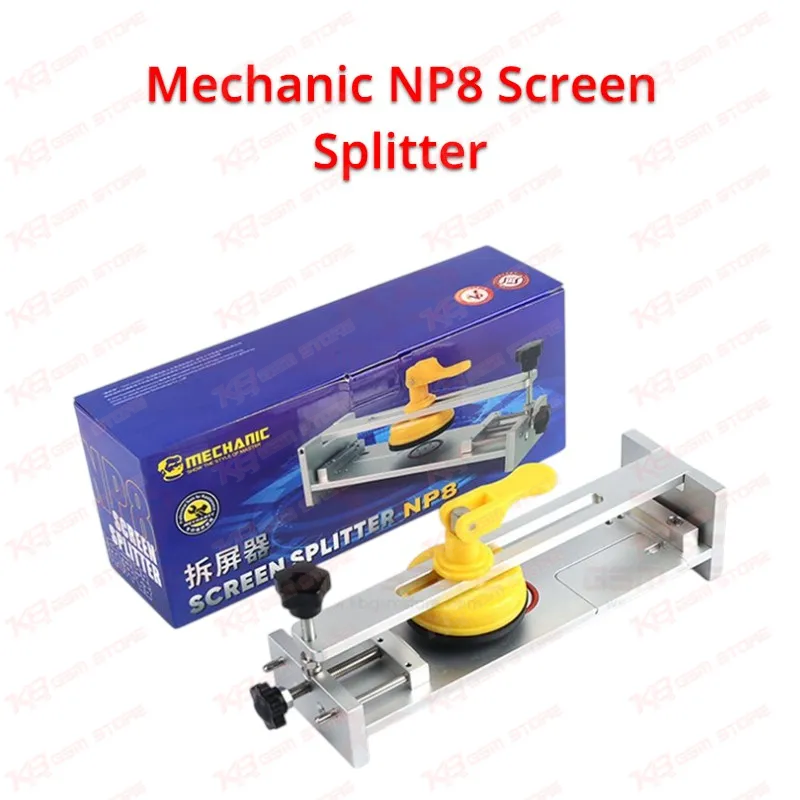
Screen removal is one of the most repeated tasks on a mobile repair bench, and the Mechanic NP8 exists to make that task faster and less risky than a traditional hot plate or heat gun setup. This is a free heating screen splitter, meaning it separates the display glass or LCD assembly from the frame purely through mechanical suction and controlled lifting force, without applying any heat to the panel. That matters on a busy workshop table because heat-based separation carries a constant risk of overheating the flex cable, warping the digitizer, or damaging the camera housing underneath, especially in the hands of a newer technician who has not yet built the feel for timing a heat gun correctly. The NP8 removes that variable entirely, which is why it is often positioned as a beginner-friendly tool even though experienced technicians keep it on the bench for the speed it adds to routine jobs. The core of the fixture is a strong suction cup mounted on a precision micrometer adjustment system. The technician places the phone into the frame, secures it using the right-side knob according to the device size, and injects a small, appropriate amount of alcohol along the frame edge to help loosen the adhesive bond. The upper section of the fixture is then lowered so the suction cup makes contact with the screen. From there, the operating coefficient is set on the suction cup, the adjustment button is pulled up, and the screw tension knob is turned slowly to draw the cup upward. This slow, uniform pulling action is what protects the screen from cracking or being yanked out too fast, and it is also what protects the internal flex cable from getting stretched or torn during separation. The internal groove on the fixture is smooth and rounded rather than sharp-edged, which is a deliberate design choice to prevent scratches on the frame and to avoid contact damage to the rear camera module while the screen is being lifted away. Because the mechanism is fully manual and heat-free, the NP8 works across a wider range of screen types than many heat-based separators. It is built to handle flat straight-face screens, curved-edge displays, cover glass panels, and even smaller curved screens like smartwatch displays, which gives it a broader use case than tools limited to a single screen profile. The aluminum alloy body gives the fixture the rigidity it needs to hold suction pressure steady through repeated daily use without flexing or losing calibration, and the compact footprint means it does not take up excessive space on a workbench that is already crowded with soldering stations, hot air tools, and diagnostic boxes. For a Pakistani repair shop handling walk-in screen problem and broken glass jobs throughout the day, a tool like this shortens turnaround time on straightforward separation work while cutting down the number of screens damaged during disassembly, which directly protects margins on jobs where the customer is only paying for a glass or LCD replacement. It also reduces training time for new staff, since the mechanical adjustment process is far more forgiving and repeatable than judging heat exposure by eye. Technicians working across iPhone and Android brands appreciate that the NP8 is not locked to one screen size or curvature, since the adjustable knob accommodates different phone dimensions without needing a separate fixture for every model. Paired with a screen protector film or a basic pry tool for the final lift, the NP8 fits naturally into an existing screen replacement workflow and complements other bench tools like UV curing lamps, OCA laminators, and frame bezel removal fixtures already common in professional repair setups.